
Who hasn’t ever wept? Who hasn’t ever felt the deepest need to be consoled? The Bible does not elude that universal experience: Jesus himself wept at the tomb of his friend Lazarus. So what does the Word of God tell us about consolation, about what soothes and lifts us up in the midst of trial?
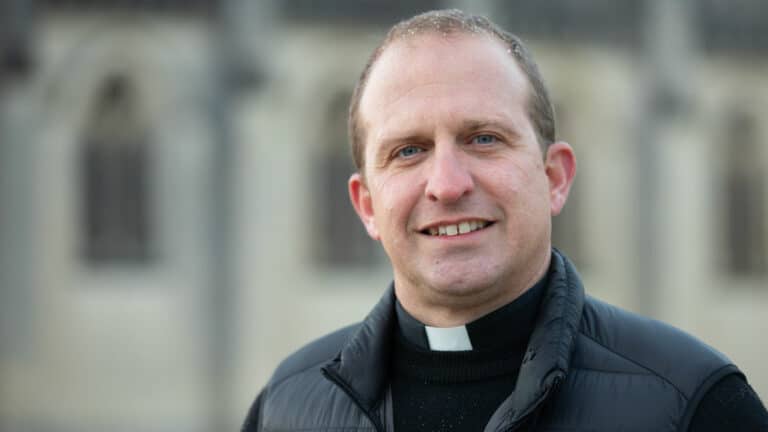
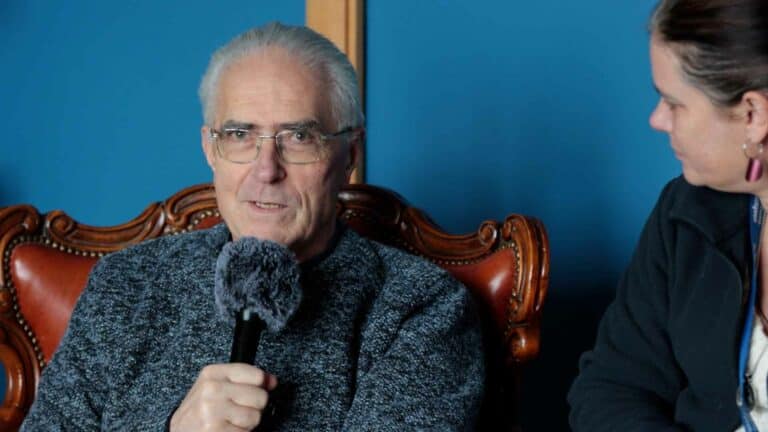
We interviewed Don Valentin Rhonat, priest of the Saint-Martin Community, also an exegete and a chaplain at Mont-Saint-Michel.
Disengaging from death, a ritual aspect of consolation
Consolation partakes of a real experience. It touches the heart, the intelligence and the will. It does not numb the pain, but it helps crossing it.
Don Valentin Rhonat explains how this works for human beings: “Consolation is an inner experience, something that does good to us. It disentangles our mind from what chokes it, and it is a very emotional, personal experience.
In the Old Testament, consolation has a very ritual, dimension, therefore a social, outward one. The term used for “consolation” is a rather strange word consisting of three consonants, נִחַם (niḥam)[1]from the root נחם (n-ḥ-m), a difficult-to-translate verb. Françoise Mirguet, a professor at the University of Arizona, works precisely on emotions and consolation in the Hebrew Bible. She has published a chapter entitled “The Root נחם (Niphal and Hitpael) in the Hebrew Bible”[2]. in which she points out that “niḥam” often translated as consolation, originally means disengagement, liberation.
The point is about disengaging from a situation which causes our suffering, i.e death. Indeed, after we have been impacted by death, whenever our loved-ones are concerned, after we have made one with that death and after mimicking death through the funeral rites – for example, ancient people used to shave their heads, they would cover themselves with dust or pretend to be touched by death themselves – once we have been through this, comes a moment when we say: “That’s enough now, I set myself free from death. I get back onto my feet and I start living again.” At that point, we reach the ‘נִחַם’ (‘niḥam‘). The state of consolation roughly consists in this, coming back to life. It is a disengagement from what chokes us – death in particular.
[1] https://brill.com/display/book/9789004536296/BP000018.xml?language=en&srsltid=AfmBOopOFHx1LA0m0QmWDI0J5KOSZXoVTOG_5EUa5Feszym0Ew2Oz5Il&utm_source=chatgpt.com
[2] https://fr.wikipedia.org/wiki/Fran%C3%A7oise_Mirguet?utm_source=chatgpt.com
When the Lord comforts, he makes a promise
The heart of the Bible is to reveal the face of God. And of course it tells us stories of consolation, using words of human tenderness. This dimension is present in both the Old and New Testaments. What is special about the Bible is that the main character is God. In the Bible, the one who comforts is God. He shows up, He gets us back onto our feet and, of course, He comforts. That is the difference with our human consolation. For a simple reason, our consolation is one of helplessness. If you loose someone close to you, I may show you my presence, my closeness and my loving kindness, I may tell you “You will feel better tomorrow”, but I can’t do anything more. The key difference with God’s consolation is that it is powerful, because He can resurrect your loved one. God promises to bring you back to your land, restore you as a people and rebuild you.
The foundation of this is theological. God promises – and God holds His promises. Consolation is not a vague optimism. It comes from a living God who acts. The Apostle testifies: “He comforts us in all our distress, so that we may be able to comfort” (2 Cor 1:4). Suffering remains real. But it no longer rules. The Word of God gives a new direction to desire and reopens the future. Don Valentin sums up what is at stake: “When the Lord consoles, he makes a promise and keeps it. This promise unfolds in two stages. First, compassion. Jesus wept at Lazarus’ tomb: “Jesus wept” (Jn 11:35). Then the action of lifting up: “Lazarus, come outside” (Jn 11:43). Christian consolation follows this rhythm. It joins in, then lifts us up. It minimizes nothing. It transforms wounded memory. It empowers us to love again, to make simple, rightful actions.
Consolation is a relationship with God
The Bible offers no magic procedure, insists Don Valentin. It suggests a relationship with God through meditation on His Word: “Speak frankly before God”. One key is to really know how to express one’s suffering to God.
The Psalms provide the words. The one who supplicates cries out, asks questions, hopes. “My God, my God, why have you forsaken me” (Ps 22:2). “The Lord is near to the brokenhearted” (Ps 34:19). Sometimes, we put up with very hard situations. The risk is to hush them up by denying them, before men and before God. Or by praying very politely, “as appropriate”. Well, no. If we are heart-rendered, God wants to heal us deeply. For this to be possible, we need to express this inner tear before God very clearly, to see His wrath. This is what Job does in the Bible. He goes through deep sadness after losing everything, and expresses a huge cry of anger, but he maintains his relationship with God. This sincerity is not doubt; it is the very form of trust.
The Book of Job confirms this pedagogy. The righteous man refuses quick answers. He pleads his case. God introduces him to wisdom. Consolation does not remove the mystery. It restores the relationship. It leads to blessing. What’s more, the Holy Spirit does this work gently. Jesus promises “another Paraclete” (Jn 14:16, 26). The Spirit recalls the Word. He strengthens the heart. It produces its fruits: “love, joy, peace…” (Ga 5, 22-23). It moves us from fear to trust.
Consolation has a ritual, social and external dimension
Moreover, in the Christian faith, we are helped by the sacraments to rely on God’s Word, His action and His grace. What the Bible reveals, the Church puts into practice. Consolation becomes common prayer, ritual and fellowship. “Consolation has a ritual, social and external dimension”, says Don Valentin[1]. Funerals, the Eucharist and blessings support the troubled heart. The proclaimed Word enlightens the night. Confession reopens the peace of forgiveness. Prayer for the dead remains a work of mercy. It links earth and heaven. It inscribes loving memory in the communion of saints. What’s more, fraternal charity weaves a presence that holds firm. Visiting, listening, sharing a meal, walking together: these modest signs become effective. They carry the weight of the day. They speak the Gospel without forcing it. They keep the promise alive. In this way, consolation is illustrated in a house church, where each person receives and passes on what he or she has received from God.
Going to confession and taking communion is very consoling
To walk this path you need a simple but sustainable discipline. Don Valentin describes its landmarks. Reading a psalm; meditating on the Gospel; asking for the Spirit; coming back to the sacrament of reconciliation on a regular basis. “Going to confession and taking the holy communion is very consoling”, he insists. The Eucharist unites you to Christ, conqueror over death. It helps us draw our life already from the Communion of Saints. On the same line, welcoming other people’s help is a good idea. Accepting a visit. Entrusting a job to somebody. Resuming a service. Writing a name to have a Mass said for someone. Such actions fashion an open memory. They turn the sorrow into intercession. Moreover, the person recovers the gestures of life. They breathe. They decide again. They go at their own pace, with no haste. Consolation does not impose its rhythm. It walks alongside, paying tribute to each person’s unique story.
Beyond illusions, the Kingdom of Heaven
God gives us grace to get through trials. He doesn’t claim they are easy, or that we should stop feeling them. He uses them to help us dig deeper and find true happiness, beyond the illusions and quick pleasures that life offers, and to help us understand the salvation we have received. Yet all this only makes sense if we recognize the Christian’s true horizon: the Kingdom of Heaven. It is not a matter of here-and-now happiness – a happiness which never lasts, is difficult to attain and, even when attained, remains fragile. The reason for Christian hope lies elsewhere: in the Kingdom.
This hope sheds light on consolation. “Blessed are those who weep, for they will be comforted” (Mt 5:4). Christ’s promise is not: “I will give them tranquilizers”. He does not make us insensitive; that would be inhuman. Tears are legitimate when we lose a son, a daughter or a brother. But according to the promise, no difficult human situation is beyond God’s power: He can restore what has been broken; He gives his answer, and he will give it in fullness. Therefore consolation doesn’t take away pain; it directs it towards God’s future, until the day when “he will wipe away every tear from their eyes” (Rev 21:4).
Christian consolation is no bypassing. It reveals the intervention of a saving God. On the Cross, Christ bears evil. In the Resurrection, he opens up a future. Between these two polarities, the Church humbly moves forward. It lives by the Word, the sacraments and charity. It keeps the promise, until the Day of the Lord.
God comforts us by decentering us from ourselves
There is no “recipe”. We need to distinguish between times of crisis – eg. “I failed my exam”, “My girlfriend left me” – when we expect immediate consolation – and long-term trials, such as “My child died”, or “I’ve just lost everything”, which require a different pace. In those situations, we have to resign ourselves and be patient: God leads through the desert, and is sometimes slow to bring us out of the ordeal. At times, we must also open our eyes to our own blockages: we may find it difficult to receive consolation, or to “come to terms with ourselves”. Consolation has a compassionate dimension – closeness, presence, words of reassurance such as “I love you, I am with you”. But God also goes through more demanding approaches: the need to hear difficult truths, to link suffering to ill-adjusted choices, to assume one’s share of responsibility. Through awareness, God enlightens, straightens and heals. All this takes time. A time for vigilance: withdrawal is a real risk.
Let’s consider the answer given by God to Job in chapter 38: He doesn’t argue with the righteous man’s logic. Instead, He draws him into contemplation: “Where were you when I founded the earth?” (Job 38:4). He takes him on a journey through creation, showing him “the most remote corners of the mountains”, some “wonderful and mysterious places”, and above all, showing him God at work. Through this poetic discourse, God takes Job by the hand, leads him out of the self-closure to which his pain had led him, places him back in the order of creation, restores trust and breaks the sterile tête-à-tête with his suffering. The “pattern of healing” thus revealed shifts our gaze: God liberates us by bringing us back to the wider horizon of his work, and allows us to contemplate himself at work, saying: “Where were you when I founded the earth?” Once again this spurs our trust. Pain ceases to reign without being denied. Our pain condemns us to confinement. God delivers us from it, if we accept this path.
Don Valentin Rhonat is a priest of the Saint-Martin Community, and also a chaplain at Mont-Saint-Michel and a teacher of seminarians.