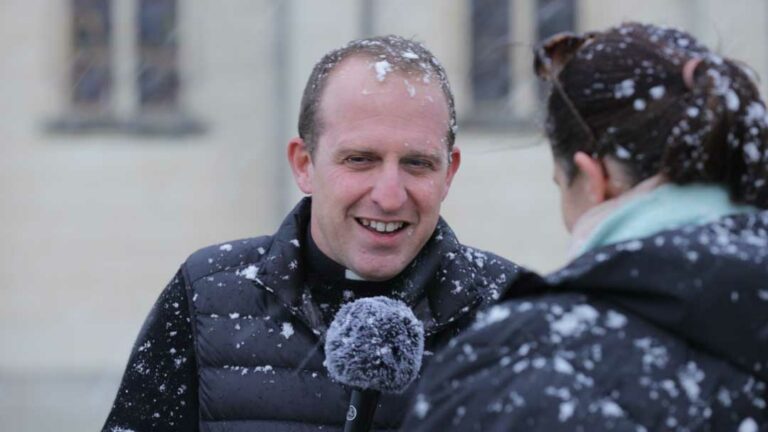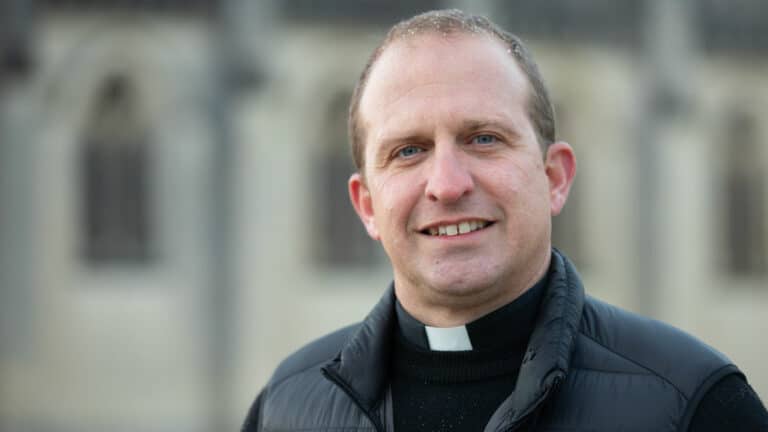
Father Charles Lenoir, chaplain at the Shrine Notre-Dame de Montligeon was invited for an interview by RCF Orne-Calvados-Manche as part of their program Sanctuaires Normands to address a simple, key question: does faith change my view of the world? In our world which has become a source of anxiety, faith is more than a spiritual idea: it provides a direction and a goal in life, and helps people go through their ordeals without denying reality. This need for guidance can also be observed through a clear sign: in 2025, over 10,384 adults sought to be baptized in France. So, faith renews the way people look at the world, other people and even death.
Does faith change my view of the world?
First of all, does faith change my view of the world? It does because it provides me with a goal and a direction. Pope Benedict 16 used to remind us that there is a close link between faith and expectant hope, in the sense that when you know where you’re going to and know that this goal is certain, this changes your behavior.
Father Charles Lenoir uses a simple example: a sports coach looks to lift his team’s morale If the team believes they will be beaten, it will reach the finish line beaten; conversely, if they believe they can win, they will set themselves in motion. Likewise, my strength to go about the world and face its damages, its violence or uncertainties is different when I know that it is loved. “Behind the scenes, there is still Someone who loves the world and who wants to save it.” This ‘Someone’ is God. So, knowing this and having no doubt about it makes the world meaningful instead of merely absurd. I do not deny the hardships though, but I refuse to interpret them as nonsensical. Faith therefore helps me discover “the presence of a God who changed death… to a path of life.” Which means that the mere knowledge that my life is meaningful already changes everything. Therefore I can work and persevere. Thus, faith changes my view, – it opens an horizon and gives me courage.
A child-like trust to get through hardships
Secondly, faith encourages me to trust like children do, whilst remaining connected to the real world. One may think this is naive, in the positive meaning of the word, i.e. ‘childish’.
“A little child does not wonder if their father will find a job. they just trust him.” That’s the attitude I receive, trusting my Father who is in heaven. I know that he created the word and watches over it. As a result, I do not lock myself in my anxiety about the future. Moreover, such trust gives me some courage for working. Of course, it does not remove the hardships but it helps me to stay on my feet and face reality. Then I can learn to view ordeals as positive challenges that train me to hold on. They teach me both perseverance and endurance, two strengths which count over time. So, instead of repeating that the future will be worse that the present, I may rather say: the future may be better. With such a view you prevent despondency from ruling. As a result I lean on what I believe and I carry on. And last, I keep a simple rule in mind: God does not let me down. This certainty does not numb me, it sets me on my path.
See the glass as half full, and take heart
Yet many people have faith and complain a lot. What does this mean? It means that their faith remains weak. However, it can grow. But converting one’s outlook involves a most practical exercise. “What if we could try looking at the glass as half full instead of half empty?” It is the same thing, and yet it changes everything. When I look on the bright side, I’m back in the thick of things. When I look at the bad side, I get discouraged. So I rely on faith to give me courage and momentum in challenging times. What’s more, the content of faith doesn’t change with the times, it remains trust in God. Circumstances do change, as do today’s problems. Yet the core remains the same: trusting in a God who loves us. As a result, I can look to the saints and witnesses as landmarks. Figures like Carlo Acutis and Pier Giorgio Frassati don’t make faith different. They just show me how to live in trust, here and now. And that helps me get through the day-to-day, without locking myself up in complaint.
“God always takes the first step.”
When I change, so do my circumstances
Besides, I don’t keep my faith to myself. I see it attracting people, especially young adults. Many of them feel they’re facing an increasingly anxious world, and that’s depressing. But they meet Christians who have a different view of the word.
That’s an early sign. Then I remember a decisive point: when someone begins a journey towards faith, they are already responding to a call. God takes the initiative, and my freedom responds or doesn’t respond. This logic sheds light on a path: you start feeling a drive, you enter a church, you try praying, and then you move forward step by step. Consequently, faith also transforms the environment. When I change, I change what’s around me. If faith helps me keep smiling and looking for the bright side, I’m spreading something other than complaint. If it leads me to put myself at the service of those who suffer, those around me see it. And my relationship with others changes. Even when others think differently, I recognize them as brothers and sisters. We have the same heavenly Father. So I cannot behave with indifference, nor with malice with them. I choose to treat them as brothers or sisters, and learn to love them for real.
When I am in doubt and no longer feel anything
Finally, faith changes my relationship with death and my doubts. Whenever death hits me, I don’t see it as the end of everything, but as the beginning of another life. I see my body ageing, gradually coming apart, and yet I expect something else: one day, I’ll find my body again in all its beauty. This hope is what keeps me going today. And what can I do when I am in doubt?
Firstly, the example of believers can help those who are searching. Secondly, I distinguish between two types of doubt. There’s the ordinary doubt: I don’t know, like when I don’t look at the weather forecast and hesitate about tomorrow. And then there’s another kind of doubt: refusing to trust. This one is even more damaging, because it closes the door. And when we mention the case of a churchgoer who says in confidence he no longer feels anything when he goes to Mass, Father Charles exclaims: “That’s a good sign!” The path to God necessarily passes through the desert. In the beginning, God may give us perceptible consolations, but then He withdraws them. In this way, he makes me grow: walk, lean on what you believe. Faith becomes less perceptible. Yet I keep going. The saints believe because they want to believe, meaning that I can learn from their fidelity.
Well then, does faith change the way I look at the world? Yes, because it teaches me to trust, to stand my ground in times of hardship, and to look on the bright side. It also makes me see others as brothers and sisters, and death as an entry into another life. Finally, when I no longer feel anything, it encourages me to take what I believe as the basis of my progress. As a result, I can move forward with more endurance and more hope. And every day, I can take up a simple act of trust, carrying it forward in prayer.