
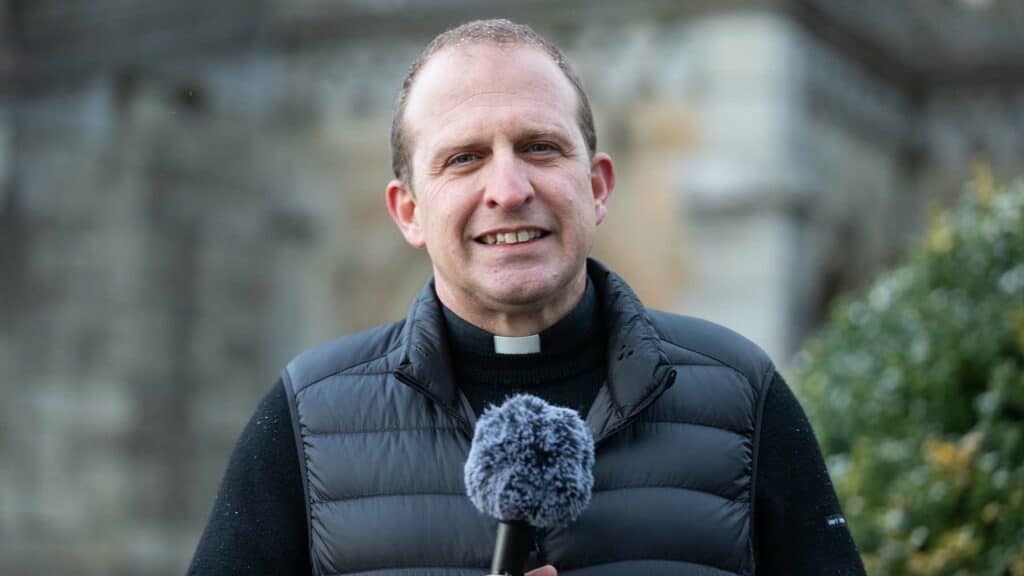
Man is a relational being. He grows with others, he flourishes thanks to them. He suffers with them and weeps because of them. Since ancient times, man has remained a mystery to himself and to his fellow creatures. As Plautus put it in the 2nd century B.C.: “Man is a wolf to man”. In the last century, Jean-Paul Sartre revived this observation with a now-famous phrase: “Hell is other people”.In this programSanctuaires normands, Don Paul Denizot, rector of the Notre-Dame de Montligeon shrine, reflects once more on this statement and answers a key question: does hell exist for Christians? The interview addresses the reality of hell in the Church’s faith, its representations, and the place of human relationships, between communion, solitude and the refusal of love.
Does hell exist according to the Christian faith?
Yes, hell does exist. Scripture bears witness to this as early as the Old Testament, notably in the prophet Daniel. However, the words of Jesus are mostly what form the basis of the Church’s teaching.
He refers to the Gehenna of fire, the place “where the worm does not die”, “where the fire is not quenched”, “of weeping and gnashing of teeth.” These expressions run through the Gospels and structure a constant teaching.
In chapter 25 of Matthew’s Gospel, Jesus describes the Last Judgment. The Son of Man separates the sheep from the goats. To the former he says: “Come, you blessed of my Father, into the kingdom prepared for you from the foundation of the world. To the others: “Depart from me, you cursed, into the eternal fire prepared for the devil and his angels.”
“Yes, hell does exist. It is a reality.”
So hell is neither a late invention nor a mere moral image. It is a reality announced by Christ himself. Certain cultural representations may suggest that all will be saved without distinction. “Even if French singer Michel Polnareff has sung, ‘We’ll all go to heaven’, it is not what the Church believes.”
Can we figure out what hell is like?
For centuries, man has sought to represent hell. It has been drawn, painted, described and imagined with flames, devils and instruments of torment. Western art and literature bear witness to this, notably in Dante’s Inferno and in the work of certain Flemish painters.
But these images quickly reach their limits. Like heaven, hell eludes adequate representation. “Hell conjures up something different to just a setting. It refers to an existential state of self locking. This intuition ties in with a deeper spiritual understanding.
Hell is then understood as a refusal – the refusal of God’s love, the refusal to get into relationship. “I close in on myself and refuse love.” This is not a sanction imposed from outside, but a self-exclusion. This refusal becomes final, with no possible opening to communion.
“Hell is a permanent refusal of God’s love.”
Why do relationships sometimes become destructive?
The contemporary figures of the selfish spouse, the toxic boss or the perverse parent raise questions. Don Paul places these realities in a broader perspective. Original sin has always wounded relationships. The temptation to use others instead of giving oneself to them has been with us throughout the ages.
To use another person is to consider him or her as an object. But the other is always a person, a vis-à-vis, whatever his or her circumstances. When the relationship turns to instrumentalizing people, it becomes perverted. This temptation also exists within legitimate frameworks, including professional or community ones, when hierarchy makes us forget the dignity of the person.
Naming these abuses helps to educate and enlighten consciences. Yet sin remains. Education, formation and the Church’s mission are necessary, but they do not abolish human frailty.
How can we learn to live together again?
The Covid period revealed contrasting experiences. Some enjoyed the isolation. Others were deeply impacted by solitude and hurt by the lockdown. Man was not created to live alone.
In a society where individualism is the rule, he proposes a simple action: look at the other as a person. We are very tempted in general to perceive others as a threat. Yet the other person is not a danger. Even in the ordinary tensions of everyday life, he or she remains a brother/sister.
He encourages us to reach out to others with discernment. The Church, in line with Pope Francis, is understood as a Church that goes outwards, willing to meet people and not afraid of relationships. Christian communities can become places where everyone comes with their own history, wounds and frailties.
Should difficult relationships be avoided?
The temptation to flee is real. Some people idealize solitude and see it as a form of protection. Don Paul calls for precise discernment. The terms “toxic” or “perverse” are sometimes used too quickly. He invites us to re-examine the facts, to ask for advice, to check the reality of a relationship.
Some relationships require a struggle. Love is not always immediate nor easy. “Love sometimes implies a struggle.” Loneliness, on the other hand, can sharpen suffering. However, we have to admit that some relationships should be avoided when they become truly destructive.
Community life, a cross-over between joy and cross
Community life is a place of joy, friendship and sharing. It can also become heavy, difficult and trying.
It can be a cross. However, running away from the cross does not alleviate the suffering. Carrying it can be fruitful. Don Paul remembers the story told by an abbot, about a monk who had remained cantankerous for a long time. As the monks were supportive of him, he changed completely in the end. A simple conviction stems out this experience.
“You should never despair of the people you live with.”
Hell should not be understood as having be in unchosen relationships but as choosing solitude. Communion [with others] remains man’s true calling, even if the relationship was hurt or impacted by trials. Never despairing about your partner or about the relationship with them opens a path of hope, whereas solitude locks you in.