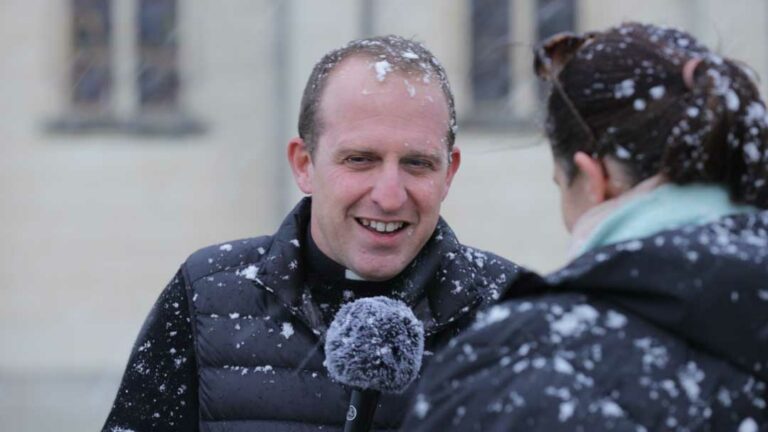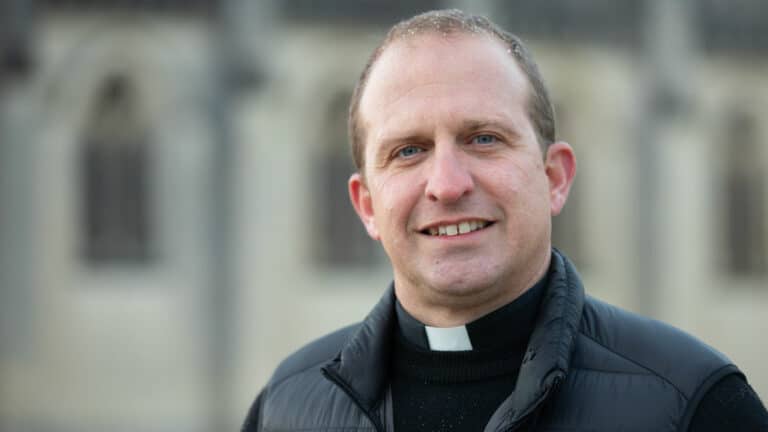
What is the use of praying, when we have been praying for years and feel we are not being answered? In the program Sanctuaires normands, broadcast on RCF Orne-Calvados-Manche, Father Charles Lenoir, chaplain at the shrine of Notre-Dame de Montligeon, answers this question in concrete, eloquent terms. He reminds us that prayer begins with a loving relationship and is built up over time, despite distractions. Finally, he teaches us how to pray when doubts arise, and why we should pray for one another, living or dead.
“The goal of prayer is not to instruct God but to construct man.”
Prayer, a loving relationship with God
“Prayer is a relationship with God.”
That’s the starting point. “I take the example of a man and a woman who are engaged: they look for every way to be together as often as possible”. Likewise, prayer seeks “every moment to spend time with God”. It is received from Him as “a loving relationship”.
Then, in more practical terms, what’s the point of praying? Here’s a quote by Saint Augustine: “The goal of prayer is not to instruct God, it is to construct man.” So prayer isn’t primarily about “instructing God”. It’s about building us up, getting us used to “being in relationship with God”. Besides, if God already knows everything, why pray to Him? “Well, for the very reason that the goal of prayer is not to instruct God; it is to construct man”. In other words, it establishes us in a father-to-son or -daughter relationship, day after day, and teaches us to dwell with God, even when we don’t see immediate results.
When in doubt, how can I pray?
“Prayer trains us to love… Prayer consists in giving ourselves.”
“First, I remind myself that prayer trains me to love and that it consists in giving of myself. I give my time, my body, my mind and my heart. Let’s start with time: When you give someone your time, you are implicitly telling them that they have value. That’s why the first rule for praying is to decide on a time. Next, I accept a concrete rule: “You need a timetable to pray.”
“Prayer requires establishing a timetable. I make an appointment with the Lord at such and such a time, and then I plan how much time I’m going to give him. A quarter of an hour, half an hour? Whatever, and then I stick to it.”
What words should we use if we don’t know how to pray? “My first approach is to dwell. One day, as I was visiting sick people in an hospital, someone said to me: “Please stay. Your presence does me good.” I stayed. “Well, it’s the same with God. Jesus is sensitive to friendllilness; prayer does him good.”
Next, I look for a form which is suitable for me. Indeed, there are as many forms of prayer as there are people who pray. It may be the silent prayer of just dwelling there; or a repetitive prayer like the rosary; or nature gazing. And last, distractions are not really an issue. Even if I am distracted, my body doesn’t move. And if I keep coming back, that’s already a prayer.”
“If we’ve been distracted 100 times and have come back 100 times, our prayer is well done.”
Who do I pray to?
Basically, Christian prayer is addressed to God the Father through Jesus Christ in the unity of the Holy Spirit. These formulas may seem complicated. Yet they describe a simple reality: The Christian life consists in having a filial relationship with our Father in Heaven, according to the blueprint, and even the life given to us by Jesus, and with the Holy Spirit who is like breath.”
“To clarify this, I’ll use an image. Picture yourself someone playing a trumpet. The listener is the Father, the trumpet is the Son. And what sets everything in motion is the breath, i.e, the Holy Spirit. Therefore, prayer is a living relationship. It cannot be reduced to a formula. It involves presence, listening and trust.”
When God seems to give no answer
Why does prayer sometimes seem to go unanswered? “Indeed, sometimes, although we pray a lot, we feel that God doesn’t answer us. I remember a remark from a former abbot. He used to say: ‘When I pray to the Blessed Virgin and she doesn’t answer, it just means that she’s making a cup of milk coffee.’ This image says one thing: silence does not necessarily mean absence.”
Does prayer change reality, or only the person who prays? “Once you start changing yourself, you will necessarily change reality.” Why? “Because prayer brings about a filial relationship with our Father in Heaven, which in turn changes the way we live our daily lives. If my daddy is God Almighty, that gives us assurance and confidence in the face of everyday realities. As a result, prayer doesn’t automatically eliminate hardships. It does, however, transform the way we deal with what happens. It teaches confidence, and that confidence becomes effective.”
Listening to God in the Gospel
Another prayer form may be listening. “When I read the Gospel, I’m actually listening – listening to God who speaks to me through his word. So that’s a relationship in itself.” Reading the Word then becomes a concrete place: “God speaks to me rather than the other way round. Then I can mull over those passages, and spot what speaks to me, what resonates strongly. “They are what the Lord wants me to understand today.”
And what’s the point, in fact? “I would come back to our vocation here. We were created to become children of God. This is God’s purpose. Therefore, prayer is the most accessible way to initiate our relationship with Him.”
I would suggest a very simple image – a mother and her newborn baby. Little by little, she teaches him to speak, because speech opens up the relationship. In the same way, prayer teaches a daughter-/son-to-father relationship. It teaches us to talk to God. It also teaches us to listen.
Praying in the communion of saints
Does it make sense to pray for others, living or dead? “It does, because we don’t live alone. God created us within a huge family, including humanity, the Church and all those things. What’s more, we’re all interdependent. Therefore, I can’t live as if I were alone in the world. Some people pray for me, some help me, so I pray for them too. In very Christian terms, this is called the ‘communion of saints’.”
In a nutshell, what is the point of prayer then? First and foremost, it’s about getting in touch, with God, creating a loving relationship and maintaining it, without reducing it to a list of requests. It also teaches us to give ourselves through concrete actions – including taking a moment, keeping a scheduled meeting, offering time, and coming back when our minds wander, without getting discouraged. Moreover, prayer is received within a specific Christian dynamic: addressing the Father, through the Son, in the Spirit, as a filial relationship built over time. Even when the answer seems slow in arriving, prayer is not useless: it transforms the one who prays, and this change is reflected in the way we deal with reality, with greater confidence. Ultimately, it includes listening: reading the Gospel is already entering into a relationship, because God speaks through His Word, and it sheds light on what He wants us to understand today. In this way, prayer becomes a simple and dogged path: come, stay, listen. And then return.