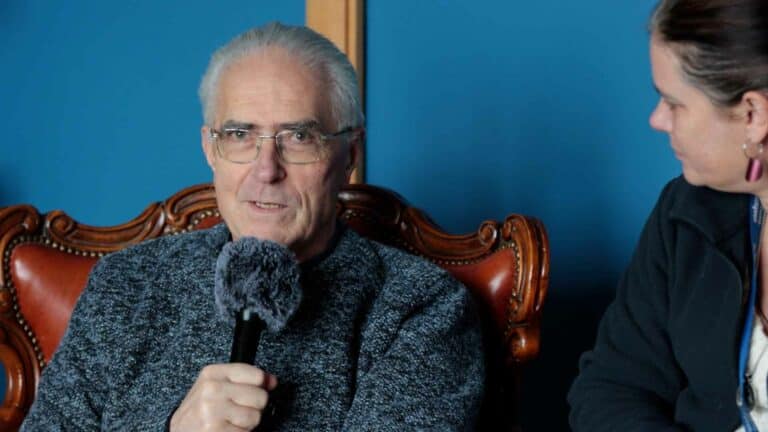
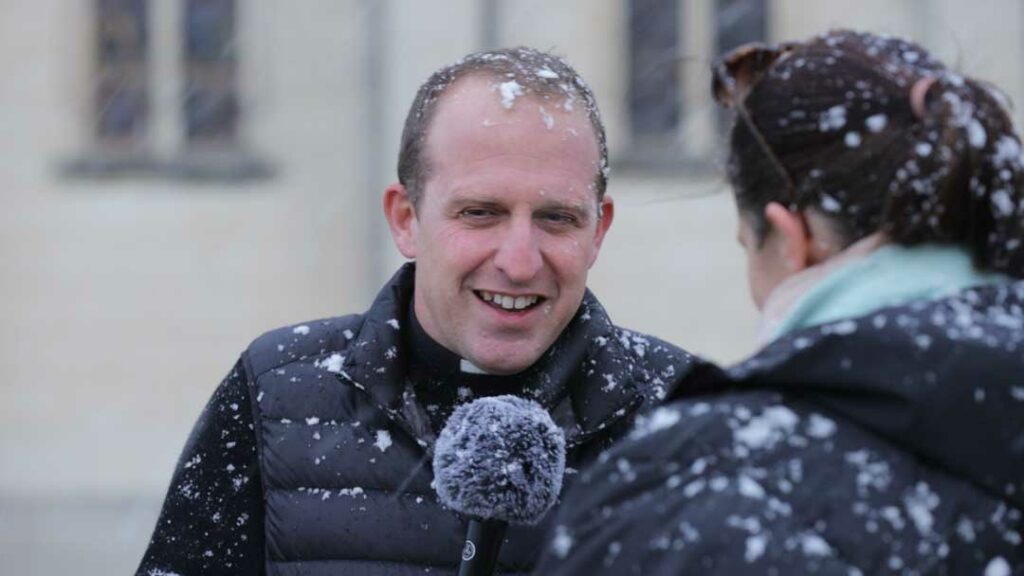
After death, shall we resurrect or reincarnate? Can Christian faith welcome the idea of reincarnation? Intuitively, we feel that the answer is no, since the Christians confess the resurrection of the dead, not the return of a soul into another body. Yet, this idea, which is both an inheritance from Hindhuist traditions, certain Greek philosophies and some modern projections, is attracting more and more Westerners. In this Sanctuaire Normands program, Don Paul Denizot explains in greater details what the Christian faith claims about the soul, the body, the resurrection and the ultimate destination of the human person.
What is reincarnation?
Reincarnation, also known as metempsychosis, refers to the passage of a spiritual principle –the soul –from one body to another after death.
It is defined as “the movement of a spiritual principle of the soul which, after a first life, changes body and goes to find another body to continue a cycle of successive incarnations”.
In some Greek philosophies, this cycle leads to going back to an original principle. In Hinduism, it leads to nirvana, i.e. depersonalization in the ‘greater whole’ at the end of various reincarnations. Reincarnation thus implies a succession of lives before reaching an end.
“Reincarnation is the movement of a spiritual principle changing bodies in a cycle of successive incarnations.”
Resurrection vs. reincarnation: what are the differences?
Both Christians and proponents of reincarnation affirm the survival of a spiritual principle after death, called the soul. But the differences between resurrection and reincarnation are decisive.
The Christian faith affirms the profound unity of soul and body. “We believe that we have one body: it is the body of my soul, which is the soul of my body.” The body is not a temporary envelope or tomb for the soul. It is the very essence of the person. “I am both, radically, profoundly, soul and body.”
Reincarnation implies a succession of different bodies over multiple lives. Resurrection, on the other hand, means returning to one’s own body, transformed, “in a stable and definitive state”. The individual does not dissolve into a “greater whole”.
In the resurrection, the person remains himself/herself. Answering the question of whether reincarnation and the Christian faith are compatible therefore implies having a clear view of what the human person is.
“In the resurrection, I remain myself. My person is called to a definitive fulfillment, body and soul altogether.”
What do we know about a resurrected body?
The idea of a ‘resurrected body’ raised hot disputes in the early centuries. Greek and Roman philosophers argued on that point, since this glorious body remains impossible to describe.
However, Christians believe that Christ’s resurrection sheds light on the matter. “His resurrection tells us something about the resurrected body.”
The Gospel accounts show that the risen Christ is indeed the same as before. He bears the stigmata of his Passion. He has a personal relationship with everyone. Yet he is different. Mary Magdalene mistakes him for the gardener. The Emmaus disciples walk with him without recognizing him. In the Upper Room, Jesus shows his hands and feet and eats in front of them: “Look, it’s really me”, he says.
He’s not a ghost. He is “made flesh and bones”. In other words, the resurrection starts a “new being mode”, with a spiritualized and glorified body. This reality is beyond our comprehension.
“It’s definitely Christ, but he is different, and he gets recognized through relationships.”
Can you be Catholic and believe in reincarnation?
Don Paul is straightforward: “I don’t think so” is his answer.
The reason is doctrinal. In line with the Catholic faith, “it is appointed for men to die only once, after which comes judgment”, according to the Epistle to the Hebrews. There is no cycle of successive lives. There is a single life, a particular judgment, and then the expectation of resurrection at the definitive coming of the Lord, the parousia.
That state is “stable and final” for both the glorified and the damned. Reincarnation, on the other hand, implies successive returns to other bodies. The two visions are incompatible: we cannot affirm both a single judgment and a cycle of rebirths.
Why reject reincarnation?
Three main arguments are put forward. First, the unity of the person: soul and body are not juxtaposed. The body says something about the person, and the soul is made for that particular body. Together, they form a unique compound.
Secondly, justice: considering that the present suffering is the consequence of acts committed in previous lives poses a serious problem. Justice must be understandable to those who suffer it. Telling a disabled child that he or she will pay for past wrongs seems unfair, since the person is unaware of what he or she is atoning for.
Finally, love: reincarnation implies the erasure of past relationships. “I’ve loved people, I’ve loved my children, and then at the end of my life, I erase everything and start again. This perspective contradicts the fundamental intuition of human love.
“There is no expectation of a love limited in time.”
“When you love someone, you feel intuitively that it should not end. Otherwise, it is not love.”
Also, as Don Paul remarks, in the Western context, reincarnation is often idealized: “The person used to be a Persian princess… They were never a fly or a goat.” This romantic vision minimizes the real significance of the doctrine of reincarnation.
Karma, justice and responsibility
The question of karma is frequently associated with reincarnation. However, it clearly differs from the Christian faith.
Christians believe that they will be judged on love at the end of their lives. There is such a thing as justice, but only the life actually lived is concerned by it.
Karma assumes that our present condition depends on acts performed in unknown past lives. “Justice must be explained to the one being punished, otherwise it becomes arbitrary. Otherwise, it becomes arbitrary. If the cause of suffering is ignored, justice becomes blind.
Why is reincarnation so appealing today?
This trend reveals a difficult relationship to the body. Already in ancient times, some philosophers regarded the body as the tomb of the soul. When Saint Paul announced the resurrection, this idea elicited a rejection.
On the contrary, biblical revelation claims that the body is willed by God. Man is not an angel. We are called to live in a body, with its limits and frailty.
The body is where relationships take place. It enables us to look, gesture and be present. It makes the expression of love possible.
« Love is forever. Otherwise it is not love. »
Ultimately, resurrection and reincarnation after death do not refer to the same vision of man. Reincarnation is not compatible with the Christian faith, which confesses the resurrection of the dead, a unique judgment and a stable, definitive state.
“I believe in resurrection, and resurrection is far more beautiful than reincarnation.”