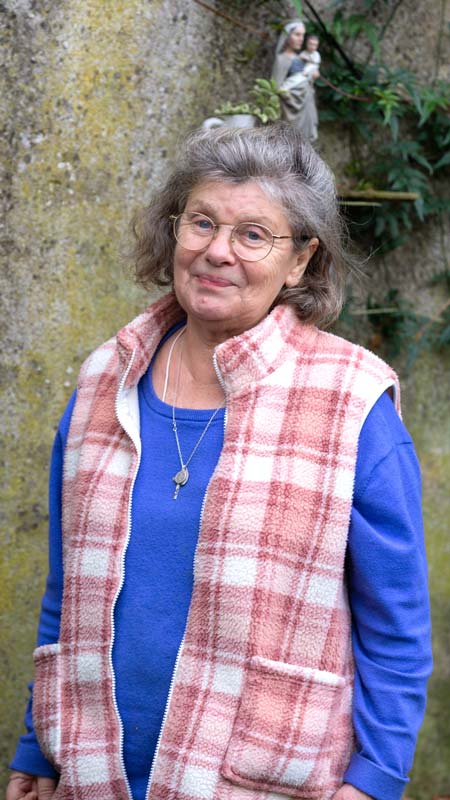
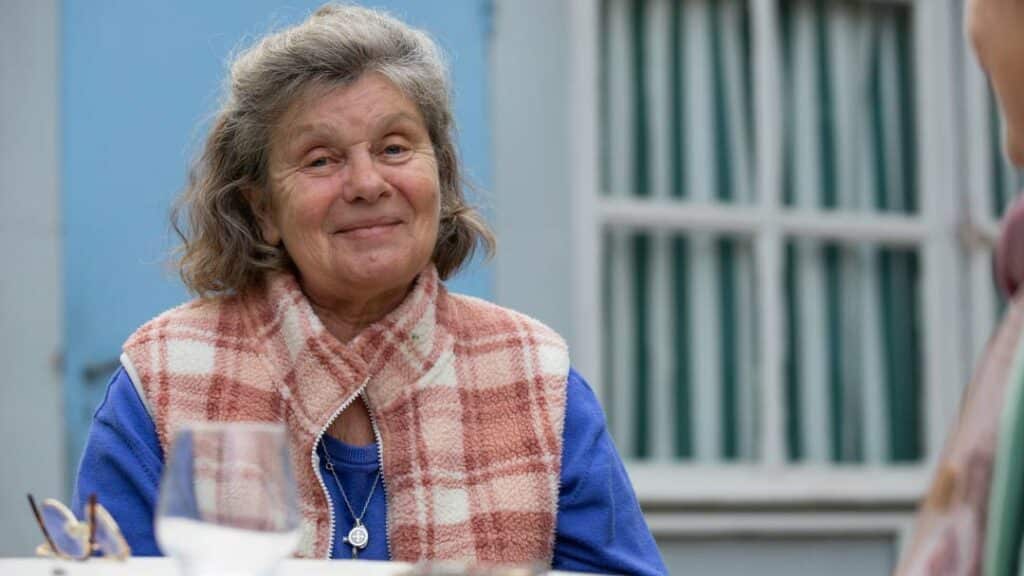
Maryvonne shares her life with us: Her childhood, marked by placements in foster care, a loveless marriage, followed by a most upsetting trial , the death of her son, Martial, aged 18. How can you continue to live and continue to believe, even when you heart is empty? This is a testimony of inner faithfulness by a woman who chose to believe, in the midst of suffering.
I’m the seventh of eleven children. Very early on, I was separated from my brothers and sisters. Despite a difficult childhood, fraught with break-ups, gaps and successive uprootings, I kept going, almost like a machine, because I had to. In the midst of these difficulties, however, there was a discreet, constant presence: my mother and I used to go to church. She’d take us there, we’d put out candles and she’d encourage us to pray. Not with big words, but rather with simple, repeated gestures that have become deeply engraved in my heart. Throughout my life, I’ve kept in touch with the Church, and faith has helped me carry my burden when it was too heavy. It hasn’t lifted the weight of hardship, but it has kept me going.
Taken in foster care at the age of four because of poverty
When I was taken away from my parents, I was very young, maybe three or four. The youngest of my siblings was still a baby. We were very poor, really poor. The French social welfare stepped in to help. They took us away from our family and placed us in Laval, in a place called Saint-Louis. Their reasons were clear: our accommodation was made of wooden shacks, my mother had nothing to feed us and some of her children had died. The situation with my father was complicated. The social workers decided to take us in.
Then something cracked for good and left me with the idea that life could unravel without warning, that you could be taken without having a say in the matter. At Saint-Louis, everything was austere. Next to us, separated by simple curtains, lived handicapped, deaf and dumb people. For a child, this presence was terrifying. The patients kept moving around a lot, trying to express themselves without being able to do so, and this restlessness scared me. Saint-Louis was also a home for the elderly. To get to the showers, you had to walk along endless corridors, lined with rows of beds, little bedside tables made of crates, each with a bucket in it. The old people sat in a row, all silent. At night, I couldn’t sleep, and this fear settled in my body. I would pee in bed, a bed that was too high and that I couldn’t climb into on my own. Everything about the place reminded me that I was small and vulnerable. We weren’t mistreated, but we didn’t receive any affection. Some nuns looked after us, but everything remained strict and regulated. Yet there were occasional relaxing moments, when we were able to play. Even if they were rather rare, they allowed us to exist.
There is something broken with my mum
One placement followed another. After a brief stint with farmers, we returned to Saint-Louis, and were again placed with an austere couple in Villaines-la-Juhel. We lived there for several years in fear, without being able to talk to one another. However, I did my First Communion, followed catechism classes and went to church, because that was compulsory. Thanks to my mother we were all baptized. Those were the moments that stuck with me. My mum finally got us back after a lengthy process. But the bond had been deeply damaged. She had suffered too much from the absence of her children, and so had we. The separation created a distance that we couldn’t bridge. Something had broken. I was fourteen when we moved out of the insalubrious shacks and into a flat. My mother wasn’t well, and I started working very early, in a sewing factory. I used to walk for miles and gave all my wages to her. My first pay was 17.50 francs – I have kept the slip.
My son Martial was ‘my all’
Later, I got married, without really choosing it. A young man decided to marry me. His father decided everything: the date, the flat… I was a fearful person, used to obeying, that’s how I found myself married. My marriage lasted twenty-two years, without love. Nearly two years later, I gave birth to my son Martial, a child full of life. Sweet, doing well at school, he passed his baccalaureate. He loved to laugh and he had friends. My whole life revolved around him. He became my anchor, “my all”.
Martial killed himself at the age of eighteen, leaving us a letter on an exercise book: “I’m leaving you, don’t be sad.” I was at work when I heard the news. I fell out of the world, alone with my pain.
I clung to the idea that suffering could be offered
From then on, the only support I had left was prayer. I spent hours praying the rosary.
I put a lot of religious pictures in my son’s room, as if to ward off the loneliness. My husband didn’t understand me and didn’t recognize me anymore, and neither did I. Yet my faith never left me. It had always been with me, but in this ordeal, it became vital. It wasn’t just one support among many: it was what enabled me to survive. I didn’t try to understand nor explain what was happening to me. I simply clung to the idea that suffering could be offered, that it might not be in vain. I thought of Christ, of the way he bore suffering to the end, without backing down. This thought didn’t eliminate the suffering, but it allowed me not to die with my son. Offering up my pain became a way of standing my ground, of continuing to live when, humanly speaking, I no longer had the strength to do so.
Join the prayer groups of the Montligeon Fraternity
The friendship of saints in times of trial
One night, I became aware of the presence of a nun in my room. I’m positive I really saw her. She smiled at me. I was not afraid of her. She stayed there for a few minutes, then disappeared. I’m sure it was Mother Yvonne Aimée de Malestroit (a French Augustinian nun and a mystic, who died in 1951, and whose beatification process is underway). Shortly afterwards, my husband became seriously ill. He died about two years after Martial. I had no children, no husband. I was on my own. Little by little, I discovered Yvonne Aimée’s story. I read and researched. Then I realized that this figure was leading me to a place, to people, to Father Labutte (Mother Yvonne Aimée’s biographer), to the spiritual centre of La Brardière (diocese of Séez).
Books on spirituality have become a refuge for me, especially the lives of mystics. I read those who had suffered a great deal, and I understood them with an ease that surprised me, as I had no school education.
Prayer is my essential support in life
I never blamed God. I’ve never rebelled, even at the worst times. I don’t know why. I never thought that God was responsible for what had happened to me. Today, I go to Mass every day. Prayer structures my life. It has become as necessary as breathing. Without it, I’d be completely empty. I believe that suffering is never wasted when it is offered and can bear fruit.
I believe in eternal life and that death is not the end. This certainty doesn’t suppress absence, but it gives it a perspective. It keeps me going. Today, I want to give without expecting love in return, to give freely and unselfishly. I think this comes from what I’ve experienced, and also from my mother: despite her poverty, she would give everything she could. This had a profound effect on me. That’s how I continue to live, and how I continue to believe, still.