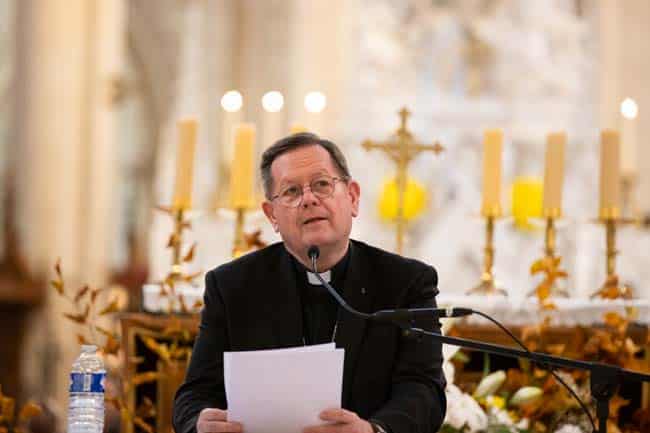
Lecture given by Cardinal Gérald Cyprien Lacroix
Archbishop of Quebec, Primate of Canada
Sanctuaire Notre-Dame de Montligeon
November 9,2025
“Therefore choose Life!”
Luke 7:11-17
The theme I’d like to share with you is ” Therefore choose life”. This theme may seem surprising for people who have come to pray for their deceased, and yet must continue their own pilgrimage through life.
Life is a journey, a pilgrimage. Today, our journey has brought us here, to the shrine of Notre-Dame de Montligeon. Whether we come from near or far, I’m convinced that our presence here is no accident. Someone was waiting for us here this afternoon.
In the light of the Gospel, I suggest that we move forward along this path, with the guidance of a reliable guide: Jesus Christ. I’ll be speaking in the first person, and I suggest that you receive God’s word as “I” too. The Word of God is for each and every one of us. It is not a general discourse. The Lord speaks to us, and I am hoping you will take these words for yourselves personally.
The purpose of what I am going to share is not for your information nor to fill your head with more ideas. My wish is that you may welcome this as the Word of God itself: it speaks and we can choose to welcome it. The Word is not just a spiritual commentary on our existence nor only an analysis or a content. The Word of God is always offered to our choice. God proposes, He proposes Himself, never imposing Himself. The Word seeks our freedom, it respects our inner self without being invasive. It meets our current experience.
Every time we let ourselves be exposed to the Word, a real dialogue opens up between God and us. It reaches out to us to transform something within – something concrete, something real.
So this afternoon, I encourage you to listen not for the sake of understanding but that of welcoming – welcoming what God wants to deposit within you. No one ever comes to a shrine by accident. You come to deposit what you bear within and what you are in God’s heart, what fills you with joy or with sorrow.
Welcoming what God wants to deposit in us. Welcoming what He wants to arouse in us. Welcoming what He may show us today. And then, each of us will see how to respond to His Word.
In the book of the prophet Isaiah, we hear the following words:
“As the rain and the snow come down from heaven, and do not return to it without watering the earth and making it bud and flourish, so that it yields seed for the sower and bread for the eater, so is my word that goes out from my mouth: It will not return to me empty, but will accomplish what I desire and achieve the purpose for which I sent it.” [1]. “
How fine these words are. I pray with you so that the Word we will welcome and meditate today will produce fruit in us. I pray that it descends and roots deep within our hearts, that it enlightens our intelligence, that it changes our views and leads us increasingly everyday towards the fullness of life, this abundance of life which Jesus takes us in.
For, as the author of the Letter to Hebrews affirms, “the word of God is alive and active. Sharper than any double-edged sword, it penetrates even to dividing soul and spirit, joints and marrow; it judges the thoughts and attitudes of the heart.[2]. “
I will speak as “I” to allow you to do the same. The purpose of what I am saying this afternoon is not only to inform you or bring you extra knowledge, but to be received in your life. I encourage you now to step into a scene from the Gospel. Imagine a town in Galilee, bathed in sunshine. We can hear people weeping. A crowd is walking slowly. Some men carry a coffin, and a woman is walking before it. She is a widow. She had already lost her husband, and now her only son.
Let’s listen to the proclamation of the Gospel of Jesus Christ according to Saint Luke (7, 11-17).
Soon afterwards he went to a town called Nain,
and his disciples and a great crowd went with him.
As he drew near to the gate of the town,
behold, a man who had died was being carried out,
the only son of his mother, and she was a widow
and a considerable crowd from the town was with her.
And when the Lord saw her,
he had compassion on her and said to her,
“Do not weep.”
Then he came up and touched the bier,
and the bearers stood still. And he said,
“Young man, I say to you, arise.”
And the dead man sat up and began to speak,
and Jesus gave him to his mother.
Fear seized them all,
and they glorified God, saying,
“A great prophet has arisen among us!”
and “God has visited his people!”
And this report about him spread through
the whole of Judea and all the surrounding country….
Let us acclaim the Word of God. Praise be to you, Lord Jesus.
What a wonderful passage! Jesus is on his way to a town called Nain.
Two processions meet, the widow on her way to bury her son, surrounded by the people who share her sorrow, and the people around Jesus with his disciples and a large crowd. They pass each other at the town gate. The funeral procession is walking outside the town. We all know it – it is our own cortege too. Raise your hand if any of you never went though mourning someone. Of course… who never experienced loosing a member of their family, a friend, a loved-one?
I can see that mother; I’ve met her hundreds of times at the cemetery, in the hospital, on the edge of a bed… She is inside me too – the part of me that mourns what is no longer, what has come undone, what has escaped me. That woman is me as well.
That procession is the slow march of all the things that get undone. You don’t need to be religious to recognize it – it is the most universal human experience. No one escapes it. Death is no hypothesis, it is our human condition, inevitable, certain and shared. Since it is certain, it becomes a spiritual foundation. It gives rise to the real existential question, the one that crosses us and strips us up from our illusions. Not ‘Shall I die?” but “What, in me, must not die, and how should I live accordingly?”
Biological death is not the only thing to consider. It also involves the death of a love, a plan, a dream. Each time I say, “It’s over, it won’t come back, there is nothing I can do about it”, I am walking with the widow of Nain, carrying the loss on my shoulders. And the surrounding crowd does not always understand the depth of the sorrow.
That procession is our human condition shared at all times and still passing amongst us: death, separation, grief. These realities are not part of the past, they are our common experience. To recognize this is already a grace – not escaping the real world, not coat it with veneer. That’s where the Gospel starts: in the real world, dust, tears… Jesus Christ’s God does not wait for us to be strong, He joins us in that walk, in our pain. He is the one who comes to us, just where we are.
I really love this verse from the Gospel according to John: “God so loved the world that He sent His only begotten Son, that whoever believes in Him should not perish but have eternal life…[3]. “
Two processions meet, one going out and the other going in. At the town gate. Opposite the mourners, the other procession is moving forward. Jesus went to a town called Nain. His disciples went with him, as well as a large crowd. [4]. Jesus too is walking with a crowd. It is not a religious idea, a symbol, or a psychological consolation, it is a real cortege. Life itself is walking forward to meet death. And in fact, Life capital L is Jesus.
Jesus does not avoid the procession of death. He walks towards it. Whereas we, most often , recoil inwardly. We protect ourselves, we distance ourselves, we harden ourselves, we go into abstraction. Jesus does just the opposite: he walks towards the weeping mother. He does not bypass grief; he goes towards the wound.
Throughout the Gospel he acts the same way, touching the leper, inviting Zacchaeus, joining the adulterous woman, the Samaritan woman. And then there’s a dizzying sentence. Saint Luke writes: The Lord was moved with compassion for her[5] . No technical theology with him, no complicated words. Jesus does not move forward to say: “He is better as he is” or “He is liberated from his suffering”. It is not an abstract answer such as “Don’t worry, time heals.” No, Jesus does not answer like that. Life personified, i.e. Jesus, is moved to the core by this woman.
Such is the God I am discovering in Jesus, a God touched by our sorrow, a God who has a heart, who allows himself to be touched, because He loves, because He is love.
The two processions advance, and the shock happens at the town gate. This is not an insignificant fact. In the Bible, the gate is where judgment, passage, fight, or decisions take place.
Jesus doesn’t go through the door… because He is the Door[6]. The boundary between death and life passes through Him. Christianity does not begin with morality or wisdom, it starts with another procession bursting in on human history – life coming to meet death in order to cross it.
As to myself, I am like the mother, like the crowd, walking between the two processions. The relevant question is not “Which one saw me come to life?”, because we do not choose our history. The relevant question is: Which procession do I decide to be in now? Death or life?
There is a choice that needs to be made. Where both corteges meet at the gate, Christianity says: Life is not the other name for death. Life is stronger and it is coming towards me. Life is a gift, offered by God, life in abundance. “I came that they may have and enjoy life, and have it in abundance[7] .
The gospel text goes on like this: Jesus drew near, touched the bier, and the carriers stopped.[8].
At the time, such a gesture was foolish. Touching death, or touching the impure was simply unthinkable. The cemeteries were outside the city for that reason, in order to avoid contamination. But Jesus does it. At that very moment, Life lays a hand on what the world believes to be irreversible. Jesus puts his hand on death so that we may see that it is not the end.
Seeing this, the universe holds its breath.
When I was younger, I thought Resurrection was only about “afterwards”, later on. But here, Jesus is acting now. Resurrection begins when Jesus touches what was closed.
The carriers stop and everything gets suspended. This time is the time of conversion. Not conversion as moral improvement or efforts but conversion as a positive acceptance of Life that comes to me. I stop fleeing to welcome. Jesus draws near with compassion for what I am experiencing.
Then Jesus said: Young man, I say to you, get up. [9] Those words are for that young man, of course, but they are also for me, for you, today. Every time I hear them, something in me can rise again. The resurrection does not only occur at the end. It begins now, in the chaos, in the dust, at the door, just where I thought it was the end.
The question shifts to: Do I accept to be touched by Jesus or do I continue to walk in the procession of death, with my good faith, my habits, my justifications?
Will I continue to walk burdened with that pain, carrying that grief on my shoulders, in my heart? Or will I allow Jesus to touch me and tell me Get up and walk[10]? There’s no neutrality here. The two processions simply pass each other at the gate. They don’t walk together. You have to choose.
Two verses in Deuteronomy confront us with this choice The Lord says: I set before you life or death, blessing or curse. Choose life, then, so that you and your descendants may live, loving the Lord your God, listening to His voice, clinging to Him; therein lies life, a long life on the earth that the Lord swore to give to your fathers, Abraham, Isaac and Jacob. [11]
There lies your life, a long life on the earth that the Lord swore to give to your fathers Abraham, Isaac and Jacob. Therefore choose life.” When Jesus said “!Arise” he did not only refer to a dead person, but to everything in me that’s creeping, despairing, numb, resigned, discouraged. He says it with the power of the creative Word in the first words of Genesis: Let there be light[12] . So, today, before you, before me, Jesus is saying, Let there be life.
What is stopping me from getting up? I’m going to say a word that you shouldn’t find shocking: sin. Sin prevents me from rising. It’s neither a shame nor a crime, it’s what closes me off to life, what puts limits on welcoming the love of God who wants to purify me, lift me up, transform me, convert me.
The Lord today comes to touch the sin in me, the death in me, to say to me: “Arise, you are loved, you are called to live.” That this shrine offers so many priests to welcome sinners and help them rise is a great thing. When Jesus speaks, sin recoils, because life doesn’t enter through coercion but by call. When I let myself be looked at by Jesus and when I discover His tenderness, it makes me want to go to him and let myself be purified.
Life — real life — does not arise out of coercion. Obedience or conformity can be obtained, not life. Life comes in as a call, a “come”, a “follow me”, an invitation affecting the individual’s freedom.
When you coerce someone, you may get obedience, or conformity, which are outward gestures, but you cannot get life. Life in the deepest sense can only enter someone if it is heard as a call. It implies a relationship, a freedom, a consent.
With coercion you are at risk of forcing, whereas a call attracts.
I’m a big fan of what Twelve-Step Self-Help Groups, like Alcoholics Anonymous, say: “Attracting rather than advertising”. Jesus attracts us with his love and benevolence.
I say to you, get up! That voice that spans the centuries. It can still be heard here. Then the son rises. The Gospel says: The dead man sat up, he began to speak, and Jesus gave him back to his mother.[13].
Nothing is lost, nothing is closed for ever, nothing is condemned to remain dead. Life puts things back together, repairs them, opens up a future. (Life with a capital L is Jesus).
The crowd is awe-stricken. It is not fear, but wonder. People say: “A great prophet has arisen among us and God has visited His people.[14]. “ God visits his people. He doesn’t look from afar. He says, “Behold, I am coming to you.”
God visits his people. God comes. God reaches out. Our God doesn’t look at us from afar. In the Bible, God doesn’t ask , Come deserve life. Come and prove to me that you are good enough for me to love you. No! He says, Behold, I come to you. He holds out His hand, he shows us His heart. Then, we can suddenly understand that the boundary between death and life is not an impassable wall – a passage exists. This is the very meaning of the word Passover, = passage from death to life, the passage from death to life that we celebrate every Sunday, and of course during Holy Week.
Here, in the procession of life, we act as support for those who were walking in the procession of death. This is what we do at Montligeon. This shrine welcomes us with those we mourn, our tears, our questions, and accompanies us to join the procession of life again.
Interceding is all about opening a breach to let life pass through death, and letting death open up to life. That’s why we’re here today. It’s nothing magical, nothing esoteric. It’s just opening up your life, your reality, to the Master of Life, our savior and redeemer: the Christ Jesus.
The purpose of the gospel text is not to tell a “Once upon a time” story. It’s a Word for me today. We don’t acclaim words, we hail the Word of the living God.
The question is: Which procession do I choose to walk in today? Shall I carry on in the procession of death, where I endure and resign myself? Or will I choose to enter the procession of life, where I welcome Jesus as the Door? Where I let His word tell me “Get up!”?
I don’t have to be pure, perfect or strong to choose life. I can get to a different cortege today.
At the gateway to the city, death and life meet, and life has final say.
I can let Jesus lay his hand on what is closed in me. I can let his Word reach what was lying in me. I can say: “I don’t know everything, but I can say yes. Yes to the life that comes to me. Yes to Jesus who is the Door.
At the Notre-Dame cathedral/basilica in Quebec City, we have a holy gate.
When the design was shown to me, I asked for two modifications: a more loving face, and the right hand sticking slightly out of the bronze, so that people could hold Jesus’ hand. At the blessing on December 8, I knelt down and said, “Lord, I’m the first one to take your hand.” And I asked Him to draw to Himself all those who would want to enter. “You who are life. You who are peace, you who are hope.”
If you ever come to Quebec City, you’ll see this gate. So many people have taken Jesus’ hand that it is completely polished.
Let the words of Jesus resonate in us: “I am the way, the truth and the life. No one comes to the Father but through me.[15]. “This Gospel reveals to us the God we worship, with whom we are connected, in friendship, in covenant: the God of life, not death. The scene in Nain heralds Christ’s resurrection. The son of Nain will die again, but thanks to Jesus’ death and resurrection, death is defeated. Easter has opened the door to eternity. Pope Benedict XVI liked to call this hope a reliable hope: our faith.
What people experienced in Nain is a sign of what we can expect when Jesus will come to meet us to enter into eternal life. In the faith of Easter, it is a reality to which we are hankering. The resurrection of the son of Nain is not just a great isolated miracle. It is the paschal miracle occuring early in the flesh of a dead man made alive.
Our Lady Liberator, whom we celebrate today, lead us to Him who is Life and who offers us Life. In Him, our hope is reliable.
Thank you very much for your listening.