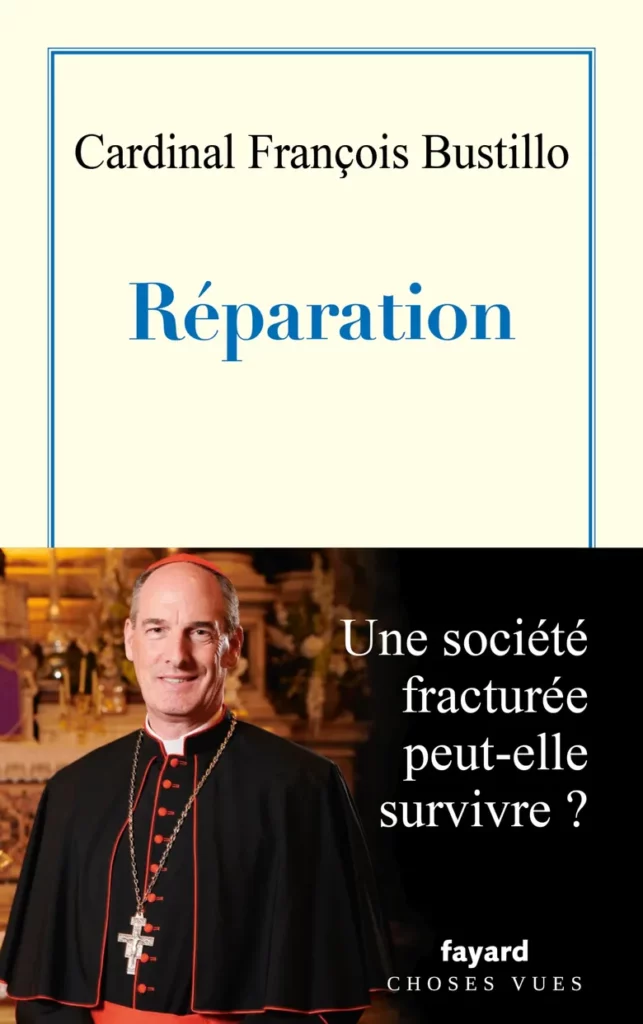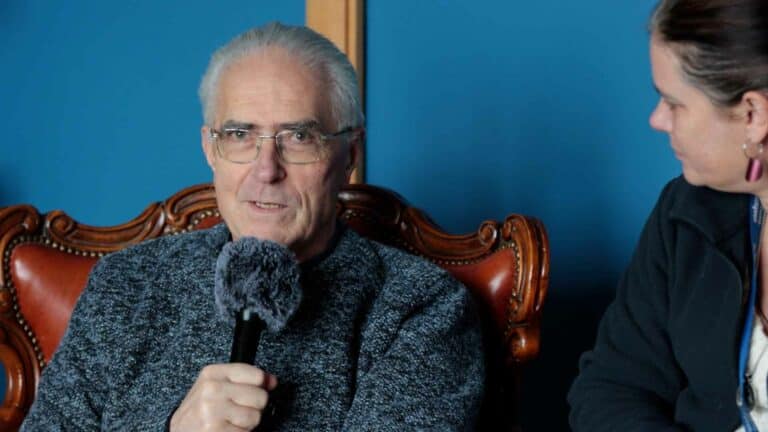
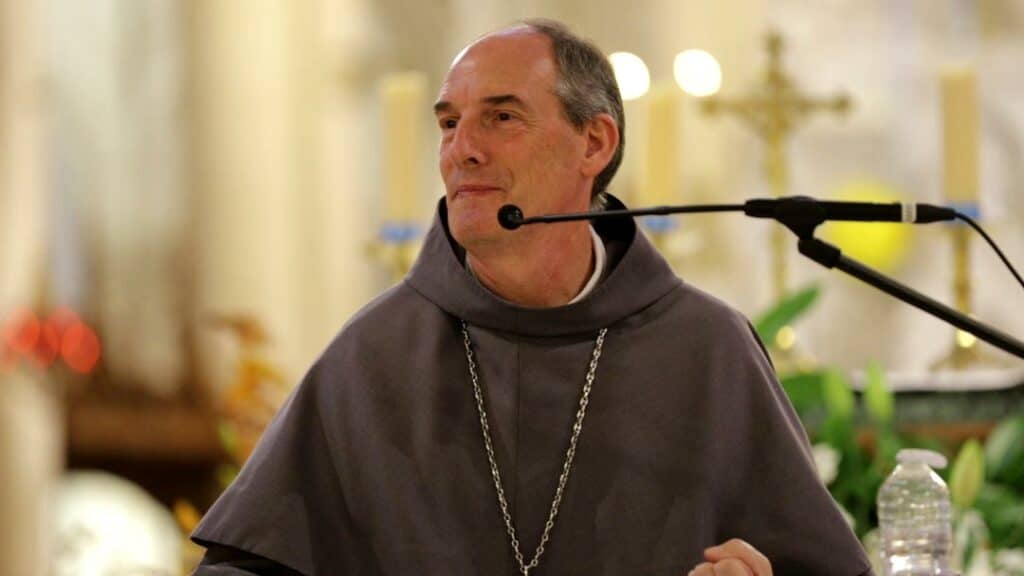
Conference by Cardinal François Bustillo, Bishop of Ajaccio,
Solemnity of Our Lady Liberator, Sunday November 16, 2025,
at the shrine Notre-Dame de Montligeon.
As we open this conference, I suggest that we invoke God’s Spirit to ask Him to visit us and open our minds, so that we may know and understand the Lord’s will.
“Glory be to the Father, and to the Son, and to the Holy Spirit, as it was in the beginning, is now, and ever shall be.”
Our Lady, pray for us.
The time we are going through is precious: a holy year, a jubilee. And this jubilee is one of hope. You and I perceive the world as rather bleak. That’s why our society needs to be repaired. We repair what has been damaged – hence, earlier today, some came to get a signed copy of my book entitled Réparation. Yes, it’s a matter of repairing a wounded society.
Repairing means that hope drives you. When something is broken with nothing to do, you throw it away. However, if it can be repaired, hope remains. We, Christians, we cannot simply observe and list the failures of our society and our Church. Instead, we have to go beyond a basic observation of facts and replace it by a positive, gospel-based response. A Christian always moves from observation to proposition.
This is not a new thing. The Scriptures remind it to us, as in the Letter to the Romans, chapter 8: “The creation is groaning“. That creation is me, is us. It is groaning but awaiting liberation. So hope always exists. Whilst creation is suffering, it is hoping to be liberated.
When we look around us, when we listen to the news, we see political instability, economical fragility, a lack of social coherence, climate disruption. Violence is omnipresent. Faced with this backdrop, we become increasingly more worried. A number of young people wonder about their future. In my generation, after our school days we had a lot of dreams: “We will do this or this or that”, we had all sorts of plans. Whereas the next generation is worried. They have diplomas, they travel around the world, discovering a variety of cultures. Yet, deep within, many young people feel anxious: “What shall we become? Where are we going to?” When you talk with youths in the 21st century, you sense a lot of fears. Their vision of the future is bleak, sad and defeated.
As I said earlier during Mass: us Christians cannot be driven by fear. The drive of our life must be love – not romantic or poetic love but the powerful love described by Jesus and saint Paul, the love that “will never end”. When we root ourselves in love, we hold on and move forward.
Although I am no longer young, I am not a mummy yet. And I am wondering about youth: Why are those youngsters like this today? On the one hand they possess extraordinary strength and freedom and on the other, they are worried. What is the reason? Are they more fragile than us? Have they lost their dreams? Have we prepared a tough and difficult society for them? Or passed them a soulless society?
Perhaps we’ve worked a lot on management, but not enough on vision. Yesterday, on my journey from Paris, someone told me the story behind this shrine and basilica. I said to myself: “What a priest! What audacity in the 19th century! What courage, what vision!” He dared to create a spiritual and material reality, caring for the soul, the body and the social context. This man was a visionary.”
Today, as we are busy dealing with the present time, with its challenges and complex issues, we are at risk of stifling the dimension of dream and vision. As Christians, our duty is to pass on everything we have received. Our christian life is a matter hopefulness and transfer. “What we have received, we pass it on to you” said Saint Paul. Peter, John and the apostles. They pass on what they have received and heard. John does not pass on a concept, a therapy or a magical recipe. To the community, he passes on his experience of Christ dead and resurrected, living amidst his people.
There we are in the 21th century, having received the legacy of the 20th century. At the beginning of the 20th, Max Weber described the world a as ‘”disenchanted“. At the end of the same century, the term “secularized” was in use. In between, there were two world-wars and a lot of violence. We were born in the 20th century. Back then, we used to say, “Neither God nor master”. God got dismissed, relegated to periphery. And yet, we have had a number of masters, each with his own recipes, his own solutions.
After the 1960s to 1980s period – when people used to say: “We don’t need God, we don’t need religion, we’re free, we’ve got science, politics, progress” – , my question is this: Are we happier today? We have science, technology, evolution, money. But are we happy? If we leave God out of the equation, we don’t achieve the fullness of joy. We can have satisfaction, not happiness.
Today, many people say either “I am pessimistic” or “I am optimistic”. According to the joke “The optimist invented planes, the pessimist invented the parachute”, we need both attitudes to move forward. However, in our society, it seems to me that the signs of violence and the news we receive through the media reveal the fragility and vulnerability of the social architecture. Brotherliness has disappeared, it is no more than a tag-line on the pediment of our town halls. Unless it is embodied, it will only remain virtual. We need to live and experience brotherliness. It is a legacy that the Church has received.
In the Acts of the Apostles, chapters 2 and 4, we discover a community where both the goods and the Word are shared – an ideal community, an inspiration for consecrated life. But as early as chapters 6 and 7, tensions appear: ambitions, divisions, conflicts. Humanity, already. Let’s not forget that the first murder in the Bible was a fratricide: Cain and Abel. The Bible reminds us of our nature and our duty of vigilance.
The Church must proclaim hope – hope, not illusion – because we are bearers of the Good News: Christ dead and risen, alive. Many young people today are worried, but they are also thirsty. Thirsty for spirituality, thirsty for life. They are looking for solid spiritual reference points. Quite often we may see some heading off to Tibet, India, the Amazon or elsewhere, in search of spirituality.
They go far away because they are empty inside – empty and thirsty. Many, as you and I can see, are requesting baptism today. They have not experienced the clericalism of yesteryear, nor a Church perceived as dominant. Today’s youths have experienced a spiritual desert. For them, the Church, priests and God are exotic realities, and they know nothing about them.
The Church must be present wherever there is a thirst for God. Here’s an anecdote, not very mystical. Last week, a chocolate fair was held in Ajaccio. Two days, twenty-five thousand visitors. When I saw our churches in town, I said to myself: “Let’s go”. I didn’t tell people I would go from one stand to another, but the fact is, in Corsica, generosity is a natural thing. So the cardinal left the fair with lots of chocolate, which we shared at the bishop’s palace.
Why am I telling this story? Because some people would say, “What’s a cardinal doing at a chocolate fair?” Well, we greeted people. In the corridors, a 24-year-old, then a 25-year-old, in different places, asked to be baptized. Who could have thought that? I never imagined it. The Lord winks at us. One young man, with an impressive tattoo, said to me, “I’m not baptized, I want to be.” That’s wonderful. These young people are looking for guidance, and the Church can offer them light and hope.
Often, we’ve worked on seeing, knowing, having power and doing, but we’ve neglected being. The Church has the power and the duty to work on being, so that human beings can be happy. Remember the Beatitudes: this is the first time Jesus speaks in public. He doesn’t start with “Mind here, mind there”, but with “Happy… Happy… Happy…!” He offers a path to happiness.
I believe that in the 21st century, the Church has the ability and opportunity to enlighten society, without pretence or shame. There are two paths to do this: reparation, and vision.
As I was telling you earlier, when we refer to “repairing”, we mean repairing what was damaged. our society needs to repair hope. Believing and hoping: when you believe, you hope; when you hope you live. We experience moments of tiredness in our lives, failure, frustration, disappointment, or conflicts. Sometimes, boredom sets in. We all have our struggles. As you know, life is about fighting and loving. To fight and love, you need the cardinal virtue of strength. When we get weakened by tiredness, struggles or failures, repairing our spiritual life, including our link with the Lord or with God, becomes key. We have to leave the horizontal plane and open to the vertical dimension. We are not naive, the world is complex. It’s not about idealizing the past and being nostalgic. Consider the Actes of Apostles, look at saint Paul, saint Peter, saint James: the first communities had their struggles too.
In his epistle to the Galatians, Saint Paul uses crude language: “If you bite and devour one another…”. He’s not talking to pagans, but to Christians. He’s saying: you can’t do that. The words “bite” and “devour” evoke predators. Already in those early communities, there were tensions. We’re always on a journey, always perfectible.
Today we have to repair hope, otherwise we might fall in the trap of describing only the things that go wrong. Whereas we are intellectually able to identify what is bleak, our responsibility demands that we go beyond that. In the heaviness of our social atmosphere, repairing our relationships and our spiritual life means believing that God wants to play an active part in our lives. Yes, nothing is simple, yes, life is difficult. However, God does not forsake us. Through the Church’s tradition, through spirituality and her Spirit — “the Spirit will remind you of everything —, the Lord urges us to embody some principles that we have kept at the periphery of our social life.
Those principles I’d say are redemption, compassion, forgiveness, reconciliation, benevolence, respect, other people’s dignity, modesty, clemency, understanding, mercifulness, reserve, humbleness. Who today talks about mercifulness, humbleness, restraint? People say it is a litany for the weak, not the strong. Yet these are constructive and positive attitudes. All this language is part of the Gospel ecosystem. Our society needs to recover its inner compass and come back to basic values. In the past, we have tasted all kinds of liberties. Yet, God is no burden. God is given.
The Church should not be regarded as a mere cold, technical reality with no connection to the world, or as a nearly political institution. The Church has a soul, which, too often, we have forgotten. We have considered the edifice, the organization, the logistic – not the soul. Today, the Church has the ability to restore the value of the symbolical dimension (in the etymological sense) and the value of unity. As to controversy, there is plenty of it, with the media giving us an earful of squabbles everyday. Us Christians, we must proclaim the power of symbol where divisions prevail. We need to bring forces capable of unifying the individuals first, then the institutions.
The Church can be part to this reparation because it draws its life from conversion. Conversion is not an attitude based on sadness or pain: it is related to evolution and progress. It is not restricted to the forty days of Lent, it is a daily experience. During Lent, the first ritual gesture consists in touching the head, with the imposition of ashes, and the last gesture, on Holy Thursday, in touching the feet, with foot-washing. Our conversion must be total, from head to toe, affecting our whole being. This path is offered by the Church, gently and clearly.
Beside the path of reparation, there is also the path of vision. If you interview people – both the active or distant worshipers – to inquire how they perceive the Church, you get telling answers. Some people regard it as catastrophic: ‘The Church is on the Titanic, everything is about to sink, everyone is against us, we are too few, there are no vocations anymore.” Whereas others go for the messianic vision: “We are going through really bad times but don’t worry, I am here”, along with a group of “pure people” who are convinced they are going to save humanity. Others have a pessimistic vistion: “We are sailing on a ghost ship in the mist, even though the port we started from was wonderful.” Others have a naive vision: “We are on a cruise-ship, everything is fine inside, let’s leave the issues on land.” Others take the fighting attitude: “The media are against us, the politicians are against us, the bishops are weak” and they value strength and violence. Now the Church cannot respond to social break-up through violence or it might betray the Gospel ideal and fall for the world’s views.
There are many different visions. However, in times of crisis, we have to dare, dream, take risks. We have to dare in confidence. As you know, pope Francis came to Corsica. I have to tell you something: when I was told about his coming, I reviewed the finances of the diocese. I thought: “We cannot do it, we will not make it, we cannot afford it.” Indeed, a pope’s visit requires considerable resources.
I was indeed very concerned.
I was thinking of the passage where Jesus sees the crowd and says to his disciples: “Feed them yourselves“. They replied: “Lord, send them away, there are too many of them. We only have five loaves and two fish“. Common sense says: “That’s not possible”. Our human logic acts according to calculation and responsibility – which is correct – but we need to add faith to the equation. We have to let ourselves be surprised by God.
In the finances of the diocese of Ajaccio, we had only “two fish”. So we asked – “Ask you will receive – says the Gospel, and we did receive. We were able to support the costs of the pope’s visit with no difficulty. We even collected extra baskets, as in the Gospel. During difficult times, you have to be bold. Otherwise, you become fatalistic, you look at facts, you sit down, you weep and you disappear. That’s the Gospel’s logic. You have to dream if you want to live.
I’m thinking of the passage in Genesis 37, the story of Joseph and his brothers. Joseph is the man of dreams. As they are jealous, his brothers throw him into a cistern: symbolically, they want to bury his dreams. We Christians cannot bury our dreams. In crises, we must trust God’s Spirit. “Behold, I make all things new,” says Isaiah. “Can’t you see it? God does not abandon us.
I think we live in a Church which doesn’t dream enough. But, remember, the Church has always made people dream. When you look at cathedrals, painting, sculpture, education, health, missions: the Church has always made people dream. And today, can it still make us dream? The prophet Ezekiel says: “I will give you a new heart and a new spirit“. Do we have an old heart and a worn-out mind? We have a remarkable heritage. We need to let the Lord renew our hearts and minds, and give us freedom – because our freedoms are often hindered by our fears: fear of not succeeding, fear of failure, fear of others. With fear, we do nothing. We need to rediscover our freedom.
In the book of Ezekiel, God uses the first person singular: “I will give you, I will put, I will make”. God acts directly. He does not remain on the periphery. He acts.
Here’s another key saying from the Gospel. In Matthew’s Discourses on the Mount, Jesus often says: “You have heard… But I tell you…”. In this phrase “But I tell you”, there is a revolution. Jesus brings something new to humanity. He moves us from one vision to another. His proposition is not a political project, it is a new, different, exciting life. He wants to renew mankind, tired of routine, night and fear, in order to convey hope to it.
At the time of her conversion, St. Teresa de Avila said: “My soul was tired. It became passionate”, suggesting a move from fatigue to passion. Jesus spoke powerful words to us: “Be merciful. Do not judge. Do not condemn. Give.” He opens up a new way of being with others. He preaches a new life, where there is no violence or vengeance, only benevolence. Throughout history, all the saints have brought something new – an understanding, a light, faith and life.
My friends, in this Church which is ours, let’s allow ourselves to be evangelized by the Word of God.
Let me also quote these magnificent words, full of hope, found in the Scriptures:
“Behold, I am doing a new thing; it is already sprouting.”
” I will open a way in the desert, rivers in the dry places.” (Is 43, 18-19)
And again, “Behold, I make all things new.” (Rev 21, 5)
These words are for us. They are the Word of God.
To conclude, I leave you with Mary, in this place. Mary Liberator – what a magnificent title! Mary is a liberator because she is the woman of trust. As we heard in this morning’s Gospel: “Do whatever he tells you. Listen to the voice of my Son, listen to his Word. Obey him.” She can say this because she herself obeyed. At the Annunciation, she pronounced her “Fiat”, her “Thy will be done”. She says yes to God’s plan. She was overwhelmed by it, but she trusted. Mary is a woman of depth: She “pondered all these things in her heart”. She did not read life superficially, but internalized what she saw and heard. She is a disciple of her Son.
Mary is a strong woman: she stands at the foot of the Cross. She cannot avoid injustice, but she stands by her Son. She suffers, she offers, she holds out. Mary is a model of endurance in times of trial. She does not give up, she is not discouraged, she stands firm.
Finally, Mary is at the heart of the Church. After the ordeal of the Passion, at the moment of Pentecost, she is present at the heart of the early Church Her presence is discreet yet effective. For the Church, she bears the memory, love and hope of her Son within her.
Thank you.
Discover“Réparation“, the book by Cardinal François Bustillo :