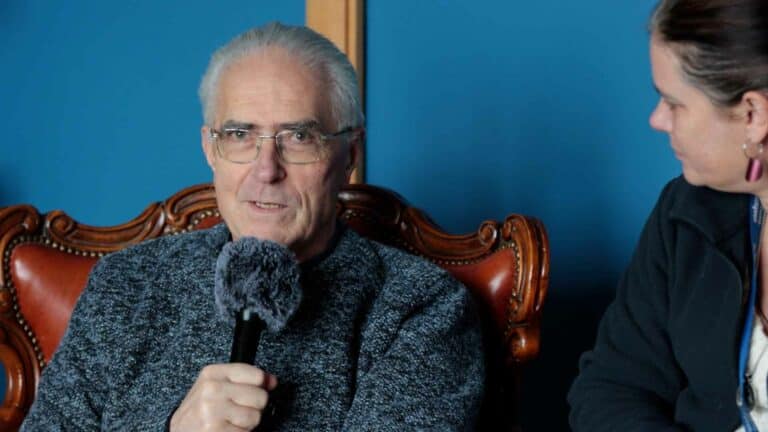
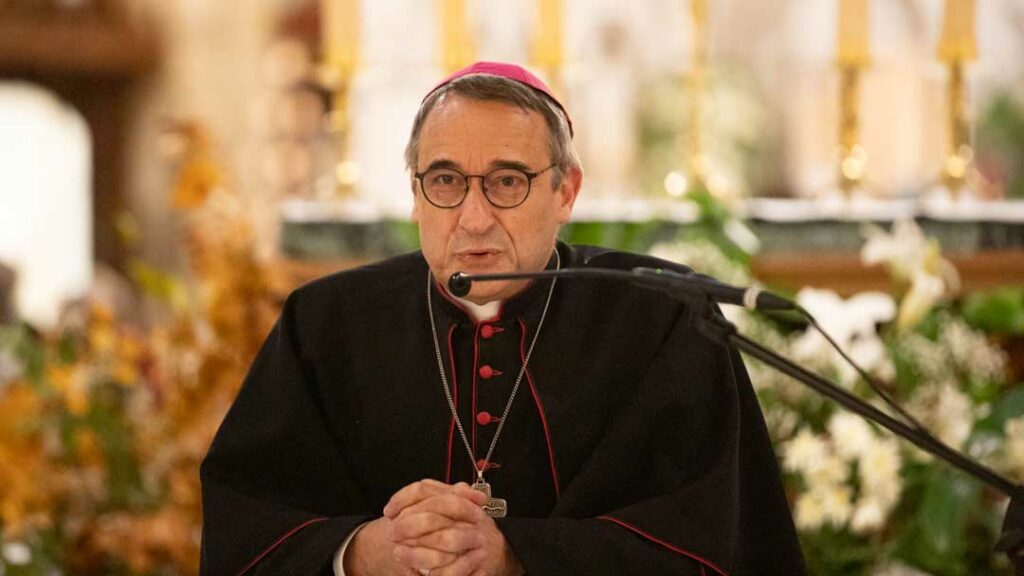
Olivier de Cagny, Bishop of Évreux, explores the meaning of the Church’s prayer for the deceased at the heart of the Mass. Digging into the Eucharistic prayers and the memento of the dead, he shows how the liturgy bears the memory of those who have left this world and entrusts them to God’s mercy. Drawing on the Scripture (the Second Book of the Maccabees, the Good Thief, the Psalms), on tradition (the Council of Chalon-sur-Saône, the teachings of Vatican II) and the testimony of St. Monica, recounted by St. Augustine, he sheds light on liturgical expressions where the dead are referred to as “servants”, “brothers and sisters”, “sleeping in the hope of the resurrection”. Finally, he elaborates on the images of rest, peace, light and participation in Christ’s resurrection, to present the great Christian hope: to be welcomed into the Kingdom. “Seeing death as a call from God enables us to understand that life does not stop, but continues with God.
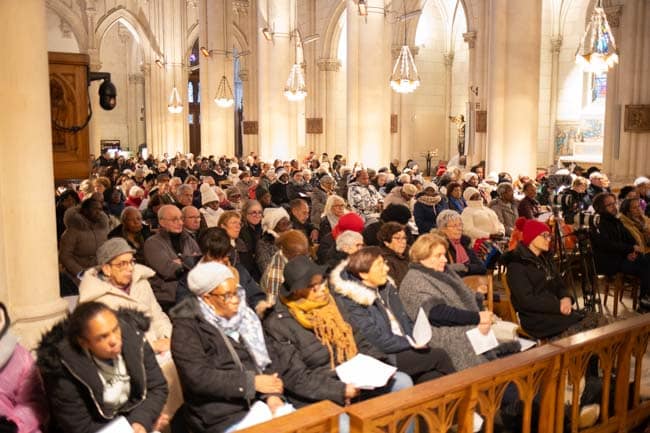
Conference by Mgr Olivier de Cagny, bishop of Évreux, for the Solemnity of Christ King of the Universe, November 23, 2025 at the shrine Notre-Dame de Montligeon.
You’re now being provided with a sheet of paper containing five columns of excerpts from the Eucharistic prayers, the great prayer said by the priest, during which, of course, the consecration takes place. But, you know, the consecration is a bit like the keystone: it holds everything else together, but everything else in the prayer is important too. And during this prayer of the Mass, we pray for our deceased. May the Holy Spirit help us, this afternoon, to understand even better this prayer of the Church for the deceased.
Mass
As you know, both the Gospel and the First Letter to the Corinthians describe the Last Supper and Jesus’ words. We are told that he gave thanks during the Lord’s Supper on Holy Thursday evening. He gave thanks as all Jews do at the Passover meal. And during this meal, Jesus gives his body and his blood. He sets the prototype, the example, the blueprint for all Masses the world over, until the end of time. In this great prayer of thanksgiving – in other words, we say thank you to God, we make of this whole prayer an immense thank-you to God – at the heart of this prayer, as is the case, I believe, in every prayer, where there is a “thank-you”, there is also a “please”. What is the reason? Because this is typical of any Christian prayer: I give thanks to God and contemplate so much what he has done for me that I want to say to him, “Please continue to give me, to give us your graces.”
That’s what happens at Mass. During Mass, we give thanks to God, we thank God. In fact, all the Eucharistic prayers begin like this: “Truly, it is right and good to give you thanks…”, “We give you thanks, God our Father…” You hear this at Mass: we give thanks. And, at the same time, in the continuation of the consecration, we ask God for things for both the dead and for the living. For the deceased, that’s what we’re focusing on this afternoon.
The Eucharistic prayers
All Eucharistic prayers – there are actually many different prayers in the world – include a prayer for the dead. In our missal, we have four main ones. You may have noticed that the priest sometimes chooses one, sometimes the other. The second and third are often heard; the first and fourth a little less often, but they’re very beautiful too. So, within these four prayers, every Eucharistic prayer, with a few exceptions, includes a prayer for the departed. It’s sometimes called the memento of the departed. Do you know what memento means? It’s not just a little notebook where you write down what you have to do; memento, in Latin, means “remember”. And we’re going to say to God, “Remember our dead.” That’s the memento of the dead.
Already at Charlemagne’s court, this tradition existed. At the beginning of the 9th century, there were monks at Charlemagne’s court who took the liturgy, the celebration of Mass and the sacraments very seriously. A certain monk by the name of Alcuin insisted that prayers for the dead be included in the Mass. As a result, a council was held in Chalon-sur-Saône, in 813. Which means that it’s been over 1200 years since a council said, “From now on, in all Masses, we’re going to pray for the dead, we’re going to pray for the dead at all Masses.” Not just because we have this in our hearts when we come to Mass, but because it’s part of the Church’s mission to pray for those who are no more.
Second book of the Maccabees
The fact that this was requested by a council in 813 doesn’t mean it is anything new. Remember that already in the Old Testament, in the second book of the Maccabees, we see men who fought a battle, a war, and stole things from the inhabitants of the villages they passed through. They died, and we’re afraid they’ll be condemned by God. So we offer a sacrifice for those who have died, because we know that they were sinners, that they were not righteous in their conduct. We celebrate a sacrifice for them.
Celebrating a sacrifice means that we offer something to God to thank Him, to ask His forgiveness. Here, we pray for someone else, for someone who has died, because we know that they have committed sins and we want to pray for them, so that God will welcome them into his Kingdom. The Gospel, of course, also gives us an example of this prayer for the dead, when the good thief implores Christ in these terms: “Jesus, remember me when you come in your Kingdom.”
“Please, remember me at the altar of the Lord, wherever you are”
Surely you know Saint Monica, Saint Augustine’s mother, don’t you? Saint Monica, the mother of that great saint, one of the greatest theologians in the history of the Church, Saint Augustine. Saint Augustine tells us about the death of his mother. He writes this in reference to his mother, who speaks of her impending death. She feels that her death is coming, and she speaks of her funeral. She says to her son, Saint Augustine:
“Bury my body anywhere. Don’t worry about it in any way. All I ask is that you remember me at the altar of the Lord, wherever you may be.”
St. Monica’s concern wasn’t so much for the location of the cemetery. Of course we can be interested in it, it’s legitimate, and it’s very nice to find a place where our body will rest, a beautiful place, a place where people will want to come and pray. But Saint Monique did not regard this as important. She was far from her home when she was dying and her sons were embarrassed, asking: “But where are we going to bury you? We might not be able to make the trip…” She replies, “Don’t worry about where I’ll be buried. “There is one thing I ask of you: that you remember me at the altar of the Lord, wherever you may be.”
After his mother’s funeral, Augustine also wrote this: as the day of her deliverance approached, she did not consider having her body sumptuously wrapped or embalmed, nor did she have any desire for a monument of choice, nor any concern for a tomb in her homeland. “She did not recommend these things, but only to be remembered at Your altar.” When Augustine wrote his Confessions, he was addressing God, so he said “at Your altar”, that is, God’s altar. “This is the only thing our mother asked of us: only to remember her at your altar, Lord.
Such was her wish, for she had served this altar everyday without missing a single day. She went to Mass every day. She served this altar, knowing that it is where the holy host is distributed, which has abolished the condemnation brought against us and which has triumphed over the enemy. Saint Augustine uses those words: Behold: it is the sacrifice of Jesus that has obtained for us the forgiveness of our sins. This is what Saint Monica asked: that she be remembered at Mass. Hence the fair tradition, which continues to this day – and which I hope will always continue – of offering masses for the deceased. So yes, we do pray to God for the dead.
We address the Father
I’d now like to review the texts you have in hands to note a few things. The first one is: who are we addressing? You know that, in the Mass, we mainly address God the Father, through his Son, in the power of the Holy Spirit, guided by the Holy Spirit. But we address the Father. Don’t forget the Father.
We often think of Jesus, and that’s fine, it’s normal, it’s Christian, it’s Christic. But let’s not forget that Jesus lets us know the Father. That’s more difficult, because apart from the “Our Father”, we don’t always spontaneously think of the Father in our prayers. I don’t know who you think of when you say “Lord”. Do you think of Jesus? Yes, certainly, often. Do you think of the Father from time to time? The Father of Jesus and our Father, the Creator of the universe, from whom everything comes? In the Eucharistic prayer, in the prayer of the Mass, we address the Father, from whom all life comes.
Earlier in the Mass, I tried to emphasize these words at the beginning of Eucharistic Prayer No 3: “You are truly holy, God our Father, and it is fitting that all creation should proclaim your praise, for You are the giver of life, You sanctify all things through your Son, in the Holy Spirit.” You are the giver of life. From time to time, even when we think of our deceased, let us turn to the Father and say, “Father. And let us look at all creation, all nature, all the wonders of the world, and say to him: “Father, You are the giver of life to the world, to plants, to animals, to the sky, to the stars, and to me, and to my parents who have died, or to my grandparents, to my husband, my wife, my children, my brothers and sisters, my friends. You are the giver of life.”
If you give life, Lord, you won’t destroy it. It will be transformed, but you won’t destroy it. The Father is the origin of life. This already fills our hearts with hope. We turn to the Father who gives life, eternal life. He even gives his own life, which he communicates eternally to his Son, and his Son passes it on to us. This indeed is the heart of our Christian faith.
So we address the Father as at Mass we celebrate the sacrifice of his Son, which is the fact that Jesus, his Son, offers his life to the Father. Not only does the Father give us life, but at Mass the Son too gives his life back to the Father. Hence thanksgiving: we give thanks. Grace is God’s free gift, the free gift that falls from heaven. Thanksgiving means standing before God and saying, “The life you gave me is so wonderful that I give it back to you. Jesus does this for us. And in doing so, he draws us into his offering.
Jesus gives his life at the heart of the Eucharistic sacrifice, the sacrifice of the Mass. As we celebrate the gift of life that descends from the Father to the Son, then ascends from the Son to the Father. We too are caught up in this movement with our deceased. They are indeed in this movement of exchange of life: life that comes from God and returns to God. Sometimes, in obituary notices or funeral announcements, we read: “He has returned to God”, “She has returned to God”. It’s true. This is beautiful, as indeed our life comes from God and returns to God.
The same movement takes place at Mass, meaning that God’s life comes down to us, and we offer our lives to God. Remember what we say at the end of the Eucharistic prayer: “Through him, with him and in him, to you, God the Father Almighty, in the unity of the Holy Spirit, be all honor and glory for ever and ever. We give everything back to God, we present everything to God: our whole life, our present life, our past life, our future life, right up to the hour of our death, as we say at the end of the Hail Mary prayer.
Death, our ultimate gift
During the Eucharistic prayer, we also say: “May the Holy Spirit make us an eternal offering to your glory.” May the Holy Spirit make us an eternal offering to your glory, to you, the Father. Doesn’t this say something about our deceased? The Holy Spirit is able to make of us – not just a small gift to God, but of ourselves, of our very selves – a gift to God. Isn’t death our ultimate gift to God, to thank him for giving us life? I’m well aware that, in the midst of grief, suffering, sadness and the harshness of separation, it’s sometimes very difficult to think of things in this way. Yet that’s exactly what happens: our life is not annihilated at death, it is transformed, it is entirely returned to God.
Let’s now turn to the texts themselves. In many prayers we say: “Remember”. We say to God, “Remember our dead.” Does God have a short memory? Does he forget things? You know very well that, in the Bible, in the psalms, we use human words to talk about God or His attitude: we say that He is patient, that He sometimes gets angry, and so on. We say things about God that sound like human attitudes. This is not to say that God is limited like a man – He is infinite, eternal, almighty. But we speak to Him with our language – and he gave it to us. He gave us the psalms, in which we say: “Remember, Lord. Remember us.” You hear this sometimes in the psalms at Mass or in the Office: “Remember, Lord.” For example, in Psalm 24: “Remember, Lord, your tenderness, your love that is forever.”
This is very typical of Christian prayer. We say to God: “What you have done, Lord, is so beautiful that I ask you to continue. It’s a bit like this: “Remember, Lord, your tenderness, your love that is forever”, which is forever. Or, in another psalm, Psalm 113: “The Lord remembers us, he will bless.” This is the certainty of the psalmist, of the one who sings the psalm and announces it to those around him: the Lord remembers us, he doesn’t forget us, that’s for sure. He will bless us, that is, give us his good, continue to give us his good. The Lord does not forget us.
Remember us, O Lord
I often say this to people who are struck by misfortune, or attacked by troubles from “the adversary”, or by specific, serious difficulties: “The Lord will not abandon you, that’s for sure. He will not loosen His grasp on you.” Sometimes we’re in a tunnel, but perhaps that’s where He holds us even more, precisely in those moments, in the darkness. He doesn’t loosen his grasp. “Remember us, Lord”. We ask Him to remember, just as the good thief asked Jesus, “Remember me when you come with your Kingdom.” Likewise Saint Monica said to Saint Augustine: “I ask you to remember me.”
This request to remember is not only aimed at God. Remembering those we have lost is something very present in our minds, in our hearts. We put a photo on the mantelpiece, we keep an album, we go to the cemetery; we have little objects that evoke the person who is no more. We remember, that is, we think of the past. But for God, remembering isn’t just thinking about the past; it’s making sure that everything beautiful in the past continues in a different way. “Remember, Lord” means: “This is what you did for such and such a person who has died and whom I mourn; what you did for him or her in this earthly life, please unfold it now that s/he has gone to you. Continue your work of grace for him/her.”
If the person was very holy, we’ll say to God, “Remember all the good things s/he did.” For someone who, from our point of view, seemed to us to be further from God – something we can never appreciate fully, as God alone judges – we can simply say to Him: “Remember him, remember her, because he, because she is your beloved creature. You created him or her in your image and likeness. You want to make him or her a saint, that’s for sure. So please, Lord, remember your plan, your original plan: don’t abandon it. Remember it.”
Mass for the deceased
So we say “Remember” in Eucharistic Prayers I, II and III. Next, in your sheet comes the largest column – column No 4 – which gives the intercession specific to Masses for the dead. This is a whole passage that can be added to the Mass when it’s a funeral, or when the Mass is celebrated especially for the deceased, or on November 2, for example.
Who are the dead? You’re going to say: that’s easy, they’re the ones who have come to the end of their earthly lives.
That’s true. But in what terms do the Eucharistic prayers evoke the dead? They don’t use the word “dead” so much. Look in Eucharistic Prayer I, we read: “Remember, Lord, your servants.” That’s interesting. With the term “your servant, we’re praying for those who have served God during their lives; meaning that we’re talking about Christians, those who made themselves part of God’s plan, who took part in God’s project.
In prayers II and III, we use the words”our brothers and sisters”. That’s correct, we’re a family, God’s children, a family of God’s sons and daughters. When we pray for our deceased, even if they are distant cousins or neighbors, they are brothers and sisters.
What about the unbaptized?
So, you might ask, “What about the unbaptized? The unbaptized are called to enter this family, since this is God’s plan for everyone, so that everyone may know Him, love Him and live His life. During this earthly life, they may not have gone through baptism; but perhaps at the moment of death, they have experienced a form of baptism. In any case, we must remember that the Holy Spirit offers every man and woman the possibility of being associated with the cross and resurrection of Jesus. Vatican Council II reminds us of this: since man’s vocation is unique, that is, divine, we must hold that the Holy Spirit offers everyone, in a way known by God, the opportunity of being associated with the Paschal Mystery, with Jesus’ Easter.
As to us, the way we know is through baptism, which makes us brothers and sisters of Christ. God may possibly know other ways. In any case, that’s our hope, that’s our faith. When we use the term “brothers and sisters”, we are also thinking of all men, since we then extend it to “all those who have fallen asleep”.
In Eucharistic Prayer III, we call our deceased “our departed brothers and sisters”.
The word “deceased” in Latin is “defunct”, meaning “one who has accomplished, or completed, her/his life”.
This earthly life is over; we take note of this, and we speak of those who have left, who have ended their earthly life. Our texts are even more precise. In Eucharistic Prayer III, we read: “Those who have left this world and find grace before you”. In the past, we used to say: “Those who have left this world and whose uprightness you know.” This passage is difficult to translate from the Latin, which reads – if translated accurately – “Those who, as they pleased you, have passed out of this world.” Those who pleased you, who pleased you, and who passed into the world beyond death.
So we ask God that our deceased may find grace before him, that is, find God’s mercy, forgiveness and gratuitous love. May love welcome them, even though they have left this world.
Those who have gone before us, with the sign of faith
We also use the phrase “Those who have gone before us, with with the sign of faith”. In Eucharistic Prayer I, column 1: “Those who have gone before us, with the sign of faith”. They have gone before us: we walk the same path. At the moment, I like to think of catechumens as people on a freeway slip road. We’re on the “highway to heaven”, as Carlo Acutis used to say about the Eucharist. Others are arriving from the smaller roads and are now entering the freeway. They are joining a large crowd of people who have been walking since Abraham – and even before – with all the saints, and who are advancing towards the Kingdom.
We must think of our dead as well as those who have gone before us, who are a few “miles” ahead. However we’re all walking the same road, the road to eternal life, the road to the Kingdom. “With the sign of faith” means ‘baptized’, bearing the sign of the cross, the sign of faith, the one we trace at baptism, to be marked by the cross of Christ and his resurrection.
Those who have fallen asleep in the hope of the resurrection
“Sleep” is also mentionned in some prayers. The Eucharistic Prayer II uses the words “Those who have fallen asleep in the hope of the resurrection”. “Asleep” may sound strange, even shocking, for we who have lost someone in the flesh know very well that it’s not a sleep you wake up from down here. But they will wake up one day, when we all wake up to the sound of the trumpet – as Scripture says – in the resurrection.
It is sleep indeed. When Jesus goes to heal Jairus’ daughter, he enters the house and tells the people, “Don’t worry, she’s asleep.” Everyone laughs at Jesus. But Jesus knows that death is sleep, even if the little girl wasn’t sleeping just to take a nap, but was really dead. Indeed Jesus, refers to it as sleep, saying “Don’t worry, she’s not dead, she’s sleeping.”
Eucharistic Prayer II refers to “Those who have fallen asleep in the hope of the resurrection”. This is the “special sleep” of death. Another prayer has it as “Those who sleep in peace.” This is Eucharistic Prayer I: “Those who have gone before us, with the sign of faith, and who sleep in peace.”
Peace
Let’s consider the peace of rest, as oppose to life on earth, which is hectic, complicated and tiring. We all experience it, more or less, and we say to ourselves: “Death will be a rest”.
In fact, we won’t be doing anything external or tiring. Of course, this doesn’t mean we should wish death to come any faster, but we can see death as a rest, a peace, after the hustle and bustle of this world subject to the vagaries of nature, including wind, cold, natural disasters… There will be no more of that: it will be rest, peace. Requiem means “rest” in Latin.
Remember that this is how the risen Jesus greeted his disciples when he appeared to them. He said, “Peace be with you”. Jesus is already promising this peace in this world, as the peace that comes from him, the Risen One. It is the gift of the Risen One, the one who knows what it means to rest in God after death. It also means that in the Kingdom there will be no more war, no more tension, no more disputes. Sometimes, when we think of dead people with whom we’ve quarreled, we feel very sad that we didn’t have time to reconcile.
Dying in peace
Let me tell you something that happened to me. I had a goddaughter – not a niece, but a young girl – who was born of parents who lived on the streets and whom we had taken in at my parish. As her father was an alcoholic and had been harsh with his daughter, she didn’t want to see him anymore. From the age of 12 to 18, she refused to see him.
When she turned 18, I continued to see her dad. He was in hospital during Covid; he had Covid and cancer at the same time, aged 55. He was close to death. I called my goddaughter and said, “Please come and see him.” She drove 600 km and came. At the bottom of the hospital, she said to me: “No, I can’t do it.” I said, “Please, you drove 600 km to see him, he might die. Go ahead.” She went upstairs; it was a Saturday morning. She had the courage to go into the room and see her dad, still very conscious but very weak. They were completely reconciled, they cried tears of joy. Then she went home on Saturday afternoon. And he died on Saturday evening.
It doesn’t always happen this way, but I often think of this episode to understand the meaning of this peace: it’s not just rest after death, it’s also something God can bring about, even if there hasn’t been this kind of visible reconciliation before death. God can do it afterwards, through our prayer. This, too, is the peace in which we wish to die, and in which we wish the deceased to rest – peace in the sense of forgiveness, of consolation.
Another prayer refers to “those who rest in Christ”. Indeed they rest, however it’s not just that the body no longer moves: they rest in Christ. In Christ, that is, in that great “Holy Saturday”: the rest of Holy Saturday, which is a Sabbath. Jesus died on a Friday for a good reason, because Saturday is the Sabbath, the completion of all creation, God’s rest, and that Jesus rests in the tomb. Such rest is the prelude to Resurrection Sunday, Easter Sunday.
In this way, our deceased rest in Christ, in this hope. For them, we pray at Mass; for them and for all others.
Naming the deceased
At Mass, we often take the trouble of naming the particular deceased for whom we are celebrating. Either we name them at the beginning of the Mass, or at the beginning of the Eucharistic Prayer, or in Eucharistic Prayer I, where we are supposed to name them, and you have “N. and N.” on your sheet. N. and N. can be Nicole and Nicolas, or any other name. We pray for the departed.
Don’t worry about the differences between parishes, between dioceses, depending on whether they are named at the heart of the prayer or at the beginning of Mass, or whether they are simply listed on the parish sheet. The priest knows very well who he is praying for, for such and such a person in particular. That’s what matters.
What do we ask God for our dead?
So, what do we ask God for our dead? Let me finish here. We ask that our dead be welcomed, thanks to God’s goodness, into the Kingdom of Heaven. We express this in various ways. We ask, for example, that they receive – in Eucharistic Prayer I – “joy, peace and light”. Joy, peace and light. Actually, in Latin, the word “joy” isn’t used exactly, but the word ” refrigerium”. It would sound strange in English to say “the refrigerating place”! Refrigerium evokes gentleness. In biblical culture, coolness is often an expression of God’s consolation, because we’re in hot countries. The place of coolness is the place where God comforts us from dryness, harshness and heat, and gives us the peaceful joy of being with him and living with him.
This is to be understood in the sense of relief, consolation. Basically, we request that the sorrows of this life, which are due to sin or, more simply, to the limits and weaknesses of human nature, wounded by sin, be definitively healed. We also ask for light, because darkness is an image of death. Not only we enter into sleep, but also into shadow and penumbra; here on earth, we have no exact knowledge of what death feels like. We express it by the word “darkness” or “penumbra”, and we ask that the deceased be welcomed into the light.
In Eucharistic Prayer II, we add a beautiful word, “the light of your face”. How beautiful! You know, there are representations of the Nativity scene where we don’t see the face of the Baby Jesus: he is in his mother’s arms, but Mary’s face is all lit up, while the whole crib is in the dark, with the stars. Mary’s face, or Joseph’s, is illuminated by the face of Jesus. In fact, the light radiates from Jesus’ face himself. It’s an artistic way of putting it.
Being together, forever
In the Eucharistic prayer, we ask that our deceased be welcomed into the light of the face of the Risen Christ, resplendent with light as at the Transfiguration: “Welcome them into the light of your face.”
Finally, in Eucharistic Prayer III, we ask God to welcome our deceased into His Kingdom, “[w]here we hope to enjoy for ever the fullness of your glory”. This is the “all”: the totality. “That we may enjoy the fullness of your glory”: glory is the radiance of God’s light and presence, the weight of His presence in the universe. We ask for “all your children and for ever”. Meaning, all of us and all the time. We dare ask God for as much as that. We mustn’t be stingy with God, or too hesitant or shy. We must ask Him for everything – “We hope to enjoy for ever the fullness of your glory” is what we’re promised, and what we’re asking for, to be together, forever.
I must finish, really, because the bells are calling me to conclude. Let’s take column 4, the largest one. I’ve imagined that we are praying for someone, a man who has died – we could say “he or she”, but I’ve retained the masculine form. “Remember him who has left this world and whom you call to your side”. “You call him to your side.” As a matter of fact, some people have said to me: It’s hard to say that “God called my child to Him; He could have waited a little”. It’s true that it’s hard to put it that way. But seeing death as a call from God is also beautiful, because it helps us understand that life doesn’t stop, that it continues with God, and that there is a mission for the person. “You call him to you.”
Lord, you will resurrect us one day in the flesh
“Since he was united with your Son in a death like his, may he also be one with him in his Resurrection.” This is what we believe when it comes to praying for the dead: since he has been plunged into your death, Lord, let him share in your resurrection, because there is not one without the other, that is Good Friday without Easter, the day when Christ will raise in the flesh those who have died and transform our poor bodies into the image of his glorious body.
That’s a beautiful sentence. Think of it when you think of your deceased, or when you go to the cemetery, or when you pray for them, or at Mass: “Lord, you will one day resurrect us in the flesh”, that is, in our personal identity. Each person is unique, with his or her whole existence. “You will resurrect us.
You may know the passage from Saint Paul where he asks: “How will we be resurrected? With what body? Psychic, physical, spiritual?” It’s very complicated. What we do know, however, is that we will be resurrected in the wholeness of our person. This is expressed here in terms of transformation: God will transform our poor bodies – which may be sick, tired, etc – into the image of his glorious body, into the image of His glorious body, into the image of His body as it appeared at the Transfiguration and was resurrected.
“When you wipe every tear from our eyes”
So we continue the prayer and end by saying, “There we hope to enjoy for ever the fullness of your glory, when you will wipe away every tear from our eyes.” This is at the bottom of column 4. “When you will wipe away every tear from our eyes” is a prophecy from Isaiah. God will wipe away every tear from every eye; there will be no more sadness. “You will wipe away every tear from our eyes, seeing you, our God, as you are.”
Indeed, for now, we see Him through faith. We don’t see God as He is; we see Him through faith. Yet, “seeing you as you are, we shall be like you forever”. Such has been man’s vocation from the very beginning, since we were created in the image and likeness of God. “We shall be like you for all the ages and praise you without end, through Christ our Lord, through whom you bestow in the world all that is good.”
This is our great hope. This is our prayer for the dead.
So, when you hear this prayer at Mass, let it carry you, let it carry us, let us be led by the Church’s prayer, which is so beautiful, so strong, and which strengthens us in faith and hope.