At the age of 25, Adriana was diagnosed with an aggressive form of cancer. In a matter of days, her life was turned upside down. Here, she recounts how this ordeal profoundly changed her relationship with life and suffering and also with God.
An almost perfect life
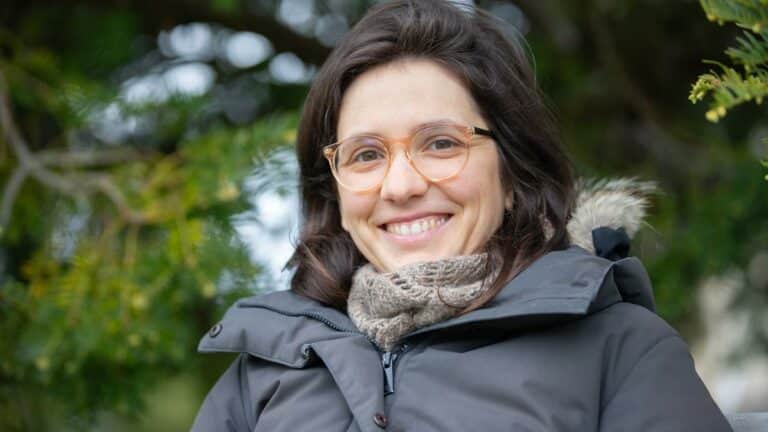
My name is Adriana, I’m 35 and I live between Paris and a small country village near the shrine. In my present job, I am working on several projects, most of them related to education. I am the second of four children. I grew up in Paris, where I began my studies in economics, before moving to London to do a master’s degree in finance. I then worked for several years in London, a city I loved very much, and which really felt like home. I found that life great, structured and stimulating. And yet, from one day to the next, something changed: I began to feel unwell. It wasn’t primarily physical, it was an inside feeling. I felt out of place. For several months, I would tell myself that I couldn’t find any meaning in my life, particularly in my professional career. I worked a lot and was very involved in my job. But at the end of the day, I felt that I hadn’t achieved what I had to, that something was missing.
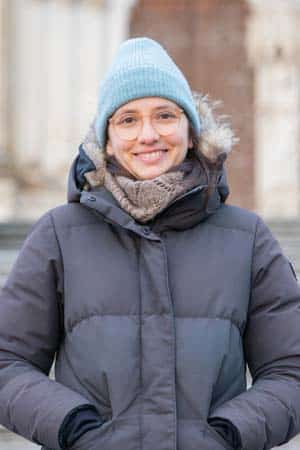
Notre-Dame de Montligeon Basilica, March 16, 2026
for the magazine Chemin d’éternité.
First symptoms in my body
Looking back I am now able to establish a connection, but at the time I had not done that. Physical symptoms gradually appeared: persisting fatigue, cough, dizzy spells, then loss of balance; sometimes I would faint or bump into things without understanding why. Gradually I would find breathing difficult, as if something was getting locked inside me.
I remember one particular moment when I choked on my food, and that’s when I really started to worry. I went to see several doctors in London, but they all told me I was fine. Even in the emergency room, when I couldn’t breathe, they told me it was just asthma; they prescribed ventoline, but it had no real effect.
A few days later, I decided to go back to France, in Paris, where I grew up, to seek advice with a family doctor. I knew something was wrong; it was very clear to me, almost physical, like a silent evidence. All these symptoms put together were somewhat inconsistent, something felt wrong. That French doctor was immediately alarmed by my condition.
I had a scan on a Friday, late in the morning; I remember that moment very clearly. The next day, Saturday morning, I already had an appointment at the hospital. It all happened very quickly: I had surgery, and then, just four or five days later, I started some very heavy chemotherapy. The diagnosis fell: a very aggressive lymphoma, already very advanced. In the space of a few days, my life changed pace, my framework, my reality; everything that had been stable became uncertain, everything that had been taken for granted wavered.
There is no room for the unexpected in a life where everything is already full
In London, I was experiencing some kind of emancipation. I had just started my adult life, an adventure in a country I still knew little about, but in which I was quickly thriving. Everything was going well, at university, in my relationships, my first jobs.
I was passionate about what I was doing, but I had no limits. I was utterly dedicated to my work, and did not really asked myself whether it was good for me, or whether it was right for me; I didn’t question the deeper meaning of what I was experiencing, beyond the intellectual stimulation and immediate commitment. I also had a rich social life, with friends I still have today and who meant a lot to me. But here again, I gave a lot of myself, not minding the cost. I was busy all the time, everything filled the space. Looking back, I realize that there was no free room left. I don’t know if there can be room for the unexpected in a life where everything is already full.
No room for God, but an intuition…
I grew up in a family where Catholicism was more a tradition than a deliberate practice. I was baptized as a child, made my first holy communion, then my confirmation at secondary school, a Catholic institution; yet all this remained rather external.
I did not practice my faith and God was not really part of my life. Even after my confirmation, I had not really understood what receiving the Holy Spirit meant; such comprehension would happen much later. So God was not present in my life through the sacraments or regular practice. Yet I did believe something greater existed. This intuition had always been with me.
A discreet presence since childhood
Today, when I look back on my story I can say that God had been there all the time. I remember a summer when I kept repeating “What a wonderful life”. At the time I did not know what the source of that joy was but I felt it profoundly. I recognize now that there was a joy in me which was beyond my control. I was aware of a presence although diffuse. It did not have a face, it was not a personal relationship. I had not made any connection to God as I discover Him now.
When nothing else works, you turn to heaven
In London, as I was growing more and more uncomfortable, I tried to do what I usually did to feel better: see my friends, go out, go on vacation, do more of the activities that normally made me feel good. But nothing worked. So, at some point, I turned to heaven. Not explicitly to God, but to my guardian angels, to my deceased grandfather. I told them: “I don’t know what to do anymore. I’ve used up all my cartridges.” I had tried everything, everything that usually helped me find some kind of joy or balance; but there was nothing coming back. It was the first time I really admitted that I couldn’t cope on my own.
“It’s probably cancer”
I clearly remember the moment when I had my scan. The radiologist was sweating. I could tell something was wrong. My grandmother was with me that day. As we often say at such moments, she told me that everything would be fine, she was trying to reassure me. But inside, I knew it wasn’t the case. I went home and started to weep uncontrollably. Then my doctor called me and said: “It’s probably cancer.” I immediately stopped crying: it was as if my body had been heard at last. I felt I was being taken care of and said to myself: “A new chapter in my life is opening, there’s no going back.”
“I can’t.
That’s too much.”
Very soon I was admitted in hospital. In just a few days I transitioned from a very busy life to medical care and got emergency surgery. The lymph nodes were compressing my respiratory tract and my rib cage and I had water around my heart. My condition was life-threatening. The doctors could not understand how I had been able to go to work just the day before. I didn’t understand it myself either. I was faced with the brutality of that contrast: yesterday I was on my feet, busy and independent. Today I am in hospital, my life relies on care and is at risk.
When they told me I had to be operated, I started to refuse. Things had been moving too fast. In just twenty-four hours, I went from a normal life to the news that I was seriously ill, had to go to hospital and undergo massive surgery. I was shattered both physically and emotionnally.
“I can’t, it’s too much for me”, I said.
I felt that if I accepted then I would not wake up. I could give a rational explanation for my intuition but it was there. I said, “No way”. The doctor replied he could not force me but I was not allowed to leave the hospital. They kept me in intensive care. The surgery was planned for the following Monday. It was a critical moment for me, the first time for me to decide freely and deliberately in the circumstances.
A decisive encounter at the hospital
The doctors would come one after the other into my room to examine me, I had more tests, everything was very technical, going very fast, nearly impersonal. Then, at once, a woman, a cardiologist came to see me. She asked the other doctors to leave and sat next to me. She came close, really, physically, as if to reduce the distance created by the others before. There was something simple and deeply human in her demeanor, in sheer contrast with the surrounding bustle. She asked me why I had refused the surgery and I explained with my own words, despite my tiredness, what I could say at that particular time. She listened to me and then asked a very simple question. “What about now? Would you be ready now?” Then I felt that something had moved within me. It was not a reasoned decision or the result of reflection, it was like an inner shift, discreet but real. “Yes”, I said. Then she explained the situation clearly and unequivocally to me: my life was at threat, there was a real emergency. I understood. I was not overwhelmed then, I was fully present to the situation.
My whole life went off track
From then on, the chain of events went very quickly. I had to be prepared for the surgery. My sister attended me, helping with surgical scrub. Although the number of care givers were reduced on a Saturday morning, many were mobilized around me. When I woke up I discovered a new reality. They had connected me to tubing and devices which prevented me from moving, I was bedridden, unable to even get up to go to the lavatory. I had lost my whole autonomy.
I thougt, “How can this be?”
The day before still, I was on my feet, working, living a normal life; and now I’m lying motionless, facing the ceiling. It was a shock, a total break with my previous life. I discovered a kind of solitude I’d never experienced in my adult life. The following morning visits were not allowed, I was alone with myself. At first, I refused to accept this reality. I told myself it was just an incident, that I would soon get well and go back to my previous life. I thougt, “I’ll sort this out and go back to London.”
That’s how I responded at first, determined to resume the normal course of life, refusing the possibility that my life might go off track because of my disease.
The likelihood of death within six months
However, I soon realized that things would not be that simple. Then a long journey in care was initiated, both uncertain and demanding. The doctors told me that I had to expect being under treatment for many months, with several extensive chemotherapy courses and, first and foremost, that there was no guarantee of a favorable outcome. They clearly said that I might or might not respond. In any case, the outcome would be clear within six months. Clearly, it meant that a fatal outcome was part of the possibilities.
At first, I did not take it seriously. I thought it wasn’t possible, this could not happen to me. I had always been a determined person and my experience of life was that whenever I wanted something I would usually get it. So I said to myself I would cope, I would hold on and control the situation. However, this certainty did not last long.
With the diagnosis, the operation, the beginning of the courses of chemotherapy, I did not have the time to think. Then as the treatments started, the pace was different. I was permanently tired. And I was in pain all the time. I started to become aware of the reality at that time. Death was no longer an abstract idea.
Chemotherapy: a school for the unexpected
With the start of chemotherapy, another kind of ordeal began. Beyond the care I was receiving, I also had to undergo major treatment courses, which were very challenging and invasive for the body, and took all my time on a daily basis. I developed all the side effects too – fatigue, pain, nausea – an almost constant kind of nausea, like a hangover lasting several days, making it difficult to think, concentrate, or simply paying attention to what was going on.
At some point, I said to myself: “At that stage, I m not going to make it.” I knew it was going to take months, and I couldn’t see how I’d be able to carry on like this. The pace was unpredictable. Some chemotherapy was done on an outpatient basis, but the effect was so strong that I had to go back to hospital regularly, not knowing when I’d be discharged. Everything became uncertain, unstable, depending on how I felt at the time. I could’t control anything. It was really a school to learn to deal with the unexpected.
Right from the start, I felt I was being carried along by something. I could not explain it otherwise. I felt it was my path. I said to myself that now I was there I had to go forward. And most of all, I said to myself that the Good Lord was good – that’s how i would call Him, the Good Lord. Jesus was not yet in the picture, I did not have a structured faith yet. Yet I firmly believed that: He is good. And it kept me going.
God manifests himself through others
I was also discovering something very tangible: God uses others to manifest himself. Gestures, attentions and words, sometimes very basic, became extraodinarily important. Nurses, carers, relatives, sometimes even people I didn’t know, would make a gesture, say a word, who would just be there. I was finding that even when everything seemed to go apart, there would always be someone who came at one moment or another to help, give and bring support. This became obvious, I was not alone. This had a deep impact on me.
Vulnerability as a place of radical change
I used to be someone who supported others. I was strong, independent, always on my feet. In the new situation, everything was reversed. I’ became dependent. I couldn’t even go to the bathroom on my own. I had to be washed, helped and supported in the most private gestures. It was a most powerful experience. I discovered how radically vulnerable I was. But I also discovered that I could let others reach out to me, touch me, help me. And that changed everything.
A new relationsip to time and life
During that period, my experience of time became different. I did not sleep at night and I was in pain during the day. The pace was no longer structured, it was a kind of survival. Yet, in the midst of it all, something was changing. Small things took on considerable value. I would gaze at a flower and find it magnificent. I would see life where I did not see it before. I said to myself: “Perhaps I will never see the sea or the mountains again.” As a result I became aware of the beauty of everything.
The leveraging power of desire
Something very concrete occurred to me: desire keeps me alive. Whilst I have lost control over my schedule, my body and my treatments, I can still desire.
Every day, I ask myself one question: “What do I fancy today?”
It may seem simple, but it became a profound journey. I relearnt to smell, to taste, to choose. Food became an important part of the process. I can’t stand hospital meals. They’re lifeless. So I’d ask people who come to see me to bring me food. I’d replace the hospital trays with what they’d bring me. It was a way of getting back in touch with life.
An encounter with God: “I have nothing to lose.”
Very quickly, in this ordeal, I met God within myself. Initially, it was not a matter of words or intellectual construction, it was an experience. I felt He was present. I felt he was good. I felt He was with me. I could be angry. I could rebel. But what happened was different. Instead, a peace settled in right at the heart of the suffering. At some point, the suffering became too overwhelming. The treatment courses were extremely heavy. I said to myself: “The cure is not worth this suffering.” I started thinking about stopping treatment. I knew that it meant dying – I was very well aware of this. I was taking time to think. I could not decide this lightly. And that’s when I found myself face to face with God.
I told him, “I’ve got nothing to loose.”
I’m ready to go. I’m not saying I want to die immediately. I know it will take time, that it will be difficult. But I’m preparing myself inside for the possibility.
I’m letting go of everything.
My life.
My death.
My plans, everything.
And that’s just when something happened. From the moment I let go, I felt I was no longer carrying the burden alone. Someone was carrying it with me. I felt peace ––I felt joy –– and this was at the very heart of suffering. I discovered that this joy existed even in the hardest situations.
After illness: a long desert and inner reconstruction
Soon enough, I started to respond to my treatments. I had a follow-up scan, basically because I had a fever, which showed that the lymph nodes had shrunk by more than 50%. The doctors said my outcome was “spectacular”. I did not take too much notice though, knowing that just because you win a battle doesn’t mean you win the war. I received this news with a positive attitude but I did not let it reassure me completely. Especially as the treatment continues, getting even more difficult. I got worse and worse. One chemotherapy course after another. I’m undergoing very heavy protocols, with several products over very long periods. When I’d leave a course, I’d be unable to walk. I saw it as a form of overuse of intensive medication, even though I knew it was necessary.
A new way of life
My last chemotherapy took place just before Christmas. That period took on a completely different tone. In fact, the change had started well before then, right from the start of my illness. The simplest things had become immensely precious. I remember some little flowers that grew in the hospital yard between concrete cracks, which I found amazingly beautiful. I would wonder about things I did not even look at before. Realizing that I might not see the sea or the mountains anymore shocked me deeply. So I promised myself that one day I would live in the countryside, on the coast or in the mountains. That’s something I have achieved today!
In the beginning, I thought I’d come back to my old life. My plan was to have some rest, after which I would start again. One month went, then two, then three. I then understood it would not be possible.
I said to myself, “I need five years”.
I realized that something much deeper was taking place.
“What do I want?”
During my illness, I discovered that what kept me alive was desire. I lived through my senses. Smelling a scent, seeing something beautiful, tasting a food, enjoying a presence. It was the way for everything. I realized it was a way of relearning how to live. I have relearnt to desire. I am still on this path today. I often ask myself: “What do I want? It has become natural.
After the treatments I was very tired, I felt lost. Although I was still an employee, I had no clear idea of where I was going to. I did not go back to work immediately. I stayed in Paris. I had a lot of questions on my mind. My mind and my body were both still very fragile. I would describe my condition with a strong image: I felt like Alep after the bombing – everything had been destroyed. I was wandering in the ruins of a devastated inner landscape.
Gradually, a desire emerged: to go and live in nature. I did not know exactly how it was going to happen, but the path was opening up. I was moving forward. Bit by bit, I left my familiar world. I distanced myself from my family, from my friends, from everything that made up my previous life.
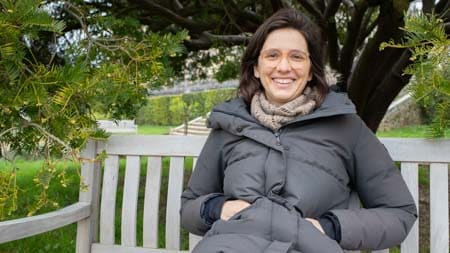
The desert: four to five years of transformation
This period lasted several years – between four to five. I crossed a kind of desert, withdrawn from the world. I went through a very deep inner journey, accomplishing a complete overhaul. My inner foundations shifted. I met new people. I discovered a relationship with God. After I had met Him in my illness, He began to become more familiar to me. I did live alone but my solitude was not an empty, it was inhabited. People often ask me how I did it. The thing is, I had joy in my heart, true joy. I felt fulfilled. The experience was beyond me. I’m talking about grace here.
Grace vanishes: a turning point
Then, at some point, something got different. The joy disappeared. I felt depressed again. I felt I no longer belong to my new place. I realized that this period was coming to an end.
On this path, one encounter was essential. A priest. He would give me support. He became a father figure to me, a spiritual father. He would make me feel welcome, he’d listen to me, help me on my way. Through him, I experienced a very real love. I could see that God also passed through this relationship.
Back to reality
After those years in the desert, I gradually came back into the world. But I was not the same person. Inside, everything had changed. But on the outside, I had to relearn everything, in terms of relationships, habits, or behaviors. I had got my life back but I had to adjust a lot of things. It was not easy. I realized that this period had been an interlude, a very special experience, something extraordinary. But now I had to get back to reality.
A religious calling?
At a certain point, I wondered if I had a religious calling. I attended a discernment retreat. But very quickly I was told that this was not my path. It came as as a surprise. Now, looking back, I realize that my place is in the world. Today, I am achieving a balance. I’m in the world. But I also need to withdraw regularly. I return to my “hermitage”. This place has become my refuge. My place of rebirth. I understand that even Jesus went through this: after being in the world he would then withdraw. It reassures me deeply.
The benefits of this trial: don’t understand – trust
Still today, I can say that I don’t always understand what God is doing in my life. I’ve often said to Him, “I don’t get your plan.” At the same time, I realize that maybe you don’t have to understand everything. Looking back, I see that my life is like a jigsaw puzzle. Pieces arrive without me knowing why. Sometimes there are missing ones. Sometimes, something comes along and fills the gaps. I understand that there is some sort of providence. This requires trust. It also requires letting go.
Letting go, a fundamental experience
Illness has taught me that I could come across very unexpected things… and find joy in them. That’s not to say it’s easy. But I’ve discovered that when I let go, something happens. When I let go of my life, my death, my plans, I felt that I was no longer carrying it alone. Someone was carrying the burden with me. Since then, I’ve seen it happen again. Once you’ve let go of everything once, it’s easier to do it again.
Availability and silence
To experience this, you have to be available. Such availability involves silence. Silence doesn’t come by itself. You have to choose it. You have to schedule it. Otherwise, you fill everything with screens, plans and noise. Today, I need silence. Even when I get back to my home in Paris, I can’t watch a movie or listen to anything. I need to settle down.
Prayer as a foundation
Prayer has become a foundation of my life. It takes different forms. It doesn’t necessarily mean praying all day long, but it does mean living connected to God. Starting the day with a time of silent prayer changes everything. It opens the heart. It makes you open to what’s going to happen during the day – a word, an encounter, an event. Prayer nourishes. It also reassures. Because letting go of your life is a gamble. And for that gamble to hold, you have to stay close to God.
The moment of radical choice
I often think back of that moment when I considered stopping treatment. The suffering was too great. I had told myself that the cure wasn’t worth the cost. I had really considered dying. I was getting prepared mentally for this. I knew it wouldn’t be immediate. I knew it would be a difficult journey. But I accepted the possibility. And that’s when everything changed.
Grief, a key to understanding life
Today, I see life as a sequence of bereavements. We have views about what our lives should be. But very often, things do not turn out as planned. Grieving means accepting this. It’s the end of one human plan, and the beginning of something else. I see it as the opening of a new life. Over time, you get used to it. You learn to be trustful.
Renouncing omnipotence
I gave up the idea of controlling everything. But paradoxically, I received something else. God came to fulfill my desires, but in a different way – a broader, deeper way. A real joy stemmed out of this, making renouncing easier.
A message for seekers
If I had to say something to young people today, I’d say this: Ambition and performance are not bad. But not at any cost. What counts is your inner integrity. Because in the end, you’re alone with God. And there, others are not watching you anymore, no external pressure is exerted. What’s left is what we’ve done with our lives.
Love: a concrete reality
Today, love takes many forms in my life. There’s God’s love, which I feel is huge. But I am also discovering it above all through others, the love of those around me. The love of my neighbor. The love of my work, when it makes sense. The love of creation. Nature is a key element in my life.
Discernment doesn’t happen instantly. It comes through prayer, time and events. Sometimes we understand afterwards. Sometimes an opportunity arises… and it wasn’t the right one. You have to accept that.
The fruits of the ordeal
Today, I see several fruits of this ordeal. Firstly, greater empathy. Having suffered and experienced loneliness has brought me closer to others. Secondly, freedom. I do more of what’s right for me. I no longer try to fit into a mold. Finally, faith. My faith has been strengthened by my ordeal.
Psalm 22
Psalm 22 is a special companion for me.
I say it often, especially in difficult times:
The Lord is my shepherd, I lack nothing.
He makes me lie down in green pastures, he leads me beside quiet waters,
he refreshes my soul. He guides me along the right paths for his name’s sake.
Even though I walk through the valley of death,
I will fear no evil, for you are with me;
your rod and your staff, they comfort me.
in the presence of my enemies.
You anoint my head with oil; my cup overflows.
Surely your goodness and love will follow me
all the days of my life, and I will dwell in the house of the Lord forever.
Every quarter, major interviews, life stories, reports and teachings to discover and nourish faith and hope.
Subscribe to Chemin d’éternité magazine