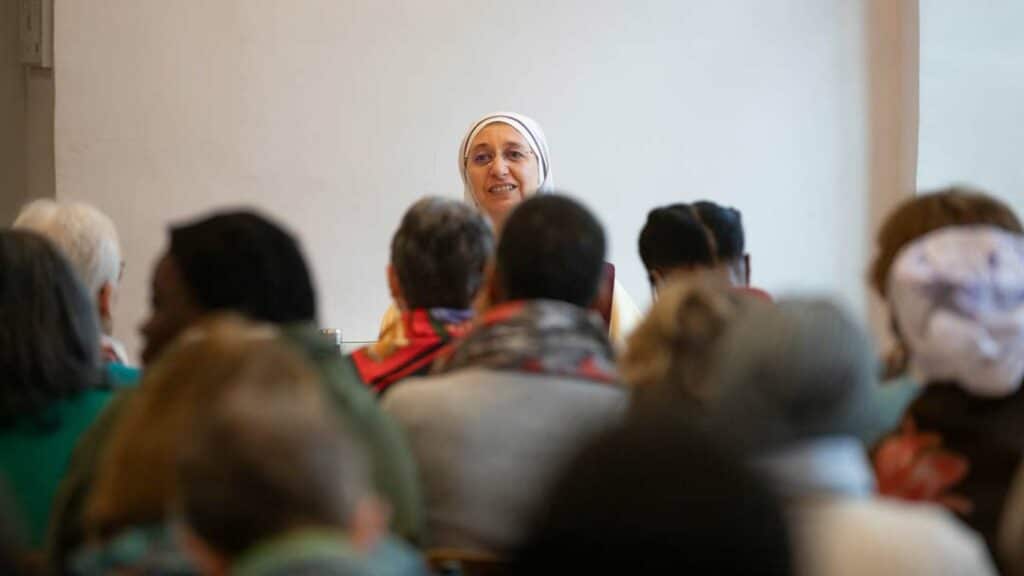
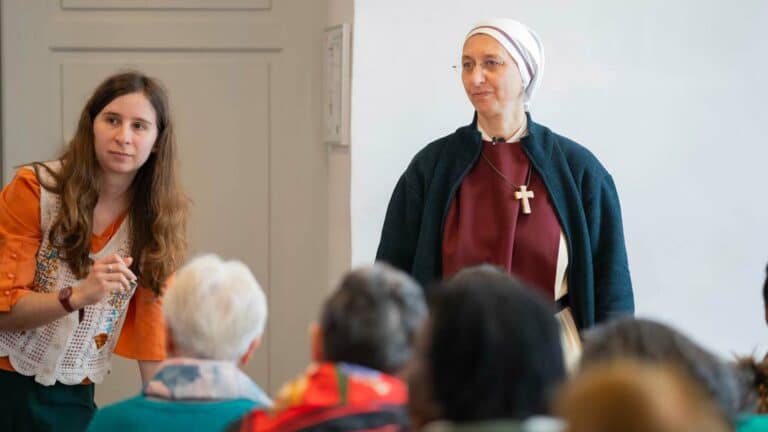
Conference to mark the start of Holy Week, given by Sister Cécile, prioress of the Nouvelle Alliance community, on Saturday March 28, 2026 at the Église Notre-Dame-des-Blancs-Manteaux as part of the Montligeon Day in Paris.
« Tomorrow, we will step into the great Holy Week that will lead us to the highlight event of the liturgical year: the celebration of the Paschal Mystery, the death and resurrection of Christ.
The liturgy is repeated year after year – not just to remember something from the past like a drama play that we’d like to re-enact or watch every year – but as an ever-present event that impacts our today and our eternity. Liturgy is the “today” of the history of salvation.
He loved me and gave himself up for me, writes Paul in his letter to the Galatians (Gal 2:20).
Paul, turned around by his blistering encounter with Christ on the road to Damascus, perfectly understood that Jesus had given his life for him personally, and that his salvation was the fruit of Christ’s love for him. It should be noted that Paul’s writings predate the Gospels. It is therefore a very early text, written some twenty years after Jesus’ death. The Synoptic Gospels had not yet been written when Paul wrote, but the Passion narratives were already circulating in the early Christian community and were constantly inserted into the references. Christ’s death and resurrection are central to Paul’s message, and it is clear to him that Christ gave his life out of love for him, Paul, and for every man.
For example, in 1 Co 1, 17 : Jews demand signs and Greeks search for wisdom, but we preach Christ crucified, a stumbling block to Jews and foolishness to Gentiles, but to those who are called, both Jews and Greeks, the Messiah, Christ, is the power of God and the wisdom of God.
In Ro 5, 8 : But God demonstrates his own love for us in this: While we were still sinners, Christ died for us.
In Eph 5, 1-2 : Be imitators of God, therefore, as beloved children,and walk in love, just as Christ loved us and gave Himself up for us as a fragrant sacrificial offering to God.
Anyone can say what Paul says, Christ has loved me and gave himself up for me. Hence, he claims that Christ’s death is a work of love of which he knows himself to be the personal beneficiary.
1 – The Hour of His Passion, the hour of the greatest love
Jesus’ whole life points and aims to the hour of his Passion, the hour of the greatest love. In the Gospels, particularly in Saint John’s, “the hour” is a central, key notion. It refers to the culmination of Jesus’ mission: his Passion, his Death and his Resurrection.
At the beginning of his ministry, at the wedding feast in Cana, Jesus makes it clear that the moment of his glorious manifestation has not yet arrived.
As we read in John 2:4, The wedding feast at Cana:”Woman, what do you want of me? My hour has not yet come.” In a way, Mary anticipates this Hour by obtaining Jesus’ first miracle, which already foreshadows the Cross. The good wine of Cana, saved for the end of the meal, heralds the blood of the new and eternal Covenant that he will pour out on the Cross. The hour of his death will be the hour of the New Covenant sealed in his blood. The Church Fathers and the entire Church tradition see Jesus as the bridegroom of humanity: Cana prefigures the Eucharist, which makes present the sacrifice of the Cross. The wine of Cana heralds the wine of the New Covenant: the blood of Christ poured out for the many.
A wedding feast mystery, a mystery of love already announced in the wedding at Cana, even if Jesus’ hour has not yet come.
Then comes a new stage in John’s Gospel, when his hour approaches. Just after his triumphal entry into Jerusalem (Palm Sunday), some Greeks (i.e. non-Jews) want to see Jesus. This is the trigger signalling the coming of his Hour (Re. Jn 12:23 ff.). There were some Greeks among those who had gone up to Jerusalem to worship God during the Passover holiday.They came to Philip, who was from Bethsaida in Galilee, and asked him, ‘”We would like to see Jesus.” Philip tells Andrew, and they both tell Jesus.Then Jesus said to them: “The hour has come for the Son of Man to be glorified.Amen, amen, I say to you: unless a grain of wheat falls to the ground and dies, it remains alone; but if it dies, it bears much fruit.He who loves his life loses it; he who detaches himself from it in this world will keep it for eternal life. If anyone wants to serve me, let him follow me; and where I am, there my servant will be also. If anyone serves me, my Father will honor him. Now my soul is troubled, and what shall I say? ‘Father, save me from this hour’? No, it was for this very reason I came to this hour. Father, glorify your name!’ Then a voice came from heaven, saying, ‘I have glorified him, and I will glorify him again.“
The grain of wheat (John 12, 23-24): “The hour has come for the Son of Man to be glorified. Truly, truly, I say to you, unless a grain of wheat falls into the ground and dies, it remains alone; but if it dies, it bears much fruit.”
The troubled soul (John 12:27):
“Now my soul is troubled. And what shall I say, ‘Father, save me from this hour’? But this is why I have come to this hour. Father, glorify your name!” Then a voice came from heaven, saying, “I have glorified it, and I will glorify it again.”
Four days later, on the Thursday evening, the hour has come. At the time of the last supper, the hour is now there. At that particular moment, in the intimacy of that meal with the Twelve Apostles, he offers his entire life as consecrated bread and wine and John gives an eloquent account of the depth of the love in Jesus’ heart, despite the highly strung, dramatic atmosphere of that last meal.
The washing of feet (John 13:1):
Before the feast of the Passover, Jesus, knowing that his hour had come to pass from this world to his Father […], loved them to the end.
Chapters 15 and 16 of Saint John’s Gospel: a strong intimacy.
Jn 15:12: “My commandment is this: love one another as I have loved you. Greater love has no man than this as to lay down one’s life for those one loves. You are my friends if you do what I command you. I no longer call you servants, for the servant does not know what his master’s business is; I call you my friends, for all that I have heard from my Father I have made known to you.”
Then comes the Priestly Prayer (John 17:1), which is the spiritual climax, when Jesus addresses God directly:
“Father, the hour has come. Glorify your Son so that the Son may glorify you”. This long prayer makes Christ’s love for those whom the Father has given him very obvious.
Jn 17:13: “But now I am coming to You; and I am saying these things while I am in the world, so that they may have My joy fulfilled within them.”
Jn 17, 23 : “May they be perfectly united, so that the world may know that You sent Me and have loved them just as You have loved Me.”
In one of his letters, Saint John states: This is how we know what love is: he, Jesus, gave his life for us. We too must lay down our lives for our brothers and sisters.
And Saint Luke reports those words from Jesus: “I have eagerly desired to eat this Passover with you before My suffering.” (Luke 22).
So it is indeed love that dwells in Jesus’ heart as he enters his Passion.
2 – Jesus’ Passion: a free and voluntary act of love
The “hour” of his Passion, of his death, for Jesus, is not an imposed fate, but a free and deliberate act. Jesus doesn’t let himself be caught by accident. In the Olive Garden, when the soldiers come to arrest him, he steps forward by himself, saying: “I am the one’ (egô eimi in Greek, a reminiscence of the divine name). His freedom to lay his life for us is proof of his love, he does not escape. He chooses to give himself.
At the hour of Passion, Jesus does not lose control. On the contrary, he says: “No one takes my life from Me, but I lay it down of My own accord.” (John 10:18). The glory of Jesus is his sovereign freedom to love even those who reject him.
3 – The Passion, an extreme act of love
St. John introduces the Passion narrative with this monumental sentence: Having loved his own who were in the world, he loved them to the very end (Jn 13, 1)
He has loved me right to the extreme limit, his own extreme limit. He has loved me in his own way – graciously, freely, in a manner that I am unable to love – with a simplicity, a selflessness of his own, his humble, non gratifying service. He has loved his own to the extreme limit. They are all his, each as a unique person, a multitude of unique ones. He has loved men so much that he gave them his Only Son – and the Verb made himself BROTHER. Amen.
Father Christian de Chergé (1937-1996) – monk at Tibhirine Monastry
The washing of feet: Prior to shedding his blood, Jesus washes the feet of his disciples (a task performed by the lowest servant). It is the prophetic sign of the Passion: he lowers himself to lift man up.
Forgiveness for the executioners: in Luke’s Gospel, on the cross, he says: “Father, forgive them, for they know not what they are doing.” (Luke 23:34). Here love is shown by a total lack of resentment, even towards those who are torturing him.
Jesus shows a total solidarity with the human condition, including with its gloomliest aspects:
Christ Hymn in Philippians 2:
Christ Jesus, who, existing in the form of God, did not consider equality with God something to be grasped, but emptied Himself, taking the form of a servant, being made in human likeness.
And being found in appearance as a man, He humbled Himself and became obedient to death—
even death on a cross.
He accepts injustice, abandonment and pain. He is the Suffering Servant foretold by Isaiah: “However, it was our sicknesses that he himself bore and our pains that he carried. Yet we ourselves assumed that He had been afflicted, struck down by God, and humiliated.
But He was pierced for our offenses, He was crushed for our wrongdoings; The punishment for our well-being was laid upon Him, And by His wounds we are healed. All of us, like sheep, have gone astray, Each of us has turned to his own way; But the Lord has caused the wrongdoing of us all To fall on Him.
He is the Lamb bearing our sins. In Leviticus, lambs used to be offered as sacrifices to atone for the sins of the people. John the Baptist is the first to apply this title to Jesus in John’s Gospel: “Behold the Lamb of God, who takes away the sin of the world” (Jn 1:29).
His thirst: On the cross, Jesus says, “I am thirsty.” (John 19:28). His thirst is a physical one but also mystical. Beyond the physical dehydration, theologians see a thirst to be loved in return by humanity. He shows his love in his burning desire for reconciliation. A physical thirst, as a sign of humanity.
In the literal sense, it’s an expression of extreme suffering. Jesus is dying of asphyxiation and dehydration. By saying this, he makes it plain that he is fully human, sharing humanity’s carnal distress to the very end.
A spiritual thirst, meaning: “I thirst for you.” Most commentators see in this thirst the cry of a God who desires man. He is not only asking for water but a response to his love.
The desire to save: As you pointed out, this is the thirst for the fulfillment of his mission. He thirsts for his sacrifice to bear fruit, and for humanity to be reconciled with God.
The thirst of souls: It is often said that Jesus is “thirsty for our thirst”. He begs for the love of his creatures.
Mother Teresa’s legacy
One contemporary figure in particular who has embodied this vision is Mother Teresa. In every chapel of her communities (the Missionaries of Charity), the words “I Thirst” are written next to the crucifix.
” ‘I thirst’ is much more profound than Jesus telling you “I love you”. As long as you don’t know, in a very intimate way, that Jesus thirsts for you, you cannot know who he wants to be for you.”
– Mother Teresa
The climax: when Jesus, before dying, says “All is accomplished” (in Greek, tetelestai), it expresses the triumphant assertion of a mission accomplished, not a relief at reaching the end of his suffering. He has just accomplished his mission: that of erasing the debt of humanity’s sin, of reconciling sinful humanity with God.
At the time, tetelestai was a term used by accountants or in the legal field to mean “paid off”.
Jesus showed the Father’s love, he forgave, he taught, and he sealed this covenant with the gift of his own life. Far from being a cry of exhaustion or defeat, it is a cry of victory and the supreme manifestation of his love. It is love fulfilled in its perfection.
4 – A love that doesn’t end with his physical death
He leaves us a legacy:
- the giving of his mother,
- the giving of the Holy Spirit.
Just after Jesus said “All is accomplished,” John writes: Bowing his head, he gave up his spirit (or ‘delivered the Spirit’).
More than just Jesus’ soul departing, the first gift of the Holy Spirit to humanity takes place then. Christ’s love does not end with his physical death: he “breathes out” his breath of life into the world, so that we can love as he did. Death becomes a source of life and the sign of a gift.
The sign of blood and water
Shortly after his death, a soldier pierced his side with a spear, and out came “blood and water” (John 19:34), symbolizing the Church’s sacraments (Eucharist and Baptism).
Christ’s heart, is literally “open” for ever. It is the image of a well which will never run dry, making clear that God’s love from then onwards is available to all, with no obstacle. The Open Heart is the manifestation of His greatest love.
5 – The Passion reviewed with the saints in the light of the love of the Sacred Heart of Jesus
All this is to shows us that the Passion can be truly understood only from the heart of Jesus. Without walking through the door of his open heart, the Passion would be nothing more than cold justice suffered by Christ to appease his Father’s anger. That’s a very dolorous vision of the Cross, as the Jansenists regarded it.
Jesus’ message to Saint Margaret Mary
It is indeed Christ crucified who shows himself to Marguerite-Marie, telling her: “My divine Heart is so passionate with love for men, and for you in particular, that, as it is no longer able to contain within itself the flames of his ardent charity, it must spread them by means of you, and manifest himself to them to enrich them with his precious treasures that I am discovering for you.” Autobiography, § 53: He revealed to me the wonders of his love, and the inexplicable secrets of his Sacred Heart.
Margaret-Mary describes the second great apparition as follows:
At that time he revealed to me the inexplicable wonders of his pure love and the excess to which it had led him to love men. (Autobiography, § 55).
“Behold this Heart which has so loved men that It spared nothing, even going so far as to exhaust and consume Itself, to prove to them Its love; and in return, I receive from the greater part only ingratitude, by their coldness and their contempt.”
Jesus asks for a reciprocity of love from our hearts: “I thirst!”
In the second great apparition, he even goes so far as expressing the pain of not receiving the love of men in reciprocation: “What ingratitude and indifference, coldness and rejection for all my eagerness to do them good… This is much more sensitive to me than all that I suffered in my Passion.”” Autobiography, §§ 55-56. In other words, he suffers even more today from my ingratitude than from all the sufferings of his Passion put together.
Theresa of the Child Jesus – The poem “Remember”
Remember, Jesus, Word of Life,
That you loved me enough to die for me.
I also want to love you madly,
I also want to live and die for you.
You know, O God, everything I desire
Is to get people to love you and to be a martyr one day.
I want to die of love,
Lord, of my desire,
Remember….
St. Charles de Foucauld, commenting a passage in St. John 19 about the moment of Jesus’ death and the spear blow:
You love us so, O Heart of Jesus! It was not enough for you to contain all men, all those ungrateful men, during your whole Life; you wanted to be open to them and to be wounded for them after your death. Your Heart is open to all, even the most unworthy; it was pierced for all! You love all the living, you call them all to you, you offer them all salvation until their last hour, their last moment. You came to bring Love to earth; you came to put the flames of your Heart in our midst. How good you are! Let us have great devotion to this sacred Heart of Jesus, through which God has kindled fire on earth! O my God, make this fire burn in my heart and in the hearts of all men! So be it.
As to St. Gemma, the Cross is the “location” of Love. She says: “It was on the Cross, O Jesus, that I learned to love you” (W 21).
“Jesus, love made you die; make me die of love too” (E 1). “Jesus, you ask me for love. Who made you die? Love did. Jesus, these nails, this cross, are the work of love. O Jesus, if only one day we could say that I was consumed by your love? You know, Jesus, how I would like to be? A victim of love for you” (E 52).
In her autobiography, the woman saint expresses the same thing, but the words are those uttered by Jesus: “Look, my child, and learn how to love. And he showed me his five open wounds. Do you see this cross, these thorns, this blood? These are all the works of love, and of infinite love. Do you see how much I’ve loved you? Do you really want to love me? First learn to suffer. Suffering teaches you to love.”
In the Christian mystical tradition, the Cross is regarded not just as an instrument of torture, but as the nuptial bed where Christ (the Bridegroom) unites definitively with Humanity or the soul (the Bride) through the total gift of self. Just like a wedding feast.
St. Catherine of Siena: The Cross was the place where the divine Spouse celebrated his marriage with the human soul, paying the dowry with His own blood.
St. Cyril of Alexandria:
The heavenly Bridegroom climbed on the Cross to draw his Bride to himself as she was captive. By the nails of his Passion, he fixed the divorce decree that separated us from God and, by his blood, he wrote the new contract of an eternal marriage.
Conclusion
Jesus knew and loved each and every one of us during his life, agony and Passion, and gave himself up for each and every one of us: The Son of God loved me and gave himself up for me” (Gal 2:20). He loved us all with a human heart. For this reason, the Sacred Heart of Jesus, pierced by our sins and for our salvation (re. Jn 19:34), “is considered the eminent sign and symbol… of that love which the divine Redeemer bears unceasingly to the eternal Father and to all men without exception. (Pius XII, enc. Haurietis aquas: DS 3924; re. DS 3812). »