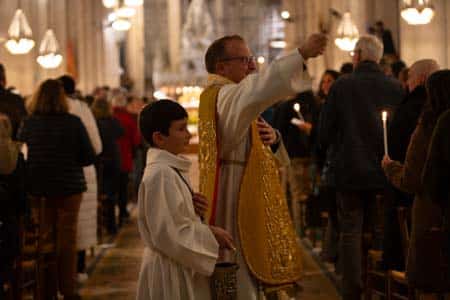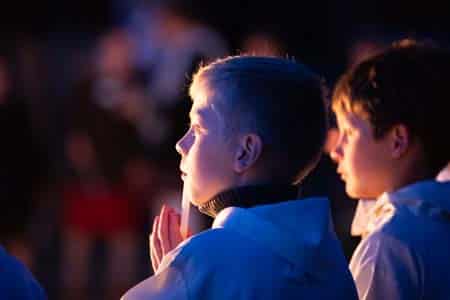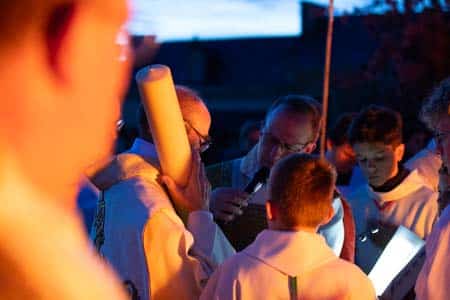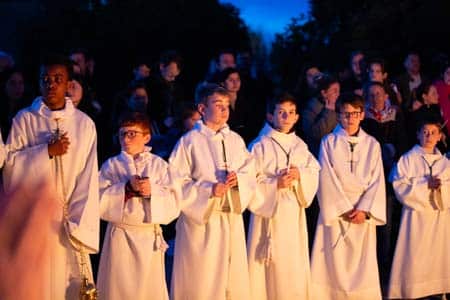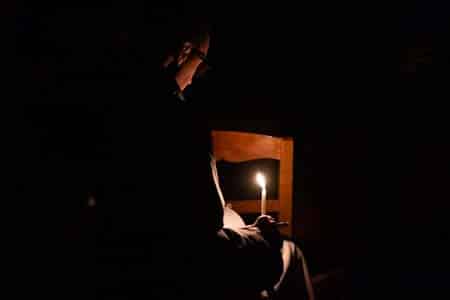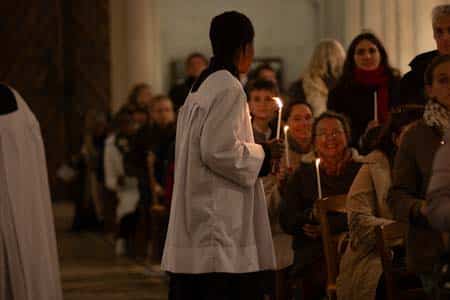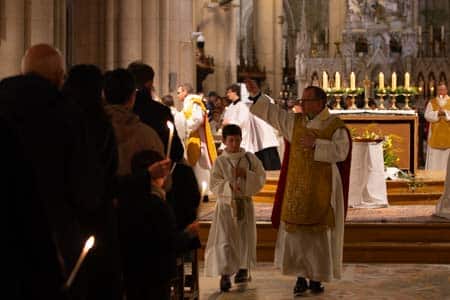
Homily for the Easter Vigil given by don Paul Denizot, rector, on Saturday April 4, 2026 at Notre-Dame de Montligeon.
Brothers and sisters,
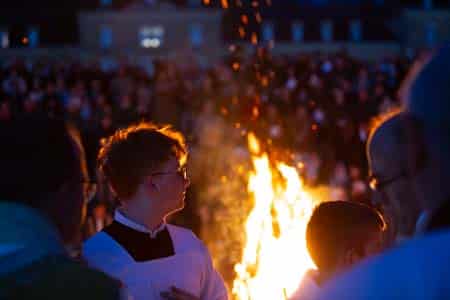
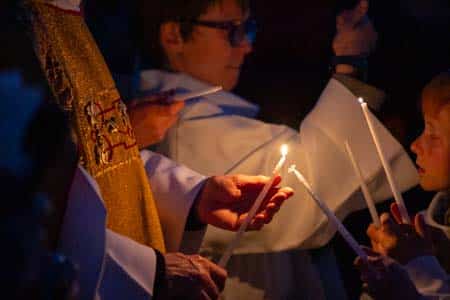
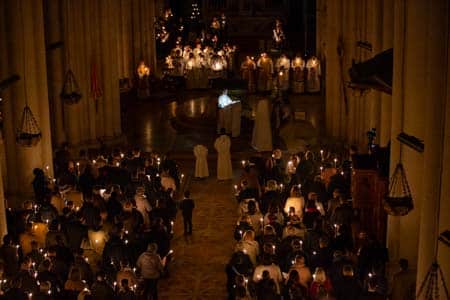
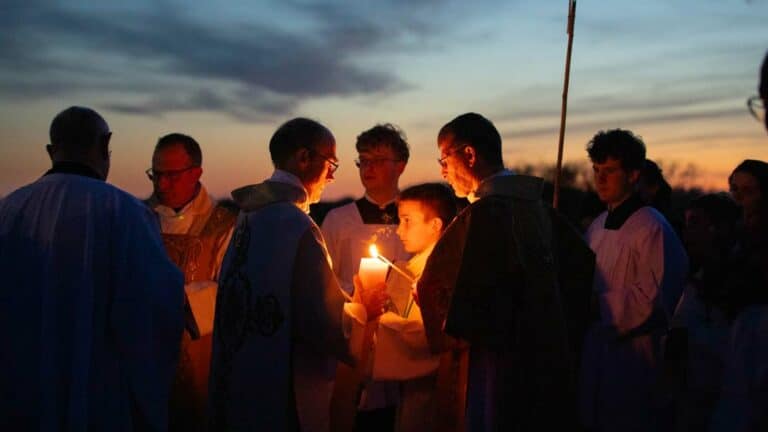
The liturgy of this Easter night is incomparably rich. It takes us step by step from darkness to light. We have seen the new fire, the light of the Paschal candle pierce through the darkness. Through the readings, we have been immersed in the memory of the history of the world, which fundamentally is a history of salvation.
We are going to renew the promises of our baptism and be sprinkled with the water that purifies and gives life, the water that has given us new life.
All these signs converge towards a single mystery: Christ’s victory over death through his resurrection. Jesus is alive today.
The readings we have heard make it clear: the resurrection is not an isolated event, nor is it just something from the past. It is at the center of the whole history of the world, from creation to its end. It is the key to the enigma of the world, giving ultimate meaning to the history of the universe and to each of our lives.
God comes to meet man. He created him to live and grow (Genesis). And he has never ceased to reach out to our wounded humanity: through the promises made to Abraham, through the great works of liberation, such as the crossing of the Red Sea, through the words of the prophets, who have never ceased to call for conversion and announce consolation.
What we celebrate tonight, the Paschal Mystery of Christ, is the fulfillment of all this work of salvation. God renews his creation. A work even greater than creation itself, as we were reminded in the first prayer of this vigil.
And yet, this immense event took place in secret (no witnesses) and manifested itself in great simplicity.
The Gospel shows us the women at the tomb. They were there at the moment of burial. They saw the stone being rolled away. Everything seemed finished. It was all over. Hopes dashed, evil, suffering and death had the last word.
And yet, they accompanied the one they loved to the end. Out of love. Despite the sadness, despite the fear, despite the risks of the encounter with the guards, they made a simple, faithful gesture. They are not resigned.
As Pope Francis reminded us: “How many people have done and are doing as these women have done, sowing seeds of hope in the darkness through small gestures of attention, affection and prayer.” In the midst of the world’s violence, indifference and injustice.
Without knowing it, these women, through these simple gestures, are preparing the unexpected.
The stone is rolled away. What seemed closed is no longer closed. And an announcement is made: Jesus is alive, and it is in Galilee that his disciples will see him.
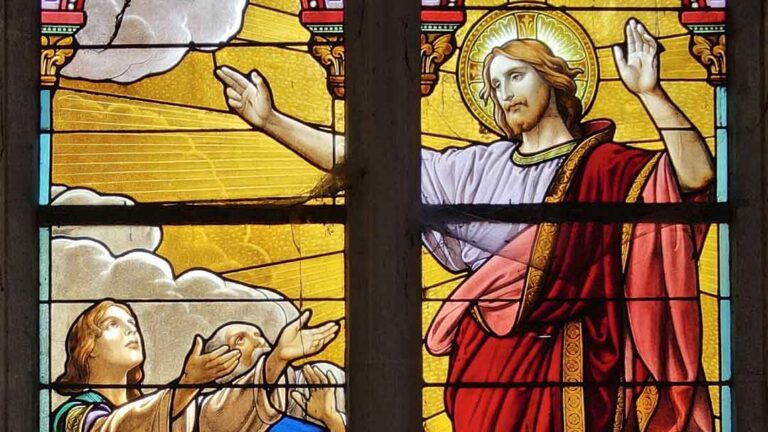
This testimony to the resurrection could have ended there, but Jesus comes to meet them. We’ve heard it before: they bow down and grasp his feet. This gesture reminds us that the resurrection is not an idea. It is not a spiritual symbol or an invention. It is a concrete reality. Christ is alive. He lets himself be met, approached, touched.
And he invites us to Galilee.
Galilee is an open space, turned towards the nations, towards the world. Jesus goes before us in our ordinary lives. He awaits us where we live, where we work… and not in the temple of Jerusalem.
Galilee is also the place of beginnings. The place of the first encounter with Jesus, and we are invited, as we renew our baptismal promises, to remember the encounters we had with him in our lives. When was the last time I met the living Jesus?
The resurrection is not just a memory. No, it opens up a living relationship, a relationship of friendship with Christ today.
This is the meaning and purpose of this Easter liturgy: not only to remember a past event, not only to remember our membership of the Church or our identity as Christians, but first and foremost to allow ourselves to be joined by the living Christ and to experience his presence now.
However, as we know, we live in a world marked by evil. A world where darkness remains: violence, war, lies, injustice, fear. I’m thinking in particular of our brothers and sisters who live in countries at war, in Iran, Lebanon and the Middle East, or of Christians who suffer open or more or less covert persecution.
How can we live out this proclamation of the Resurrection when we are in a time of “already and not yet”?
Already, Christ is risen. Already, he has conquered death and evil.
But not yet: not yet because the new and the old coexist for the time being. The old is on its way out and the new world has already been born; we await its definitive fulfillment… we are in the end times.
Because Easter has opened a breach.
A breach in this old world. A breach in our confinement. A breach in everything that seemed blocked, closed, with no way out. Death and evil do not have the last word. This is our hope.
Brothers and sisters, on this night we are invited to rekindle our faith in the risen and living Jesus. To live a living relationship with him, who comes to meet each one of us, whatever our history, our sin, our misery.
Tonight, like the holy women, let us leave with the certainty that is the joy of Easter: nothing is closed for God. Nothing is lost. The Lord has conquered death.
Amen.