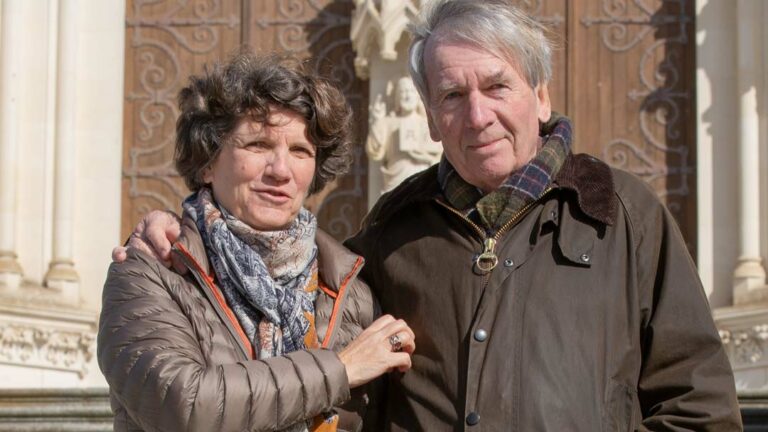
After a serious accident, Tony was in a coma for two weeks. A friend from his prayer group recommended him to the Fraternité Notre-Dame de Montligeon and offered a certificate to his wife Karine. Today, Tony is now up and about, but the ordeal is not over. They came to the shrine as a couple during Holy Week and shared their conviction: “Prayer is vital”.
The accident
Everything started on a Sunday morning, on November 17, 2024, just before Mass, a week before Christ the King’s Day. Tony wanted to reattach a ladder to climb up to the attic, while the family was getting ready. The fall was violent. He fell just as they are about to leave. Karine took immediate action with their daughters. Given the emergency, she called the fire brigade. While waiting for them to arrive, she blessed Tony with the oil of St. Charbel and wrapped his thumb in a rosary. This little object would never leave him afterwards. At the hospital, some of the nurses even took notice of it, even though it could have been lost in the linen or during treatment.
The shock was considerable. Tony was unconscious. Karine found him laying on the ground, but at first she couldn’t tell whether he was alive or dead. The accident initiated a period of great uncertainty. Very quickly, however, a prayer chain was set up with the prayer group. Friends, relatives, parishioners and scouts acquaintances relayed the news. Novenas to Saint Charbel were started, then repeated. In Karine’s words, it was “an incredible chain of prayer”. In the midst of their daze, the family would soon welcome this support as a grace.
During his coma, prayer structured his days. Before, Tony used to read the Prayer of the Hours in the magazine Magnificat. Since he could no longer do so now, Karine, the girls and his brother would read the texts to him. Even though nothing could take away the anguish, this very tangible fidelity to prayer helped the family go through the stress while they were waiting. Karine puts it simply: these prayers have been a support for them, helping them to hope.
Two weeks in a coma
Tony remained in a coma for about two weeks. As Karine explains, the awakening is not like what you see on TV. It’s neither a sudden return to speech, nor a sharp awakening. First, the body displays a few reflexes. Then the eyes open. Then come small gestures, a few mimics, a way of shaking hands, tiny signs that loved ones begin to recognize. It’s slow, gradual, uncertain. And yet, for the family, every one of these gestures counts.
After extubation, the real learning begins. You have to start all over again. Walking, eating, talking, regaining coordination, finding a place for yourself in your own body. Karine insists on this point: when a person comes out of a coma, “they have to relearn everything –like a baby”.
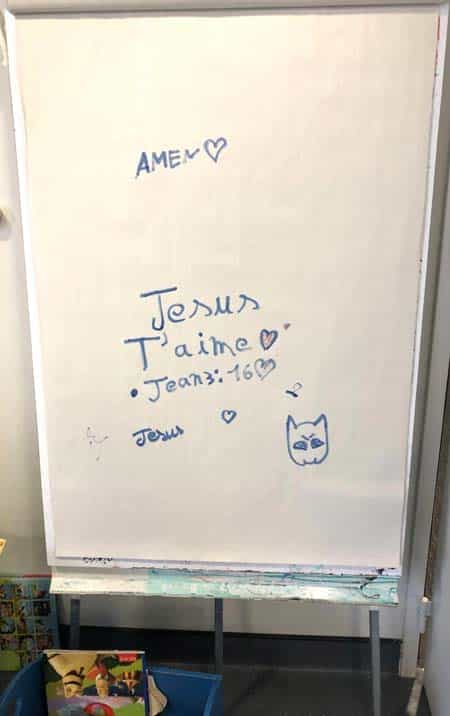
“When I arrived in the waiting room of the intensive care unit where Tony had just been transferred, I was devastated. I looked up with tear-filled eyes, and in front of me was a painting in which a child had written “Jesus loves you” Jn 3-16 (see photo forwarded by Karine). I was immediately consoled and was able to hold on, I believe, thereafter with and through Him.”
“My heart was struck as by lightning”
Tony has never believed in chance and he believes in it even less today. A second accident on May 7, 2025, combined with a fit of epilepsy and a stroke, also stunned the health professionals. These events, Tony explains, brought him closer to God. “My heart was struck as by lightning.”
Since these trials, his faith has grown. He feels closer to those who have lost part of their health, to those who have suffered serious accidents, those who have been tested in their flesh. He regards his condition as an “invisible handicap”: although he still understands most of what he hears, expressing himself remains difficult. Despite this, something remains very much alive within him. His heart is more open than before, he says, tears come more easily, and the suffering of others now feels more perceptible.
It is “like a godsend”–not because the accident was good in itself, nor because he understood its meaning straight away, but because it has brought him closer to the truth which, in his view, is Jesus Christ. He makes that point clear: initially, he had absolutely no comprehension of it all. His body function was no longer like it used to be. He had to be treated in several hospitals, undergo hard treatments. And keep his sense of humor too, because, as he likes to say, you have to laugh at least once a day. Yet in the midst of all this, he remembers the medical professionals he met– of whom he keeps fond memories.
Back to God
Tony’s faith did not emerge as a result of the accident. It had been dormant for a long time, in sometimes more diffuse forms. Before his marriage, he asked for confirmation. Later on, he strayed from faith several times. He would go back and forth. He even went through a period when he played sports games on Sunday mornings. At the same time, he worked as a member of a company fire brigade until 1999. During this period, he says, he felt increasingly unwell, both estranged from his loved ones and from his faith.
It was then that he somehow felt a call to come back to God. This return took the form of a pilgrimage to Lourdes, in August 1999, as a volunteer carer for the sick. There, he discovered something that had a profound effect on him: Lourdes gave him “a foretaste of heaven”, it felt to him as a place where there was room for everyone. He came back in a state of emotional upheaval, shedding a lot of tears. This sensitivity would never leave him afterwards. Since his last accident, he says, he has “inherited tears” more than ever before.
His tears are not to be mistaken for sadness. They also express a kind of opening of the heart. When individuals are struck by a great sorrow, a serious illness, paralysis or an accident, they feel rejoined and concerned. They get closer to those situations through their experience. Not only they see a new closeness with human reality but also with Christ. So faith does not suppress ordeals but it crosses it in a different manner. It does not suppress fatigue, nor vulnerability or inner struggle. However, it provides a direction and a way to experience what is going on.
Montligeon and perpetual Mass
Tony discovered Montligeon through an act of kindness. A friend from their parish who had a connection with their prayer group offered Tony a registration to perpetual Mass soon after the accident. She entrusted Tony to the Fraternité Notre-Dame de Montligeon and then handed Karine the card and certificate of registration with the Fraternity as a live member. Karine said that when she received it, she cried, because she perceived it as a very beautiful gift. That’s how the shrine became part of their story in a very real, personal way.
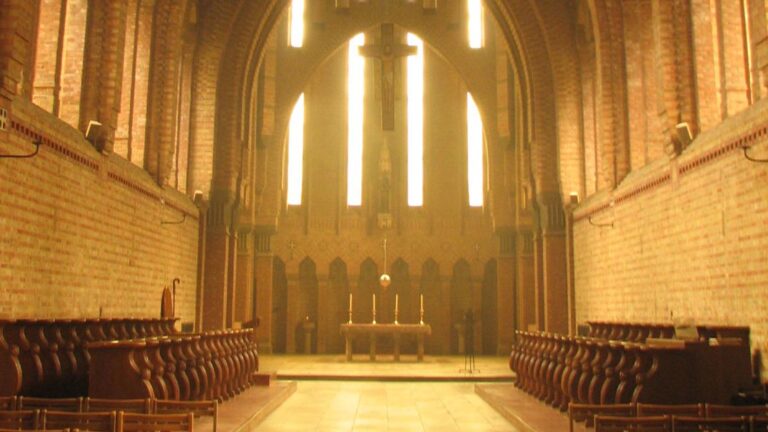
Soon afterwards, she began to offer this kind of registration herself, especially for deceased persons, whilst still remembering that there are also masses for the living. She and Tony visited Montligeon for the first time in January. They came of their own accord, not registering to any planned event, just because they felt that they had to come against all odds. They had a profound experience there. Later, during the Holy Week, some friends in their parish offered them to drive them there. Although the initial plan was dropped, they decided to take their own car to go. After a four-hour drive, unexpected events and tiredness, they did reach the shrine and here they are.
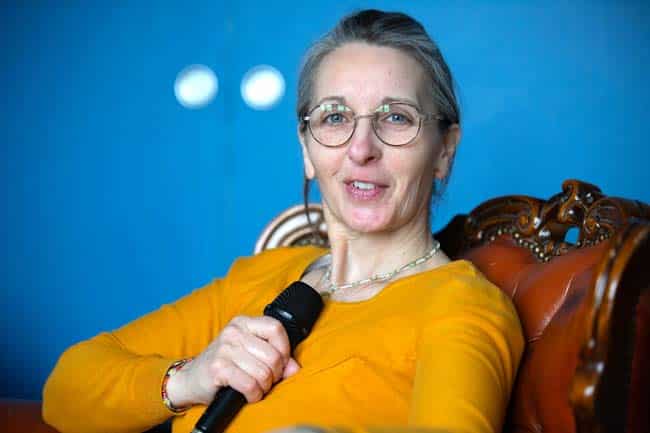
Tony says that his desire to come had emerged a long time ago, chiefly because it’s a place of prayer for the souls in purgatory. He even says, even though it’s paradoxical, “thank you again for my accidents”, because those hardships have led him here at last. He had been moved by the idea of praying for the deceased for a long time. He mentions all those souls before us, on their way to heaven, with that invisible relationship which prayer makes possible to experience with them.
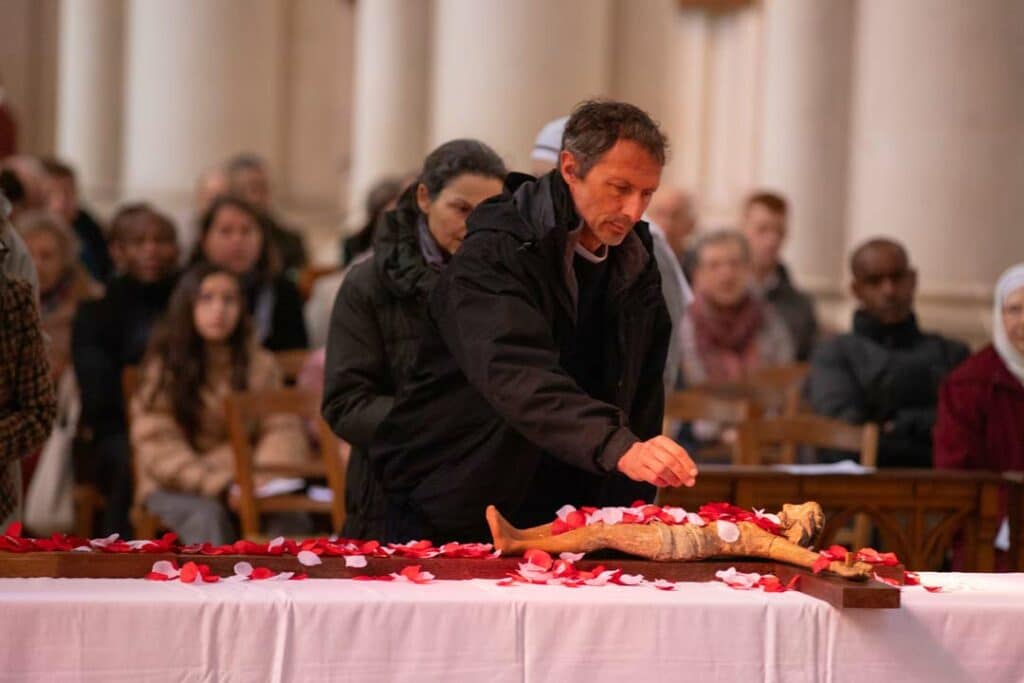
With the Eucharist, heaven remains open for our dead
As he is sharing his story, Tony tells us about his younger brother, who died from cancer on January 6, 2002, as well as his father, who died in 2019, three days before Pentecost day, when he was celebrating the fiftieth anniversary of his wedding. At the time when Tony was taking his first steps again, on January 6, Karine was saying her 6th novena to St. Charbel. She says that she saw a day of grace there, precisely related to the death anniversary of Tony’s brother’s death. She had the feeling that “the people in heaven were around” and that this brother was supporting them in their trial. As for Tony, he uses more circumspect language. He says that it’s just an interpretation, he cannot prove it but he believes that we do have a connection with those who lived before us.
For him, this conviction is rooted in the fact that with Jesus Christ, heaven got open. He affirms his trust in God and his desire to persevere in faith until his last heartbeat. He often quotes St. Jean-Marie Vianney: “I look at him and he looks at me.” For him, adoration is a place where, even if it sometimes seems like nothing is happening, a real closeness is experienced with Christ. In the middle of the night, during Holy Week, he would leave his bed to go and pray at adoration, where he finds inner peace in the silence.
The role of Eucharist here is central. Tony uses very personal terms to talk about communion. Since he has his accidents, each time he comes near the consecrated host, tears spring to his eyes uncontrollably. He no longer wipes them, he just welcomes them. Prayer, adoration, Mass, communion have become his spiritual food. That’s what he means when he says: “Prayer seems vital to me.” He even calls it “the best food”. He then uses the same language talking about the souls in purgatory, the Eucharist or inner life. Prayer nourishes, helps going back to God, even when its fruit remain invisible.
Purgatory and the invisible fruits of prayer
Tony explains that he has a long-standing devotion to the souls in purgatory. He mentions specific acts of renunciation, such as temporarily stopping drinking alcoholic beverages. Even though these are small efforts, they are part of an inner logic of prayer, invisible solidarity and intercession.
Likewise, he states that whilst the fruit of our prayers is not known, it is very real nevertheless. He regards prayer as an active process. It can result in healing or to a deepening of faith, or to people coming back to God. All these things usually remain invisible. Yet he does believe in them. Prayer is silent, during Eucharistic adoration, at Mass or during traveling.
A transformed life
Karine is very clear about this: the accident has been the starting point of a new life. “It’s my Tony, but it’s not quite the same.” Beyond the sober phrasing, the sentence says a lot. There is continuity and transformation. Their marriage, however, has not unraveled. On the contrary, she stresses that their sacrament is stronger. Their family faith has grown. Their children’s faith too. Their parish, their friends, this whole network of relationships has been key in getting them through their ordeal.
When they were told that Tony was between life and death, she says, she felt serene in a certain way. Not because she had anything under control nor because she gave herself the right to judge about Tony’s salvation but because she was full of trust. They would say farewell to each other every morning –because “you never know what may happen”. She believed that he was already hankering for heaven. That did not suppress the pain nor the fear but it provided a sort of inner peace in the face of the possibility of death.
Asking for prayer, receiving and sharing it
“You must ask people to pray for you” –Karine insists on this point. “If we hadn’t formed this prayer group, we might not have received so much.” Some people told her in confidence that they had picked up a rosary they’d forgotten in a drawer. Others began to pray whereas they no longer did or had never done it in their lives. Their daughters’ friends joined in. Tony’s friends, especially those he used to bike with, were also very supportive. Through this ordeal, they discovered people’s hearts.
We must not hesitate to ask God, but also to ask our friends to pray for us, since we are all children of God. Real graces can be obtained thence. This means that prayer is not something that you do on your own; it becomes a flow, a chain, a living communion between people, families, loved ones, saints and even the deceased. This point is directly in line with what they have discovered at Montligeon: a way of praying that links the living and the dead in Christian hope.
This prayer is fueled by many faces: St. Charbel, St. Anthony of Padua, St. Margaret Mary, St. Raphael, St. Cyril, and more broadly “the whole heavenly court”, says Karine. The family regularly invokes these saints. They provide tangible help. So the ordeal has not only strengthened human bonds, it has also made them more aware of a wider communion that includes the saints and those departed before them.
A whole life to reshape
The testimony does not close on complete healing or regained balance. Karine says it plainly: “We’re still going through the ordeal or, more accurately, the aftermath”. The hardest part is over, but nothing is completely behind them. On the day of the accident, everything came to a halt. Tony was hospitalized. She stopped work. The girls’ studies and daily lives were turned upside down. Today, the family is still reshaping its life.
They need patience now. They must be able to wait. Not rush answers artificially. Karine phrases it in the following terms: “The most important thing now is not to find a job right away but to roughly know the way.” Right now they don’t know it. All they know is that they still need to wait.
And yet, in the midst of all this wait, one thing remains:
” Although we still need everyone’s prayers, we also want to share our prayers. There are so many reasons to pray. “