Nowadays, death takes place behind the scenes. According to some people, to die well today often means dying in one’s sleep, without even knowing it. Yet those who assist people at the end of their lives describe a more nuanced experience: on the threshold of death, essential words emerge, reconciliations become possible, and some discover an unexpected form of peace. Marie de Hennezel, a psychologist and author of numerous books on end-of-life care, shares what she has learned from those approaching their ultimate passage.
Each one has their own own way of dying
Being able to spend about ten years assisting people as they were dying taught me a great deal. First, I came to understand that everyone has their own way of dying. Rainer Maria Rilke puts it very well: “Lord, grant each person their own death.” These words reflect what I have observed: each person has a unique way of dying, tied to their history, their relationships, and the way they have lived, loved, resisted things or accepted them.
If I were to generalize—albeit cautiously—I would say that one thing struck me: virtually no one, on the brink of death, says there is nothing. People may have called themselves atheists or agnostics before; but at the moment of death, I haven’t heard that. At most, they say, “We don’t know. It’s a mystery.” Those words made a deep impression on me, because they emerge when one is no longer dealing with general ideas, but with the immediate experience of the transition.
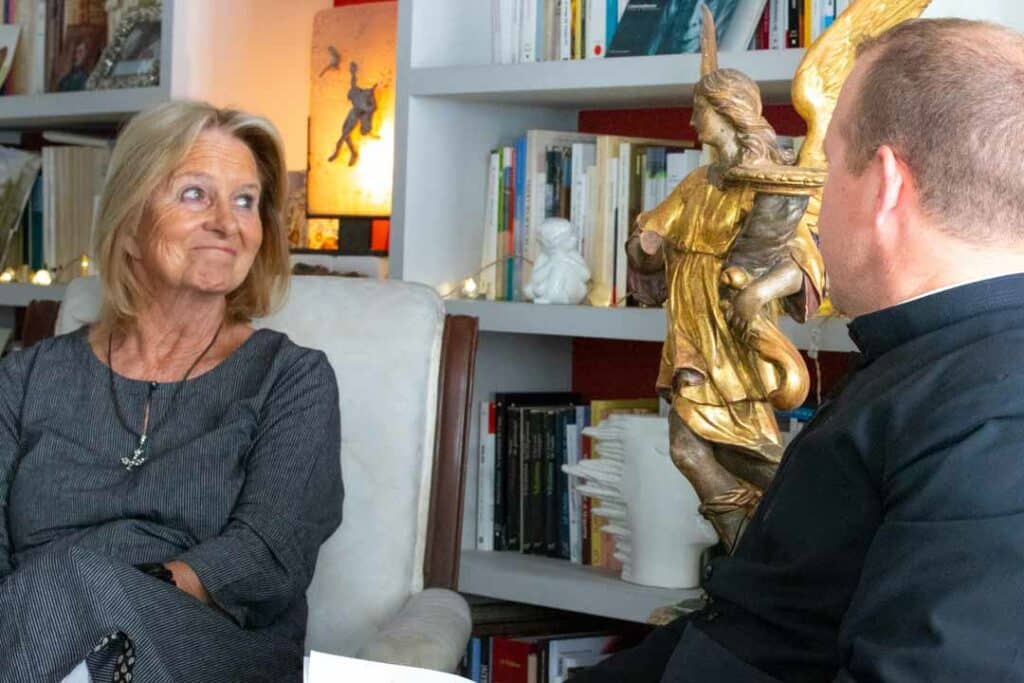
Trespassing as a process
In believers or in people who have trust in life, including in the part of life which is death, I saw an ability to let go. Death is part is life. When people have become fully convinced of this truth, it can give them access to some kind of peace. It does not remove the ordeal but sometimes it allows them to go through it in a different manner.
To die peacefully, one often needs to have done some preparation work beforehand. I’ve in mind the work of putting one’s life in order, making peace with others, and passing on one’s legacy. The psychoanalyst Michel de M’Uzan calls this “the process of dying.” He describes this astonishing energy that sometimes emerges at the very last moment, when the body is very weak, worn down by illness or old age. This energy is channeled into a final inner process.
That’s a kind of attempt here to “deliver oneself fully” before disappearing. It’s a very beautiful expression. It speaks to a kind of “child-birthing” of oneself—a birth from the depths of one’s being, from one’s inner wisdom. It’s a fulfillment. There’s nothing spectacular about it. I’ve simply seen people find the strength to wait for someone they hadn’t seen in a long time—someone they wanted to say goodbye to, thank, or ask for forgiveness, someone to whom they wanted to pass something on.
Sometimes it takes just a few words. Sometimes it’s conveyed with just a glance. But when people are able to do that, they leave with greater peace of mind.
When no farewell could take place, a ritual is still possible
For many people, this process of saying goodbye was made impossible during the lock-down. That is why one of my books is titled *The Forbidden Farewell*. where I condemned this act of inhumane cruelty from the French health-care authorities during Covid –the loneliness of the dying, and this “nightmare of inhumanity,” in the words of nurses, which consisted of preventing a loved one from coming to say goodbye. Many people who died during this period were unable to complete this particular process. Consequently, this led to very difficult grieving experiences for the survivors.
However, this doesn’t mean that the grieving process is impossible. In that book, I wrote a letter to those in mourning. My advice to them, if they had to suffer such a situation, is to do a ritual. A ritual is an ordered sequence of symbols. It may include a photo of the dead person, a flower, a candle, a religious object or simply something meaningful. Then, the thing to do is to talk to the person and tell them what we wish we had been able to tell them.
I think rituals are very important during the grieving time, especially when rites before death could not take place. When you are faced to the mystery of the death of a loved one, you must first allow time for listening, i.e. talking about the woman or the man you have loved, evoking them and expressing your suffering, your emotions, all the things you still bear within yourself. Then the ritual will open a path. Before death, assisting and attending the person is already a ritual –saying goodbye as you are facing the person, exchanging some words, having some specific gestures or religious rites, the anointment of the sick, etc. When none of those things were possible, the rituals after death are still available. Although we don’t know much about death, a certainty is that we step out of time. This means that even six month or a year later, we can still take a positive step or talk to the departed, seeking to make peace with them.
Live each day as if it were your last
A good death in the past meant to have time to get prepared to it. Nowadays, in our secularized society, many people say: I would like to die quickly, without being aware of it, in my sleep or abruptly, in any case without suffering. A good death now means a quick, controlled death. You even hear people say that they wish to anticipate their death.
Of course, when a neighbor dies in his sleep even though s/he was doing just fine, you might say that it was a good death for him/her. But it’s hard for his loved ones because they weren’t able to say goodbye. And even for the person who died, one might wonder if they were at peace with their life and with others. When you know you’re going to die, you can prepare yourself. So, a good death is certainly one you can prepare for—a death you can think about, even well in advance.
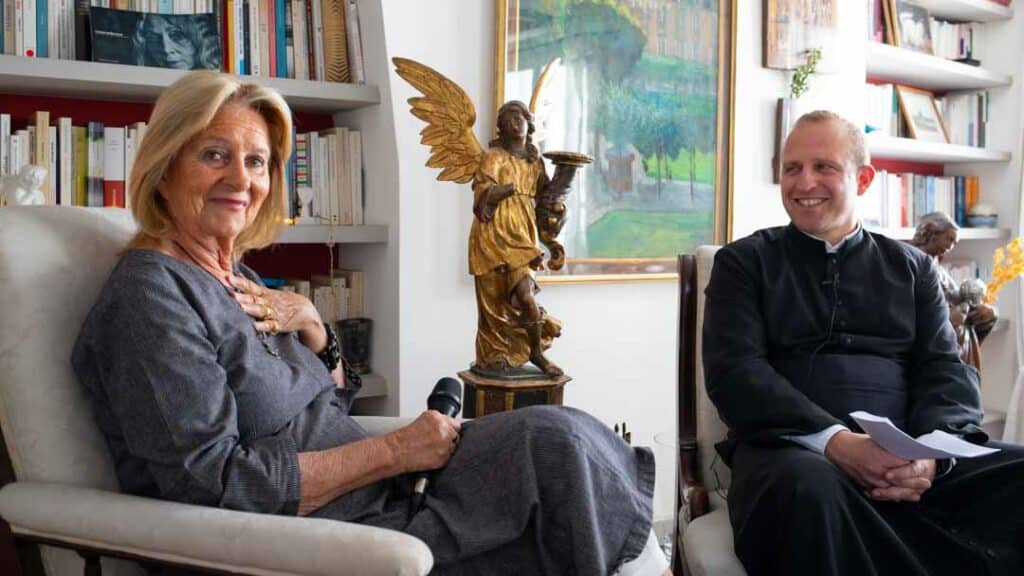
Preparing for death means accepting one’s own mortality
My eightieth birthday is around the corner. Which means that I am entering this phase of life when you know that you are heading towards your death. One thing I know is that I know neither the day nor the time. It could be tomorrow. I have a sharp awareness of the frailty of life and the fact that anything may happen anytime. Such awareness forces you to be at peace with yourself and other people as much as you can. It also suggest that every day should be lived as it it were your last.
All traditions have a similar awareness. I often mention this image of Native Americans for whom death is like a bird sitting on the left shoulder, and asks every morning: “What if it were for today?” It ties with what St. Benedict used to say in his memento mori: it can happen today. So, how shall I live today?
I think it’s very important to maintain this awareness throughout one’s life. I’ve noticed, however, that as people grow older and approach death, they become increasingly aware of their own finitude and what that entails. But it must still be embraced. Peace has something to do with accepting reality: not what I would like, but what is. It is a matter of spiritual surrender. I surrender to what is. I accept the course of events.
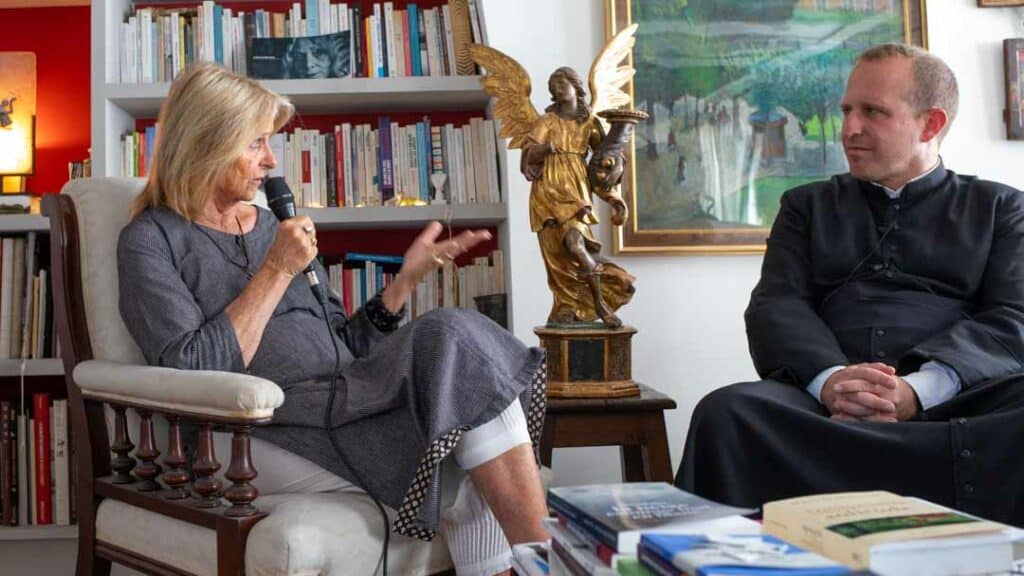
To surrender is to place one’s life in the hands of God and others
This isn’t very common, because we live in a society where mastery and control are encouraged. We’d like to control our own death just as we control everything else. Yet I’ve witnessed some truly beautiful deaths—deaths marked by spiritual surrender. To surrender is to place oneself in the hands of God and of others, and to accept the course of events without knowing how long it will take. I sometimes use the phrase “letting go,” even though it’s often used today in the context of personal development—and thus as a form of self-control. Yet true letting go is not about control. True letting go is surrender.
The time we have left to live is a great mystery. Many people ask doctors, “How much time do I have left?” No one can say. When doctors say “three months” or “six months”, they don’t really know in fact. They can give a statistical estimate, but they don’t know the actual amount of time. We can only tell what we know.
I have witnessed several people who lived much longer than their medically predicted life expectancy. I had this conversation with François Mitterrand during the early years when I spoke with him at length about death and spirituality. When he told me, “The doctors have given me little time to live,” I replied: “But who can tell you how much time you have left to live?” I added that it depended on his desire to live, on what he still had to do on earth, and on the power of the spirit. He echoed this phrase in his final words: “I believe in the power of the spirit.”
I’ve seen doctors respond more appropriately to patients: “I know I can no longer cure you, but the time you have left belongs to you.” Here, doctors would what they know, without pinning the patient down to a specific date. That time belongs to the mystery of the soul, the body, and life. Giving a specific number can be harmful, because some people end up conforming to the timeline they’ve been given.
Helping someone die peacefully
To help someone find peace, you must first tell them that the time they have left to live belongs to them. Then, you must ask them: “What can help you?“ This question is key. The answers will then come. Some people say they are not at peace with a brother, a sister, or a child they haven’t seen in a long time. They would like to see that person again. They need peace on a human level.
Other people say: “What would help me is if someone prayed beside me, or with me.” Others request some music. I remember patients who knew exactly which piece of music would help them. Fauré’s Requiem is often mentioned. Myself, I wrote in my advance directives that I wanted to hear the songs and mantras from Taizé, because I listen to them often and that soundscape completely soothes me.
Death puts and end to life –not to relationships
As death approaches, family relationships take center stage. Death is a permanent separation in the visible dimension. There is something radical about death, and that radicalness is painful. We must prepare for it. When death is sudden, it is very violent. That is why the grieving process takes time and goes through familiar stages, particularly those described by Elisabeth Kübler-Ross.
When providing support for a peaceful death—or a death according to the Indian tradition or the traditional way of dying—there is a time to say what needs to be said. Talking to one another is possible. People can say goodbye. This is extremely important, because later, during the grieving process, you are able to state: I said what I had to say; and we are at peace.
Death according to tradition, or the Indian tradition
I also helped two people, including my mother-in-law twenty years ago, and then my ex-husband this summer. Both died in a special manner. I then realized something that many geriatricians have observed: at a given time, those people are no longer hungry or thirsty. Hunger and thirst are sensations triggered by the brain. In us, healthy people, they occur naturally, whereas they stop in those people because the body has reached the end of its journey.
At one point, both of these people said, “I’m not hungry anymore; I’m not thirsty anymore.” They simply asked that this be respected—that no one would force them to eat, that they be allowed to drift away gently, at their own pace. It takes as long as it takes. There is also a surrender here to what is—to the end of the body, which is not the end of the soul.
My mother-in-law used to say, “I’m dying the Indian way.” In one region of India, elderly people die that way. She had heard about it and would tell her son—my husband—about it. For her, it was an acceptance, a consent to her fate—a serene acceptance.
It’s important to distinguish this from suicide. In suicide, a person inflicts violence upon themselves through an act. Here, there is no violence. There is a gentle acceptance. People do not suffer. They fade away gently, like a little candle. Nor is it the “slipping syndrome,” which follows a different pattern, involving depressed individuals who protest by refusing to eat. In that case, we need to understand what’s going on and figure out how to help that person with their depression. That’s not what I’m talking about.
Frequently, the family members create a problem. They think: That’s not possible, s.he wlll die if s.he does not get fed. So they force-feed the person. They try to open a mouth that remains closed. Sometimes, an infusion line is requested to feed the dying person because some family members have requested it. But the body is expressing something. And even Alzheimer patients shake their heads to say no.
It’s Never Too Late
After that, communication takes on a different form—it happens in the unseen realm. Many people say they feel the presence of those who have passed away. There is prayer; there is that in the movieTuesday with Morrie : “Death is the end of life, not the relationship.” I find those words very beautiful. The relationship continues. That’s also why it’s“never too late” to make peace, as Pope Benedict XVI said.
I’ve accompanied many people who wanted to live as long as possible to be with their loved ones. I remember a woman, at the very end of her life, who had a thirteen-year-old son. She told me: “I’d like to tell him that after I die, I won’t be abandoning him—I’ll be with him.” I told her she had to tell him that. But she couldn’t. Her emotion prevented her.
She died a few days later. I met with the little boy and told him what his mother had said. I said to him: “Your mom wanted to tell you that she wouldn’t abandon you and that she’d always be there for you.” That had a great impact on him.
There are people express what they feel in words. That doesn’t mean they don’t have faith; it just means it is not easy to phrase it. Even when we have faith, we’re at a loss for words. Faced with this mystery, we stammer.
As for me, I really feel that the people who have passed away are with me. I don’t know if I’ll have time to say this at the end—or maybe not—but my children and grandchildren know that after I die, I’ll still be there, too. I’ll keep praying for them.
The communion of saints is something I experience. It’s not just a mental concept. I know it in my very being, in my flesh. I feel this communion of saints. When I’m in trouble and I call out to my grandmother, my mother, or my father, I feel extraordinarily supported. As soon as I cry out for help, I get an almost immediate response. I am not alone. I am deeply surrounded by others. Perhaps all those years of living so close to death have taught me that.
A spiritual dimension often emerges at the end of life
At the time of dying, spirituality takes a different dimension depending on people. There is not just one way to experience it. I was very deeply touched by some words, and one of them continues to stay with me. I remember this woman I didn’t know. I came and sat down next to her; she took my hand and said, “My child, don’t be afraid of anything. Live everything you’re given to live, because everything—everything—is a gift from God.”
How she said that, with such energy, such a gaze, such strength. She was dying. She died half an hour later. Those words perhaps made her able to pass away. They expressed a very strong faith and I was the recipient.
I also remember a young woman who sat very straight in her bed. She said to me: “Madam, I want to die with my eyes open.” I asked her why. She replied: “Because I am curious of what’s coming next.” She had no apparent religious support. Yet she did say that: “curious of what’s coming next”.
I was struck by this. Even people who followed no religious path are able to express some openness in the last few days. You don’t always hear this three months or three days before. However, on the brink of death, when the end is near, this attitude is quite frequent: whilst people don’t have faith, at least they don’t know. So sometimes, a curiosity for what comes next emerges. I think that most people have a sense of the beyond, even it is not always part of a religious tradition.
I have also attended terrified people. I have attended a couple of priests who were terrified and it really struck me because I thought they should have benefited from the support of their faith. This shows that death remains a daunting passage, even for those who gave their life to God.
I have often noticed a cultural difference between men and women when it comes to death. Men are sometimes more at odds with their impulses to dominate and control. On the other hand, women, in their bodies themselves, have a different relationship with the process of letting go. When they give birth, they undergo a physical and spiritual experience of letting go, letting things happen, and allowing the process to unfold. Even women who have not had children sometimes have this particular relationship with letting go within them.
That doesn’t mean men aren’t capable of it. My ex-husband, who died this summer, was like many men in that he was a control freak. I was by his side during his final year. He told me, “You’ve talked to me a lot about letting go. That’s a spiritual experience I need to have.” It took him a year to discover what letting go really meant, because his body had, in a way, let him down. He had lost all his muscle strength, could no longer get up, and could no longer do many things, even though he was still in full possession of his faculties and could speak. He was dependent on others. This is how he described the task that remained for him: learning to let go.
I also supported many men living with AIDS, back when the disease was still very rapidly fatal. I was struck by the journey they undertook in the short time leading up to their deaths. One can come a long way. But to be able to let go, you have to feel that you’re not being abandoned. You have to feel supported—by doctors, by loved ones, by friends. That makes it possible to embark on the journey of letting go. For people who are alone and abandoned, it must be very hard.
Supporting a loved one means being there for them
Loved ones often feel helpless. They’re grieving, they’re bewildered, and they don’t know what to say or do. In my experience, I’ve helped loved ones a great deal. I would come with them into their room, sit with them and tell them that it was all about being there, being present, and accepting their powerlessness.
It’s not easy. Being there means acknowledging that I can’t stop the other person from dying. I can’t stop them from walking the path they must walk. But I can be at their side, even if I don’t have the answers, even if I don’t know what to say or what to do. I used to tell them: let your heart speak.
There are not always specific things to do or say. You have to be listening to your heart, in the relationship to the other, and let your intuition speak. I often saw loved ones who needed to be allowed to do nothing, just be there, and let their heart speak.
Physical touch is also very important. I’m thinking of a fairly young woman who was dying of liver cancer. She wasn’t in pain, but she was very restless. Her family was sitting around her, feeling helpless and restless themselves. I had read in her medical records that she had a twin sister. As I entered the room, I had an intuition—I think the Holy Spirit must have prompted me—to speak to that twin sister.
I told her, “When you and your sister were in your mother’s womb, you were pressed close together and you were safe. Why don’t you get into bed? Hold your sister in your arms, just like when you were in your mother’s womb.”
She understood right away. She climbed onto the bed, lay down next to her sister, and wrapped her arms around her. Her sister calmed down immediately. In that moment of contact—which evoked a memory from before they were born—something was soothed. Their mother was there. It was an extraordinary moment. She didn’t die right away, but she remained serene and calm until her death a few days later.
Physical contact can convey a reassuring, wrapping presence that helps one let go. In The Solitude of the Dying, Norbert Elias discusses the importance of holding hands. Something is conveyed through touch.
Loving kindness is also of great hep. It can be expressed through touch, but also through words, through the eyes, and through one’s demeanor. All human beings, before birth, in their mother’s womb, have experienced something of this tenderness: being immersed in amniotic fluid, in a sensation that surrounds the entire body. Not everyone experiences tenderness after birth, even though many babies are, fortunately, properly surrounded and looked after with tenderness. Still, before birth, there is that experience of being enveloped that people may sometimes seek to rediscover on the brink of death.
When someone has another person sitting next to them, when they feel that tenderness and love around them, they may also sometimes want to be left alone. That is strange yet frequent. When people have received what they had to receive, solitude is sometimes needed for the soul to be able to part from the body. So many times death occurs during the five minutes when the people around have left to get a cup of coffee. The family members say: we had been there all the time. It isn’t like that all the time but quite frequent.
I think it happens mostly when the person has received all their fill in terms of love and tenderness. At one point, we are alone as we are facing death. It is the essential solitude described by poets and writers. We are alone to live our life, alone to live our death, even if we have links with many other people.
The fear of being a bother affects many elderly people
I often hear elderly or sick people say, “I don’t want to be a bother.” Behind this statement lies the increasingly widespread feeling that old age is a burden –a burden on society, a burden on one’s children. Society, in fact, helps reinforce this message. “I don’t want to be a bother” often means: I’d like to make myself as small as possible and disappear.
I’ve sometimes told very elderly people, who felt like they were a burden, that a smile or a glance could mean a lot to those who came to care for them or visit them, even if only for a short time. A person may not want to be a bother but they should know that if they smile or make eye contact, they’re giving something.
Often, the crux of this sentence lies here: “I’m no longer of any use; I’m no longer useful; I have nothing left to give.” In reality, a person can give something right up until the very end.
I remember Christopher’s final days. I would come to spend an hour with him. I would sing the piece we used to sing together—the Dona nobis pacem. I would sing it over and over. He would close his eyes; his face was very peaceful, and I could tell it was comforting him. When I was done, I would leave to make room for others. My time slot was from 7:00 to 8:00 a.m. He would open his eyes and say “thank you” with his lips. He couldn’t even really say the word anymore. He no longer had the strength in his voice. But I could tell. That “thank you” was all he could still give me. And it meant the world.
For the people who are experiencing a bereavement, there is no simple technique nor ready-made process. What is helpful is to think that the person is present in our heart and let the heart speak. The other is no longer there physically, that’s true. However, they dwell in our heart for good.
Talking to someone who is about to die without upsetting them
For people who are about to die and to whom no one dares to talk to about death, I believe we should ask questions rather than make a harsh remark. Often, people sense that they are going through what they are about to experience. If someone says, “I’ll pull through; I’ll regain my strength,” it’s possible they’re saying that partly because it’s what everyone around them wants to hear. I’d rather ask a question: Do you really think you have much time left to live? If the person sees that you’re not in denial, they might respond, “No, I don’t feel that way.” I often used to say, “The situation is serious, after all. I can clearly see that your body is failing you.” This statement sometimes helps the person feel that the other person isn’t in denial.
Saying, “You’re going to die” is hard. It can feel as if death is going to happen at any moment. You could say, “I think the end is near. What do you think?” Or, “What might help you during the time you have left?”
In most cases, people know this. They say, “I don’t have much time left.” At that moment, you must not respond by denying the reality. You should ask, “What’s important to you? How can I help you?”
Mourning retreats at the Notre-Dame de Montligeon Shrine
To die well is to embark on a path to peace
Dying well does not mean controlling one’s death. It may mean embarking, as much as possible, on a path of peace: peace with one’s life, peace with others, peace with one’s body as it fades away, peace with the mystery that is unfolding. Sometimes this requires words. Sometimes a ritual. Sometimes a hand. Sometimes a prayer. Sometimes just a silent presence.
Death brings an end to visible life, but not to the relationship. That is why mourning can become a journey in which the heart continues to speak. And that is why prayer, the communion of saints, and the love received or given to the very end still open a path, even when everything seems to have come to an end.