Baptized as she neared death, then confirmed and admitted to the Eucharist, Victoria died two weeks later. How does one celebrate the funeral of an adult who had become a Christian only a few days earlier? At Quarr Abbey, Dom Gregory Corcoran explains the liturgical choices made to ensure that the celebration most accurately expressed the grace of baptism and the hope of the resurrection.
Quarr Abbey is a monastery of the Congregation of Solesmes on the Isle of Wight in the United Kingdom. Victoria, one of our tenants, was suffering from terminal cancer. Having attended a school run by nuns, she had some knowledge of the faith, but had not been baptized.
She approached a monk to ask to be baptized. The parish priest, who was also the diocesan chancellor, granted her permission immediately, since her health no longer allowed for instruction. She promised that, if she recovered, she would submit her marital situation to the judgment of the Church.
Victoria was baptized at the hospice, fully conscious, with her two sons—both Catholics—serving as her godparents. She then received Confirmation and Holy Communion. Later, she received the Anointing of the Sick. Victoria died two weeks later, without ever having left the hospice.
Dom Gregory Corcoran is a Benedictine monk at St. Mary’s Abbey in Quarr, on the Isle of Wight, which belongs to the Congregation of Solesmes. He made his first monastic profession there in 1966. Now the prior of the community, he participates in the liturgical and spiritual life of the abbey, particularly through his preaching.
The family requested that the funeral Mass be celebrated at the abbey, and permission was once again granted. It was clear that the texts intended for the funerals of baptized adults and children were not appropriate, since Victoria was an adult neophyte.
One fundamental principle of liturgical practice is that the texts used should correspond to the theological reality of the situation. We were able to draw on the experience of Bishop Robert Le Gall, former president of the Liturgical Commission of the French Bishops’ Conference, who lives with us. Under his guidance, we selected the Mass prayers—both the plain form and the form with the Gloria—from among those designated for the weekdays of the Easter season, using the first preface for the dead.
These texts do not ask for forgiveness of sins, but celebrate the renewal of baptismal grace at Easter.
This unexpected experience led us to adapt the guidelines in the Missal.
We hope that this account may be of assistance in similar circumstances, while remaining faithful to liturgical principles.
Dom Gregory Corcoran
Prior
Quarr Abbey
A few lines of explanation
The decisive factor is her baptism, which she received just two weeks before her death.
The Catechism teaches very explicitly:
“Through Baptism, all sins are forgiven—original sin and all personal sins, and all the penalties of sin are not retained. ” (CCC 1263).
And immediately afterward: ‘Baptism makes the neophyte “a new creation” ‘(CCC 1265).
This is precisely the meaning of the word “neophyte”: one who has just been born into the new life of baptism. The National Service for Liturgical and Sacramental Pastoral Care echoes this definition: neophytes are the newly baptized “who have just been born into divine life.”
In Victoria’s case, it would therefore have been theologically rather strange to choose primarily funeral prayers that emphasized the need for God to forgive her the sins of her past life: everything that preceded her baptism had, in fact, been forgiven through baptism. According to the Ritual, baptism is a passage into “the state of grace and adoption as children of God” and a birth as a “new creation.”
This explains that the readings chosen were those for the Easter time. The Easter liturgy is particularly rich in references to the newly baptized: new birth, passage from death to life, incorporation into Christ, and resurrection. It is therefore a much more fitting way to celebrate a woman who had just received baptism, confirmation, and the Eucharist.
On the other hand, since the forms were intended for a baptized childn thus posed another difficulty: Victoria was obviously not a child. These texts also address a specific pastoral situation—that of parents facing the death of their child. Therefore, they could not simply be applied to an adult woman.
However, an important theological clarification must be added: this does not mean that Victoria no longer needed the Church’s prayers or that one could assert she was already in Heaven. She had lived for two weeks after her baptism, and the Church does not pass judgment on the inner state of the deceased. The General Instruction of the Roman Catholic Church (GIRC) reminds us that the Church offers the Eucharist for the deceased so that “spiritual assistance” may be granted to them.
That is probably why the solution adopted at Quarr is particularly interesting: it combines two dimensions. On the one hand, the Easter prayers express the objective reality of Victoria’s recent baptism: she has died and risen with Christ, becoming a child of God and a member of the Church.
On the other hand, the first preface for the deceased retains its distinctly funerary and eschatological dimension: death, the hope of the resurrection, and entry into eternal life. This adaptation also corresponds to a principle expressly stated by the GIRM: for the funeral Mass, when selecting the variable parts, “one should take into account […] pastoral considerations regarding the deceased, his or her family, and the congregation.”
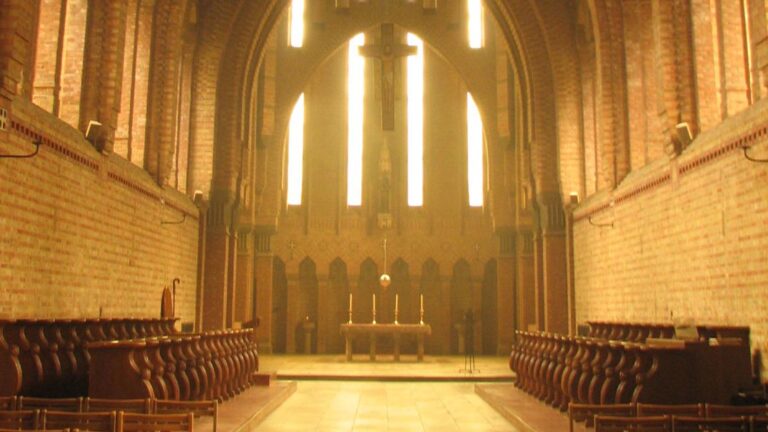
Photo : Lawrence OP-Abbey church after Mass _ The abbey church of Quarr-Flick