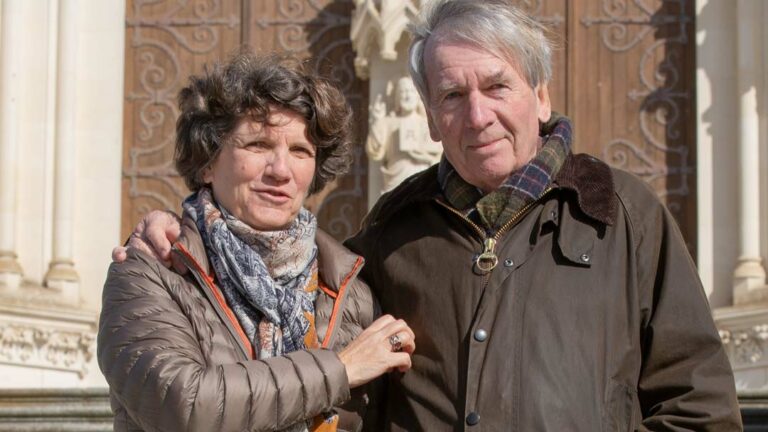
During the 1-week mourning session in March 2026, Chantal and Gilles shared their story of the loss of their son François-Loïs, who died aged 37 from cancer after several years of living with multiple sclerosis. They describe the difficult times they endured through faith, prayer, and friendship, and explain how their son continues to draw them toward hope and communion with those who have gone before us to Heaven.
“We have four children, and our fourth has been in Heaven for two years“
We have four children, and our fourth has been in Heaven for two years. François-Loïs passed away on February 21, 2024. He died from cancer, after living for several years with multiple sclerosis, which first appeared when he was 29. He suffered greatly, but that suffering never diminished the person he was at his core: a man driven by an immense desire to live, to love, and to share the Gospel.
He loved celebrations, meals, conversations, and books. He read voraciously and had written a novel, Maresia [Éditions du Rocher, Sept. 2023]. The book had received rave reviews in several newspapers, but he didn’t have time to properly promote it. Yet this novel already revealed something of his inner journey. “When I read the back cover blurb, I smiled to myself, thinking that some of our friends in Versailles might not necessarily appreciate the book’s tone.” However, behind the guise of a mystery novel lay something else: a genuine quest for redemption. “It’s a novel that, if you dig deep enough, is about redemption.”
He had a very strong longing for the absolute, and even when he went through more difficult periods in his faith, he kept searching. Like many young people, he had experienced a sort of spiritual halt during his teenage years, but he later said that he envied those who discover their faith later in life, because they seem to burn with a newfound passion.
.
“I dream of being like those new converts who discover the faith later in life. I want to have a burning faith.” Those words made a deep impression on us because they truly came from his heart. He didn’t just want to believe; he wanted that faith to permeate his entire life.

“His illness had adopted him, and he had adopted his illness”
Multiple sclerosis had profoundly held him back, particularly in his desire to start a family. We believe this was what he regretted most, even though he never allowed himself to be consumed by bitterness. This reality was part of his life, a life he accepted as it was. As Father de Maistre pointed out in his funeral homily, François-Loïs had articulated three “yeses” to life: yes to life, yes to his own life, and yes to eternal life. Right up until his final weeks, he would write down “five reasons to give thanks” every evening in a small notebook. He would call those notebooks his “gratitude journals.”
He once told us something that we never forgot : his illness had adopted him, and he, in turn, had adopted his illness. That sentence sums up quite well how he got through those years of suffering. Of course, the treatments were grueling, and the many medications sometimes affected his mood. And while his mood swings troubled him, he still managed to maintain a certain clarity and a sense of humor about himself.
When he was diagnosed with cancer in 2023, we felt that his faith had grown even deeper. He was already a believer, but something within him seemed to have deepened. His relationship with Christ became simpler, more direct, and more radical as well. He, who had already strongly advocating the dignity of all human life, spoke out very clearly against euthanasia. For him, this debate often revealed how the strong view the weak. He said that those who today consider themselves on the side of the strong may forget that one day they, too, will become vulnerable.
This conviction was not merely theoretical. It stemmed from his firsthand experience with addiction, physical suffering, and vulnerability. Yet he never presented himself as a victim. Even during the most difficult times, he maintained an astonishing vitality and energy that many around him pointed out.
A vast chain of prayer to help enduring the illness
He began his first round of chemotherapy on Good Friday, 2023, and very quickly a strong sense of solidarity formed around him. His friends took turns accompanying him to the hospital and arranging transportation between the Pompidou hospital, where he was being treated for cancer, and the Foch facilities, where he was being treated for multiple sclerosis. They prayed with him, watched over him, took care of very practical matters, and formed an incredibly strong support network around him.
He would call them “his guardian angels,” and this wasn’t just a pious image. We truly felt that they had been his guardian angels on earth. Even his oncologist had advised us not to upset that balance by moving in with him. He had told us, “I’m getting to know François-Loïs quite well. Leave him with his circle of friends. They’re the ones who’ll help him get through this.”
“He would call his friends his guardian angels.”
We remain immensely grateful to this oncologist, who showed remarkable sensitivity and compassion. We can even say today something that may be difficult for some parents to hear: despite everything, this was a blessed time. We were supported by doctors who were likely not believers for the most part, but who knew how to be there for our son through his physical and emotional suffering. This left a deep impression on us. “We tell ourselves that faith is never far away, even when we think we don’t believe in anything.”
François-Loïs himself was amazed by this thoughtfulness. He had retained an astonishing sense of optimism and would often lift the spirits of the medical staff when certain people entered his room with awkward or overly sympathetic remarks. He found it amusing and responded with his very personal way of sharing the Gospel.
His greatest pleasure, he said, was “connecting a Catholic with a non-Catholic.” He loved building bridges between people, bringing people together—whether or not they shared the same faith. In reality, what perhaps defined him most deeply was his love for others.
“Everything had to be experienced in trust.”
In the fall of 2023, the chemotherapy had produced such encouraging results that we almost believed—perhaps naively—that he was cured. Then, around Christmas, the cancer spread extremely quickly, and everything accelerated within a few weeks.
When we arrived at Pompidou late Friday morning, his oncologist explained to us that, unless the situation improved very quickly, he likely had a few hours left—or one or two days at most. In the end, there was a slight improvement, and he was able to be transferred to palliative care. This transition was very important for him as well as for us. For eight or nine days, his friends took turns staying with us almost continuously. From nine in the morning until evening, the rosary was recited in his room or in the family lounge right next door. He wanted his pain medication to remain as mild as possible so that he could remain conscious, retain his mental faculties, and continue to talk, think, and pray.
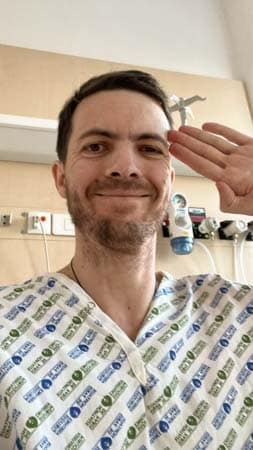
Little by little, we all came to realize that he was going to die, and he, too, must have gone through this spiritual struggle. Priest friends came to see him every day. There was an extremely devout atmosphere around him, but without any agitation. Everything took place amid great inner peace. “Everything had to unfold in trust. ” Deep down, we felt that he needed that time. If he had died suddenly, something would have been cut short. On the contrary, those final days allowed him to complete a journey, to ‘reset’ certain things—as he himself put it—and to prepare himself inwardly.”
“O soul, you may ascend to your Creator”
François-Loïs died while Abbé de Maistre was reciting the prayer for the repose of the soul. He drew his last breath at the very moment the priest uttered these words: “O soul, you may ascend to your Creator. ” We have lost our son, but he departed in a spirit of great fervour. At the moment of his death, about ten friends were praying in the adjacent living room, and there was an extremely strong human and spiritual presence surrounding him. This remains an invaluable experience for us.”
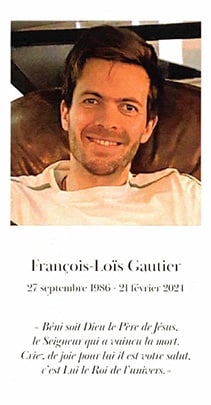
Of course, losing a child is still an extremely difficult ordeal, even a 37-years old child. We are believers and practicing Christians; we pray a lot, but that doesn’t mean we wake up every morning filled with joy. There is a suffering that remains, and we do not believe it will ever disappear completely. However, we are gradually discovering that it is possible to suffer with Christ rather than alone in our pain. François-Loïs did not suffer alone; we deeply believe that the Lord suffered with him. And even today, we experience that we are not abandoned in this grief. We are sustained by our own prayers, but also by the prayers of others.
The loss of a son changes
one’s perspective on death
We were already familiar with Montligeon before our son’s death. We had enjoyed wonderful retreats and memorable moments there. Fifteen days before this week of consolation and mourning, we had returned to celebrate the second anniversary of his passing. We enrolled him in the Fraternity of Our Lady of Montligeon, and that inspired us to also enroll our parents and other loved ones there. In a way, this place has become our home. We think of François-Loïs from morning till night and thousands of times throughout the day; yet, even though he is gone, he has never been more present.
In Montligeon, this presence becomes almost more intense. There is a special peace here—a peace found in prayer, but also an experience of grief shared with other families going through similar hardships. There are words, gestures, and places where one feels a different kind of consolation. We hadn’t given much thought to purgatory before, but the teachings we’ve received here have confirmed an intuition we already had: François-Loïs likely went through an extremely intense period of purification while on earth. He himself often said that one had to “reset the clock” before dying and make the most of the time remaining to get prepared.
Looking back, we really feel that those few extra days were given to him for that reason—aas well as for us.
La joie, la foi, la croix
[Joy, Faith, the Cross]
There is something strange about what we are presently experiencing: usually, legacies are passed by parents to their children, but we feel that now we are receiving a legacy from our son. He’s leaving it to his brothers and sisters, his nieces and nephews, his friends, and, of course, to us.
Ever since he began his life in Heaven, we’ve felt as though he’s reaching out to us, and our own view of death has been transformed. Having a child who has gone before us to Heaven profoundly changes the way we look at the future. We don’t know when or how our time will come, but we know that he is reaching out to us.
When we think of him, three words immediately come to mind: joy, faith, and the cross. For a long time, we wondered in what order to list them. Today, we believe that joy had led him to faith, and then faith had led him to the cross.
We are all made to be reunited to those who have gone before us. Some will be reunited with their parents; others, perhaps more painfully, will be reunited with a child. Yet we always move forward. We continue on our journey in the communion of saints, united with those who have left this earthly life but now live with God.
Mourning Support Sessions in 2026
Each year, the sanctuary hosts five “Comfort in Grief” retreats and two “Consolation in Grief” weeks. These seven annual sessions allow those who are grieving to find hope and comfort after the death of a loved one.