
Are we awaited in Heaven? If so, by whom? Sister Cécile and don Stéphane Pélissier deal with that question from two, complementary angles. One relates to the expectation we have to meet our deceased loved ones again. The other shows that God does not only await us, He “hopes for us”. But both perspectives enlighten the same Christian hope.
Am I awaited?
The answer to this apparently trivial question is not obvious in fact because attributing to God the feelings sand attitudes of men is always a tricky matter.
Then shall I be expected and, most of all, by whom?
God’s eternity is not in itself compatible with the reality of time, yet time and waiting seem to be fundamentally linked. God does not seem to have anything to do with either time or waiting: “With the Lord, one day is like a thousand years, and a thousand years are like one day” (2 Peter 3:8, quoting Psalm 90:4).
Following in the footsteps of the philosopher Spinoza, French writer Henri Gougaud would even go so far as to write –in a novel about the Cathars: “God expects nothing of us” (L’Expédition, 1991).
In eternity, however, there is a sense of waiting. Indeed, before Jesus’ death and resurrection, all the righteous who had gone before him were awaiting Christ’s redemptive act. Likewise, “the souls in purgatory undergo a purification after death in order to attain the holiness necessary to enter into the joy of Heaven” (CCC 1030), which implies their waiting for beatitude.
When we pray for the deceased, we also pray for all the dead whose souls are waiting to be reunited with the Lord.
Let us also add that the soul, even while already in the contemplation of God, nonetheless remains “awaiting reunion with its glorified body” (CCC, No. 997).
We are “hoped for”
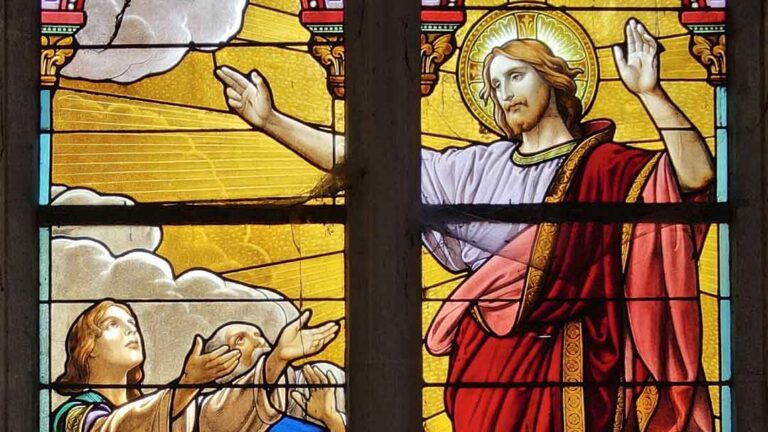
To refine our answer, let’s delve into the Gospel. In the parable of the Prodigal Son, the father waits, watching for his younger son’s return; he even goes so far as to run and “throw his arms around him” (Luke 15:20). It is also the host who never ceases to invite people to attend his son’s wedding feast (Matthew 22:2–10) and sends his servants to invite the poor, the crippled, the blind, and the lame (Luke 14:21–23). Through this parable, Jesus is very is very clear about his Father’s desire to offer every person a share in this eternal glory. In his high priestly prayer, he makes this will his own: “Father, I want those you have given me to be with me where I am, so that they may see my glory” (John 17:24), while promising us a place: “When I go and prepare a place for you, I will come back and take you to be with me, so that where I am, you may be there also” (John 14:3). This place with him depends entirely on God’s free initiative, for he alone can give himself. It surpasses the capacities of the human intellect and the strength of the human will, as well as those of any creature. We are therefore awaited—or rather, we are “hoped for.”
What about those who have gone before us? Here again, let’s listen to Christ: “There is joy in the presence of the angels of God over one sinner who repents” (Luke 15:10). Let us have no doubt that this joy also extends to all the saints!
— Don Stéphane Pélissier (article published in the magazine Chemin d’éternité No. 318)
Am I awaited?
Death always raises questions because it confronts us with the unknown: Is there really something after death? Will I be reunited with my loved ones? And am I expected there? Atheists will say there is nothing—only nothingness. But the Christian faith, on the contrary, opens the door to an entirely different perspective.
Jesus says: “In my Father’s house there are many dwelling places […] I am going to prepare a place for you. And when I have gone to prepare a place for you, I will come back and take you to be with me, so that where I am, you may be there too. ” (Jn 14:2–3). “Father, I want those you have given me to be with me where I am, so that they may see my glory. ” (Jn 17:24) In this light, Saint John Paul II said: “Earthly life is a great homecoming to the Father’s house.”
While the Father awaits us “at the threshold of his house” (as a hymn people sing at funerals puts it), Jesus also said that “many will come from the east and the west and will take their places at the feast with Abraham, Isaac, and Jacob in the Kingdom of Heaven. ” (Mt 8:11) This multitude of the elect described in the Book of Revelation (Rev 7:9) will consist of the Virgin Mary, the angels, and the saints of all ages and all nations—and, of course, our deceased loved ones. But how will I find my loved ones in the midst of this innumerable crowd? Will they be waiting for me when I arrive? Will there be a welcoming committee?
While we may have no idea of the nature of this reunion, many signs suggest that Heaven leaves no room for anonymity or oblivion. As early as the first centuries of the Church, Saint Cyprian of Carthage (3rd century ) wrote:
“Many of our loved ones are waiting for us there; a vast crowd of parents, brothers, and sons are eagerly awaiting our arrival.”
“They are already certain of their own immortality, and yet they are still anxious for our salvation. What a joy it will be for them and for us to arrive in their presence and embrace them!” Saint Thérèse of the Child Jesus wrote: “I cannot help but think tenderly of my little brothers and sisters who are waiting for me in Heaven…” The Catholic tradition thus encourages us to hope that our loved ones are waiting for us, but the nature of this reunion is beyond our earthly imagination. Love will be entirely purified by the vision of God. We will recognize ourselves in the love and truth of who we are through God’s luminous gaze—a gaze filled with wonder.
Sister Cécile (article published in the magazine Chemin d’éternité, No. 328)
Let’s not waste our energy dwelling on the past for years and years. The better we live on this earth, the greater the happiness we’ll be able to share with our loved ones in Heaven. The more we mature and grow, the more beautiful things we’ll be able to bring to them at the heavenly banquet.
Pope Francis, *The Joy of Love*, No. 258