How do we know about the afterlife? From messages delivered by The Blessed Virgin Mary? From near-death experiences? What is precisely the source of the knowledge we have about it? Rather than knowledge shouldn’t we rather call it faith or hope since after all, no one ever came back to tell us how things are “later on”? A few answers are suggested below.
For decades, our ancestors used to be surrounded in pictures of the afterlife which they thought to be intangible certainties. These days, we are faced with a more complex situation. Whilst what is called “the final ends” tends to be much less discussed in the Church, we observe an increase in the number of books claiming to reveal some of the mystery of the beyond based on testimonies of individuals’ experiences. Now, it is important for us, Christians, to have a few clear notions on the matter.
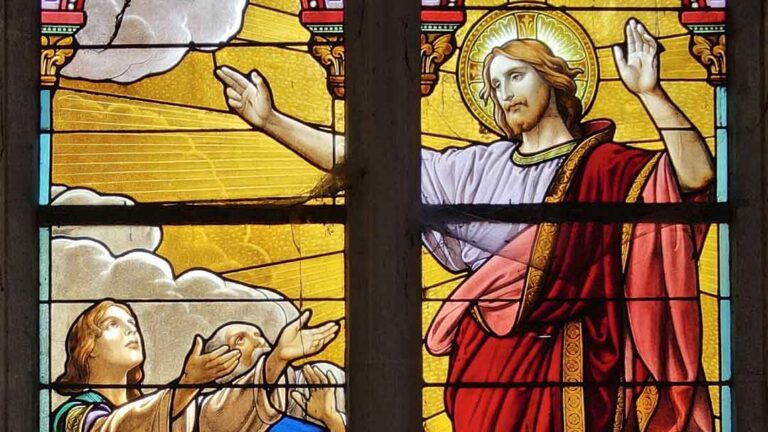
To know the afterlife is, first and foremost, to listen to, contemplate, and come to know Christ
Faith is man’s response to God, who has revealed Himself—that is, who has given Himself to us by sending His Son. A passage by Saint John of the Cross, a 16th-century Spanish mystic, is very enlightening in this regard: “Since He has given us His Son, who is His Word, God has no other word to give us. He has told us everything at once and all at once in this one Word, and He has nothing more to say […]. That is why anyone who would now wish to question Him, or desire a vision or a revelation, would not only be acting foolishly but would also be insulting God by failing to fix their eyes solely on Christ, without seeking anything else or any novelty.”
Understanding the afterlife is not a matter of seeking “something new” but of turning our gaze toward Christ. Yet this is an aspect we have often overlooked: we tend to view the mystery of eternal life as a kind of scenario projected into the future, in which we try to fathom the soul’s destiny after the body’s death. This is not to deny the value of certain experiences—which sometimes align with this perspective—but to remember that the Christian view of the afterlife is first and foremost a present and immediate focus on Christ. When Martha blamed Jesus for the death of her brother Lazarus, Jesus replied, “I am the Resurrection and the Life.”
Understanding the afterlife is not a matter of seeking “something new,” but of looking up to Christ.
Contrary to what we might instinctively imagine, the afterlife is not a reality entirely different from the one we are already living; but rather the full unfolding of all that is most beautiful and greatest in our present life—a life enlightened and already transfigured by Christ. As we often say, “eternal life has already begun”. In practical terms, this means that a moment of intense communion with those we love, or a grace we have received, constitutes a true foretaste of eternity—far more so than experiences or stories bordering on the paranormal.
Did the Church “made up ” certain things?
Of course, one might say, we must contemplate the mystery of Christ as it is handed down to us in the Gospel. But what, then, are we to make of statements that have no explicit basis in it? Nowhere does Jesus speak of purgatory, nor does he specify what awaits the soul after the death of the body. Is there not some element of invention in the Church’s faith? The Church’s teaching, as we have said, comes from revelation—a revelation that is now complete, since God has told us everything through his Son. But the revelation needs to be explained.
This explanation does not consist of a series of deductions that would allow us to expand our knowledge indefinitely. It arises from a thoughtful and prayerful reading of the Word. Purgatory, for example, is not a medieval invention, even though the term itself first appeared during that period. This truth stems from the fact that, from the very beginning, Christians have prayed for the dead, holding to the conviction of faith that it was still possible to do something for them. This conviction is itself rooted in a distinctly spiritual and Christian experience: that of the necessary purification required to draw near to God in prayer—a spiritual purification that already gives us a glimpse of what the purifying experience of Purgatory might be like.
The role of revelations
One final question may arise. What about the Blessed Virgin’s apparitions or even of a whole series of private apparitions relating to the fate of the departed? In Fatima for instance, the children had a vision of hell. In order to understand this vision, it is important to remember that it does not describe a factual situation nor that its purpose is to complete the revelation. It enlightens an aspect of it and means to call to conversion. The apparition accounts may help and encourage us on our path to sainthood. Now, if we figure out that they will further our information or teach us something new, we are proving rather poor in our faith in the end. Indeed, our true, unique treasure is faith!
Author: Bertrand Lesoing, chaplain
Source : Chemin d’Éternité No.285 – Mach/April 2018