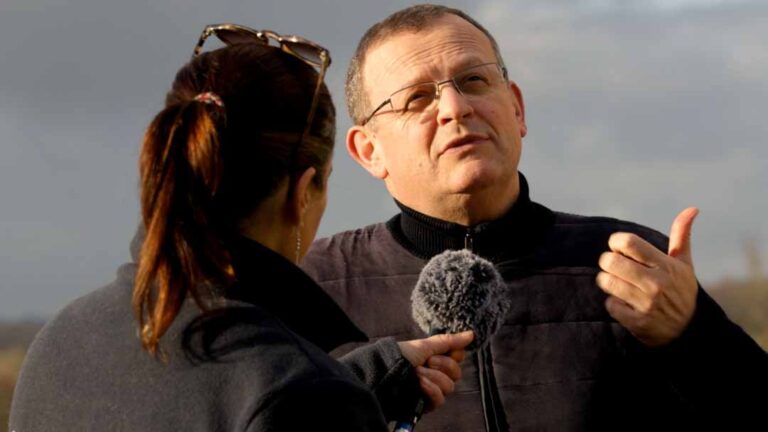
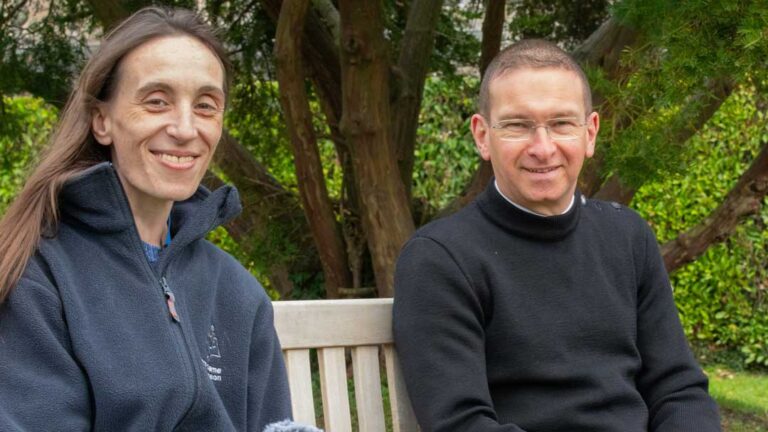
We can pray for our deceased loved ones at home or at church. So why go to the cemetery? What do we seek at a grave, and what should we do when a loved one’s grave is too far away? On the radio program Sanctuaires normands (RCF), Father Patrick Pinard-Legry, chaplain at the Notre-Dame de Montligeon Shrine, explores the meaning behind this practice. A visit to a grave emphasizes absence, but it also helps experience our connection with those we love in a different way. The question remains: what hope is there when you are faced with a body that returns to dust?
The cemetery is the place where people sleep
The word “cemetery” comes from the Greek koimêtêrion, which means “place where one sleeps.” For a Christian, this word is telling when it comes to death in that the life of the deceased does not end with their earthly existence.
“The deceased is someone who has lived out their life on this earth but has not yet ended their life.”
Their life will find its fulfillment in Heaven. That is why we lay our dead to rest in these places of rest. The prayer recited at funerals also uses the expression “to fall asleep in death.”
Thus, the cemetery is a place where we can continue to maintain a connection with our departed loved ones. Today, cemeteries are often located on the outskirts of towns. Over time, health and regulatory reasons have led to this separation. However, parish cemeteries reflect a different arrangement: the cemetery is located right next to the church.
This closeness reflects our communion in prayer with the deceased. In fact, in some villages, the dead are still buried there. So when people pray, they pray with them. This arrangement makes visible the bond between the Church on earth, those who are still in purgatory, and those who are in the glory of Heaven.
Experiencing relationships differently
Don Patrick discusses the Church’s encouragement to visit cemeteries between November 1 and 8, in connection with the plenary indulgence for the deceased 1. Even when these places are out of the way, we need to visit them regularly. Why? According to him, deep within every person lies the desire to acknowledge that life does not end with death. Philosophers have long pondered and debated the immortality of the soul.
“I visit my loved one’s grave to come to terms with the fact that the person I loved and knew is truly gone.”
However, visiting a grave also compels us to face the reality of death. The person we knew and loved is truly gone. We must therefore find a new way to maintain that relationship.
Prayer allows us to enter into this different way of experiencing our connection and to move forward in the grieving process.
In the ground or in a burial vault: awaiting the resurrection
From a Christian perspective, burial in open ground and burial in a vault have the same meaning. The difference lies primarily in the layout of the burial site: an open-ground burial lacks the structure of a vault. Don Patrick notes in this regard the simplicity of certain burials of monks and those of the early Christians 2.
This return to the earth reminds us that we are children of Adam: we return to dust, awaiting the resurrection. Jesus himself was laid in a hewn tomb, which resembles a vault. Some burial sites make this return to the earth less immediately apparent. Don Patrick refers to places where a vault would be required. And also to graves located further out in mountainous regions or, in Italy, funerary structures that resemble small residential buildings.
Next comes the question of cost: Is cremation less expensive than burial? In his former parishes, he consulted with funeral homes on several occasions. They told him that the costs could be roughly comparable. He is careful to point out, however, that prices vary by location. Here, he reports the responses he received during his ministry, without providing a general price range.
Caring for the deceased, beyond the Christian framework
The issue of the destitute reminds us that respect for the deceased is a matter for society as a whole. Don Patrick mentions the burial plots set aside by municipalities to provide them with a dignified burial. However, his remarks regarding a legal obligation to bury the deceased require further clarification 3. What matters to him here is the care given to the deceased: one does not bury them just anywhere. Even a burial on private property is subject to regulations and requires authorization. Human remains are not just any ordinary object. This consideration therefore extends beyond Christian practice alone.
In a secular society, the importance placed on burial sites continues to reflect the significance of those who have died. One example is the Pantheon in Paris. The transfer of a body involves choosing a place to honor the deceased. Military cemeteries also reflect this need. People tend to the graves of soldiers who died in wars, maintain these sites, and thus preserve their memory. Through these examples, Fr Patrick emphasizes that we need a place to honor our deceased. The care we take of their graves demonstrates this concern, even when those who provide it are not acting out of a sense of faith.
Praying for the deceased, an act of charity
Is it necessary to go to the cemetery to honor the deceased? For a Christian, any place can become a place of prayer, and any church allows us to pray for them. The Church nevertheless encourages visits to the cemetery, especially in November. Father Patrick believes that visiting regularly helps us—even on a human level—to come to terms with the death of a loved one. These visits also teach us to experience a different kind of relationship. We can no longer communicate with our deceased loved ones as we did when they were alive.
“What will unite us with them is communion and love.”
Going to pray at their graves is therefore an act of charity. An African priest he met at the shrine told him about a customary practice in his culture: when someone wishes to seek advice from a deceased person, they go to the cemetery and knock on their grave. Don Patrick sees this as an expression of a bond that endures, though he adds a warning: “There is undoubtedly something that needs to be purified, because we do not communicate directly with our deceased loved ones.” People shouldn’t expect a direct answer. Help and discernement are rather obtained through prayer and intercession.
“I won’t get a direct answer, but this deceased person will be able to help me figure things out.”
In Montligeon, we pray for the deceased, who in turn can intercede for us. Just as the church marks God’s presence in a village, the cemetery reminds us of this connection with our dead and signifies that life does not end here.
When the graves of our loved ones are in a remote location
Some people are unable to visit the graves of their loved ones. In Montligeon, Father Patrick is deeply moved by visitors who come to pray here even though they could do so in their church, at home, or in a chapel. They feel the need to go to a place where they can reconnect with their departed loved ones. He mentions, in particular, people who have come from Africa or Latin America, far from their family graves. At the shrine, they can pray just as they would at those graves. 4. What matters is the act performed: we go there just as we would when visiting a living person.
“In Montligeon, I can truly pray for my deceased loved ones as if I were standing at their graves.”
Coming to Montligeon can thus provide a way to experience this journey when one cannot go to the cemetery5. For those of us still living on earth, this pilgrimage allows us to honor the deceased, pray for them, and practice charity. There is a link between this visit and the works of mercy. It also helps us come to terms with a death that we may have sometimes refused to accept. In the midst of grief, it allows us to get to terms with the reality of the death and of the bond that remains—in a different form—with our loved one.
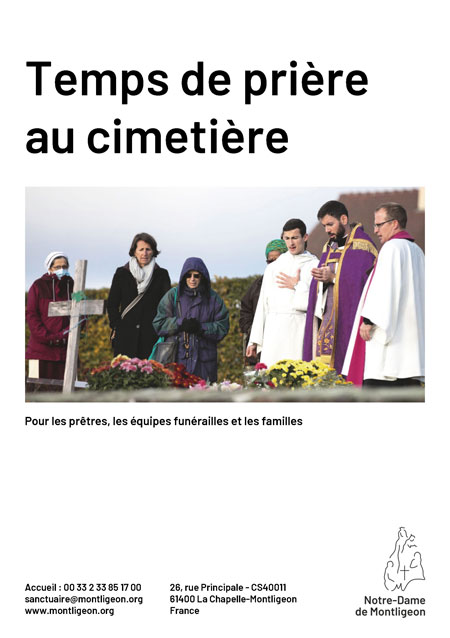
Would you like to pray at the cemetery for a deceased loved one?
Download this prayer guide provided by the Shrine of Our Lady of Montligeon for priests, funeral directors, and families.
It will guide you in your prayerful reflection with prayers for the deceased, biblical passages, and suggestions for grave blessings. A resource to help you experience this place not only as a space for remembrance, but as a place of faith and hope.
- Indulgence from November1 to 8
The Enchiridion of Indulgences, published by the Holy See, specifies that between November1 and 8, a faithful person who visits a cemetery and prays for the intentions of the Supreme Pontiff and for the deceased may obtain a plenary indulgence each day.
Under the usual conditions: sacramental confession within eight days, reception of Holy Communion on the day the indulgence is sought, and prayer for the Pope. ↩︎ - Burial Practices and Costs
This reference to monks, early Christians, and the shroud does not allow us to generalize about funeral practices across all eras. ↩︎ - Funérailles des personnes sans ressources
L’article L. 2223-27 du Code général des collectivités territoriales prévoit la gratuité du service pour les personnes dépourvues de ressources suffisantes et la prise en charge communale dans les conditions indiquées. Il prévoit aussi la crémation lorsque le défunt en a exprimé la volonté. ↩︎ - The Presence of Souls and Communion with the Deceased
The separation of the soul from the body does not imply the omnipresence of souls, and there are no wandering souls in the Christian faith. Every deceased person is judged by God immediately after death. Nor is the body a “prison of the soul,” as per Plato’s concept. Body and soul are destined to be reunited at the time of the final resurrection. ↩︎ - Works of Mercy
Visiting a cemetery is considered one of the works of mercy. In fact, it is one of the spiritual works of mercy (praying for the dead). ↩︎