In one of his fable, Jean de La Fontaine wrote: “Since there are some living people, let’s not remember the dead“, encouraging us to turn the page and dedicate ourselves to the living. Yet is it so easy? Many find it unconceivable to forget their dead, or even impossible. Should we really give up their memory to continue to live? In this talk, don Paul Denizot helps us understand how we can maintain our link with our deceased in a spirit of hope.
Is it normal to be afraid of forgetting a loved one who has passed away?
Yes, this fear is part of the grieving process. When we lose a loved one, we instinctively seek to cling to anything that reminds us of them: photos, a scent, a piece of clothing, an object, their voice, a message…
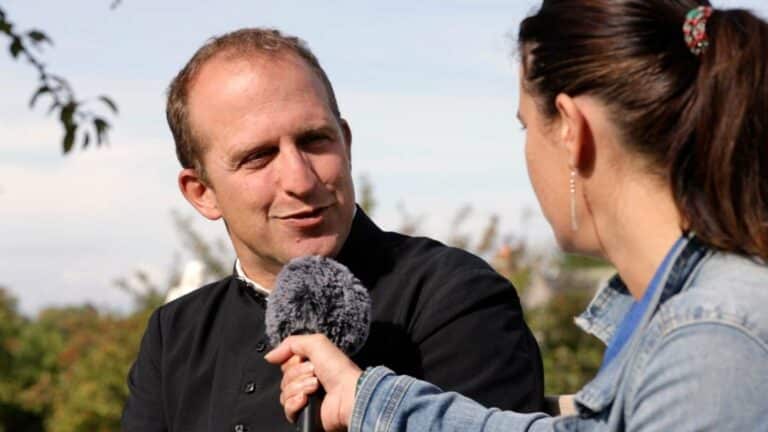
Don Paul Denizot interviewed for the program Sanctuaires normands.
Myself I have kept messages of priest friends who died a year or two ago. It’s a way to keep a live memory of what they have been. You don’t want to lose therefore you keep what you can. However, time does its part. Bit by bit the memories get blurred: voices become indistinct, the photos on a USB key disappear, a message gets erased and you don’t know why. Then comes the time of sorting things through. This time in grieving is not the same for everyone. You must not force yourself. Still, sometimes you need to accept the disappearance of certain objects or the fact that others get out of our control, in order to retain only one or two –a photo on your bedside table, a precious object. This detachment is part of how grieving tears you out of the past.
When is the right time to sort through things?
There are no hard and fast rules. Everyone moves at their own pace. Some people suddenly feel that the time is right. You also have to trust your intuition. But sometimes, people need to get support. I’m thinking of families who had turned their child’s room into a sanctuary, a tomb, a mausoleum. That can become a burden for everyone. In those cases, there’s a question to ask: Is that really what you want to keep of your child? You shouldn’t rush things, either. Everyone does what they can, at their own pace.
How can we strike the right balance?
I don’t think there’s any specific procedure or rule. Everyone copes as best they can when a loved one dies. When you lose a child, when you lose a spouse, your first priority is just to survive.
The question might come up after a while: after two or three years, what role do certain objects still play? Sometimes there are objects that hold special meaning. For example, I keep my father’s wallet. I know that one day he’ll be gone, and I’m preparing myself for that.
You can keep sentimental items, but sometimes they take up too much space.
Earlier, I was talking about turning a child’s bedroom into a sanctuary. If the room hasn’t changed in three or four years, there might be a problem. Because, ultimately, we’ve brought the tomb into the house.
The real question is: How can we live in a new way while preserving the memory of our loved ones who have passed away? Has the way I live with these objects become a bond that imprisons me, or is it a form of legacy, a new kind of presence?
Is smiling a betrayal of the deceased?
That’s not a way to forget them. Many people who are grieving figure out that, in order to keep their memory alive, they have to suffer. I remember a father who had lost his child and who once told me, “All of a sudden, I caught myself laughing. And I was thrown off balance by that joy, even though the death of my child inhabits my heart.”
Continuing to smile and live doesn’t mean forgetting the person we loved. Suffering less doesn’t mean forgetting. The memory of those we love isn’t tied to suffering—it’s a new way of loving them.
We’re all afraid of forgetting our loved ones who have passed away. Yet just because we don’t think about them every day doesn’t mean we’ve forgotten them.
For example, there are friends we love but don’t think about all the time, and yet they remain in our hearts. I don’t think about my mother all the time, and yet I don’t forget her.
We need to reassure those who are grieving: just because your loved one isn’t right in front of you every moment doesn’t mean they’ve disappeared. We can’t forget the people we love.
Yet, in the Gospel, some of Jesus’ words can be unsettling for those who are grieving.
What does “Let the dead bury their dead” mean?
These words may seem shocking. They sound harsh, almost inhuman. But we must consider them in context. Jesus himself went to pay his respects to his friend Lazarus. He wept at his tomb and comforted Martha and Mary. For him, then, it is not a matter of severing the bond with our departed loved ones—a bond that is beautiful and natural.
In this Gospel, Jesus reminds us of the Good News: hope permeates every situation in our lives, including grief.
We Christians prefer using the term “the departed” rather than “the dead”. The word “departed” means “those who have completed their pilgrimage.”
These words invite us to look not to the past, but to the future. Our departed loved ones are not behind us, they are ahead of us. Only hope matters: eternal life is given by Christ.
In other words, don’t get caught up in nostalgia. Move forward. Your loved ones who have passed away are waiting for you in the light of God.
We don’t forget our departed loved one, we move forward with them
We don’t forget them; we think of them. And in fact, in the Church, the entire month of November is dedicated to them. We pray for them on November 2, but also throughout the month.
“We refer to them in the light of hope, not with our eyes fixed on the past”
These words echo the Gospel: “Let the dead bury their dead.” It is not a matter of forgetting, but of living in hope. The departed belong to the communion of saints. We journey toward them as we move forward in life. And it is precisely this hope that allows love to continue to live on, beyond death.
Pope Francis told widowers, widows, and those who had lost a child: “Don’t spend your lives looking back at the past. The better you live your lives, the more beautiful things you will have to bring to them at the heavenly banquet.”
Can love endure and grow beyond death?
Yes. We are assured by the Christian faith that death does not sever the bond of love. That bond remains; it continues to live on beyond death. It is a spiritual presence—real, though different.
Death wounds us deeply. It strikes us at our very core. But in the light of Christian hope, we believe that this love does not die. It is transformed and grows.
It transforms and grows. For us, the dead are not dead: they are living beings. Those who have completed their pilgrimage continue to love us and to be present in another form of life.
“The bond of love that united us with them is not severed by death. We can always continue to nurture that bond of love through prayer.”
Praying for our departed loved ones, then, means continuing to love and to believe that when love is united with Christ, it never dies.
Are the dead really alive?
Dead persons are physically absent, but they are present in God. They live in Him, in the communion of saints. They are not primarily in a particular place: our hope is that they are with the Lord, that they are enjoying life—not only in our memory, but in the reality of God.
This certainty is a matter of faith. It cannot be scientifically proven.
If Christ is risen and gives life to the dead, then God takes those who have fallen asleep to be with Him alongside Jesus.
They are truly alive—even more alive than we are. And many people experience this in Montligeon. During the Eucharist, many pilgrims say they feel the presence of their deceased loved ones: during Mass in particular, they are reunited with them. This is not just an idea—it is a real encounter, experienced through faith.
Coming to Montligeon is like coming to a reunion. We pray for them and with them, in this communion that death can never break. It is also this communion that nourishes our prayers for them.
Why pray for the dead?
We pray for them because we entrust them to God. We ask Him to welcome them into His presence, so that they may fully experience the joy of Heaven. If there is anything left in them that needs to be purified, we ask that this be accomplished during their time in purgatory, so that they may enter into full and definitive communion with Him.
The closer they are to the Lord, the closer we are to Him as well, and the more united we are with one another. Prayer for the deceased is therefore not focused on death, but on life. It connects us to them in the great hope of the resurrection. To pray for the deceased is to believe that God’s love reaches them wherever they are, that it continues to transform them and unite them with us in the light of Christ.
Do our prayers still count if they are already in Heaven?
Our prayers are never in vain. Every act of love bears invisible fruit. Even if the person is already in Heaven, it is not a waste of time: the bond of love continues to grow beyond death.
Additionnally, the Lord uses our prayers and even our smallest charitable actions to bring benefit to everyone: the souls in Purgatory, the saints in Heaven, and also those who suffer here on earth. In the communion of saints, love flows and gives life to the entire Body of Christ.
In this way, every prayer becomes an act of love that allows life to flow between Heaven and Earth. Nothing is ever lost; everything is offered.
What is a meaningful way to honor the memory of someone who has passed away?
This can be done very simply, at home. We can take a photo of the person we loved, look at it, and remember the moment when it was taken. This simple act touches us and brings back memories. Give thanks to the Lord and pray for that person. Tell the Lord what’s on your mind: “You see, Lord, I miss him… I miss my father… I’d like to tell him this or that…”
The most important thing is to let your heart speak in prayer, addressing God, who bridges the gap between heaven and earth.
Simply say, “Lord, let all of this reach him—all my love, everything that is in my heart.”
Always looking toward hope: that is the heart of our faith. Saint Paul reminds us: “You are not like those who have no hope.”
Honoring the memory of the deceased is an act of living love, directed toward the light of Christ.