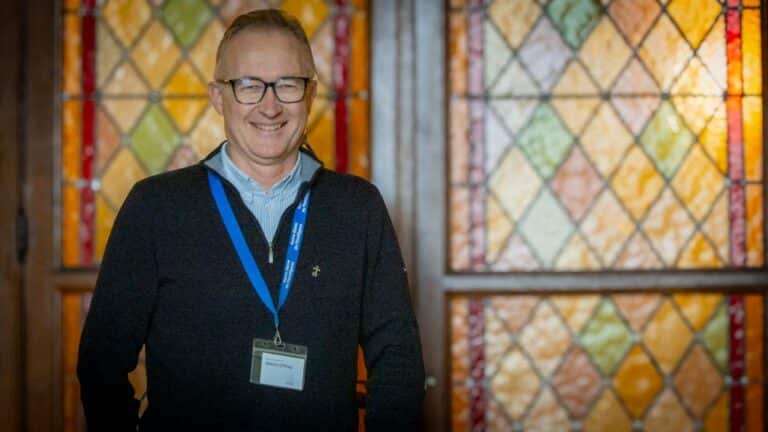
After a youth marked by upheaval and wandering, Guy Berthier discovered his faith in a cistercian abbey. Now a deacon at the Notre-Dame de Montligeon Shrine, he reflects on his journey, his calling, and his mission to serve pilgrims and those who are grieving. .
The diaconate is the first level of the sacrament of Holy Orders, which consists of three levels: the diaconate, the priesthood, and the episcopacy. The deacon is configured to Christ as a servant. He does not celebrate Mass, nor does he hear confessions. However, he can baptize, bless, preside over certain celebrations, and pray. He has a specific role in the liturgy. Some deacons aim to become priests but permanent deacons remain deacons for life. Since the second Vatican Council, this ministry has been restored to allow men—especially married men—to serve the Church.
Who can become a deacon?
The diaconate is open to any baptized male who feels a calling after discernment by the Church. He may be married or single. If a man is married, he must have been married for some time. This ministry requires availability, a strong faith, and human quaities. It is carried out alongside a professional career, and one’s work also becomes a place of ministry.
“Wherever I am, that is where I bear witness.”
My encounter with God
“After my parents’ break-up, I kind of ‘went off the rails’ as they say. I left home, started hitting the road, and went abroad. I lived a wild, carefree life. So I did seasonal work to survive including picking strawberries, harvesting peaches in the South, and picking apples. And then I was called by the Lord. I heard that there were monks in Maine-et-Loire, at the Abbey of Notre-Dame de Bellefontaine, who were looking for seasonal workers to help with the apple harvest. I went there simply to work. And there, I met the prior—a holy monk who welcomed me. Gently, with great wisdom and tact, he spoke to me and helped me reflect on the meaning of my life. At the same time, I watched the monks go about their lives. They worked in the garden; they seemed at peace with themselves, happy. That touched me deeply.
Little by little, it sank in, and let myself be won over.
My conversion
At that time, I was already cohabiting with the woman who would become my wife. The priest in charge of the hospitality at the monastery would counsel us. He made it clear to me that it might be a good idea for us to get married. I had been baptized and had received my First Communion, but we were on the fringes of the Church, somewhat marginalized. That monk taught us the catechism and prepared us for marriage. Then he married us in a small chapel attached to the abbey. And when our first child was born, he was baptized in that same place.
“We have been shaped by the spirit of the cistercian monks, by monasticism, and by their spirituality.”
It left a deep impression on us. It got etched in our hearts with great joy. When I think back on it, it was a great blessing. At that time I returned to the faith. After that, we joined some new Christian communities for a while. Today, I am married, the father of two grown children—a 50-year-old son and a 44-year-old daughter—and the grandfather of four grandchildren.
My call to the diaconate
The diaconate is a calling. It was a deacon in the diocese where I lived who spoke to me. He was my employer, who was also the director of the facility where I worked as a special education teacher. He asked me if I had ever considered the diaconate. His suggestion met the inner journey on which I was already traveling. After my conversion, when I was about 22 or 23 and I had rediscovered the faith, I had a strong desire to live it out. My wife and I lived for a while in a new Christian community, and then we left that way of life. At that time, I felt that something was missing in my life.
“This desire to become a deacon filled that void.”
It was a call to devote myself more fully to serving the Church. I began with an day to discover the diaconate, followed by a year of discernment, during which I had the option to withdraw. After that, the formation program lasted about six years.
Why Montligeon?
We arrived in Montligeon eight years ago, when we got retired. After my job as a special education teacher, I had been a chaplain at a psychiatric hospital for ten years. So when we retired, we thought about what direction to take in this new phase of our lives. We wanted to be closer to our family in western France, and my wife wanted to live in the countryside. For my part, I was worried that there would be no spiritual life in those parts. So we looked for a place near a shrine or a community. We considered several locations.
Although the house we had contemplated proved more expensive than expected, everything was made possible, through an astonishing chain of events. The Lord himself had prepared all this for us!
My missions in Montligeon
Like all chaplains, I greet pilgrims and provide a listening ear during the special sessions “Consolation for those in Grief” and “Breaks for those in Grief”. I assist with liturgical services, that is, religious services. I also write texts and meditations for various publications including Chemins d’éternité, the Rosary supplement, and other materials.
Grief and the grieving people at Montligeon
When I arrived I had no particular awareness of the question of deceased people. I was not particularly drawn by the subject. I was not keen on celebrating funeral services. However, here I have discovered this suffering –losing a loved one– and I was deeply moved by this.
“At the same time, behind this suffering I have discovered that formidable Christian hope which works as a driving force.”
People open up with great honesty but also with modesty. They strive to find a meaning to what they’re going through. That leads to some very moving encounters. What also touches me deeply is that when people come here, they find the place sublime. They say: “It’s wonderful, it’s a magnificent setting, it’s a place filled with prayer.” And I realize then how lucky we are to be here.
I look back on this journey as a series of unforeseen circumstances and encounters. Yet my path has taken shape little by little, leading me back to faith and a commitment to the Church, thereby fulfilling my need for spirituality. Today, I continue to serve God in Montligeon, listening to and supporting people through this hope that transcends death.”