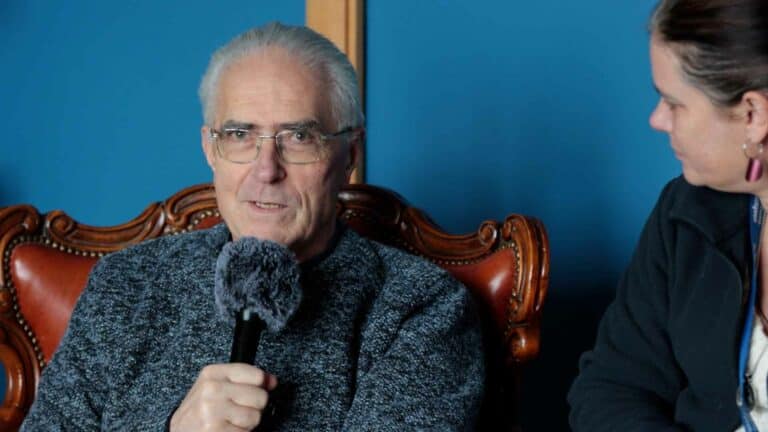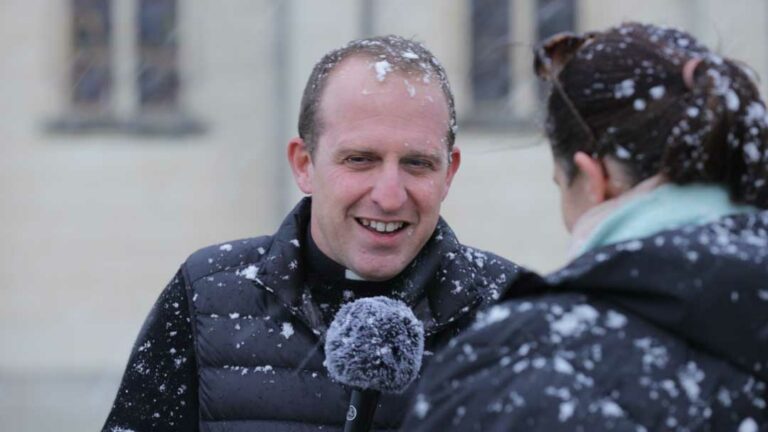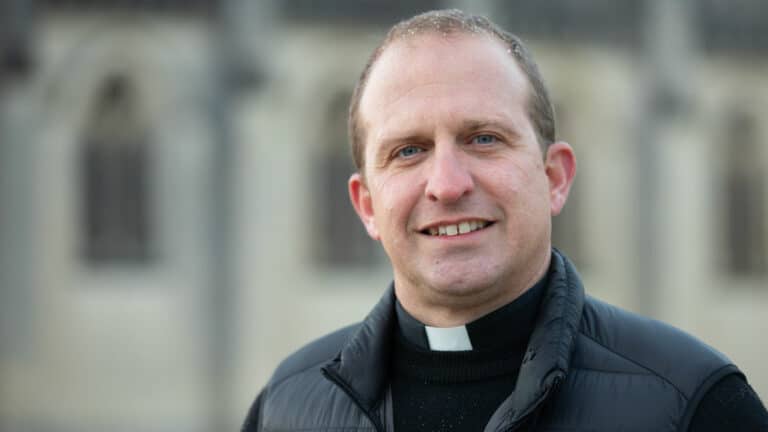
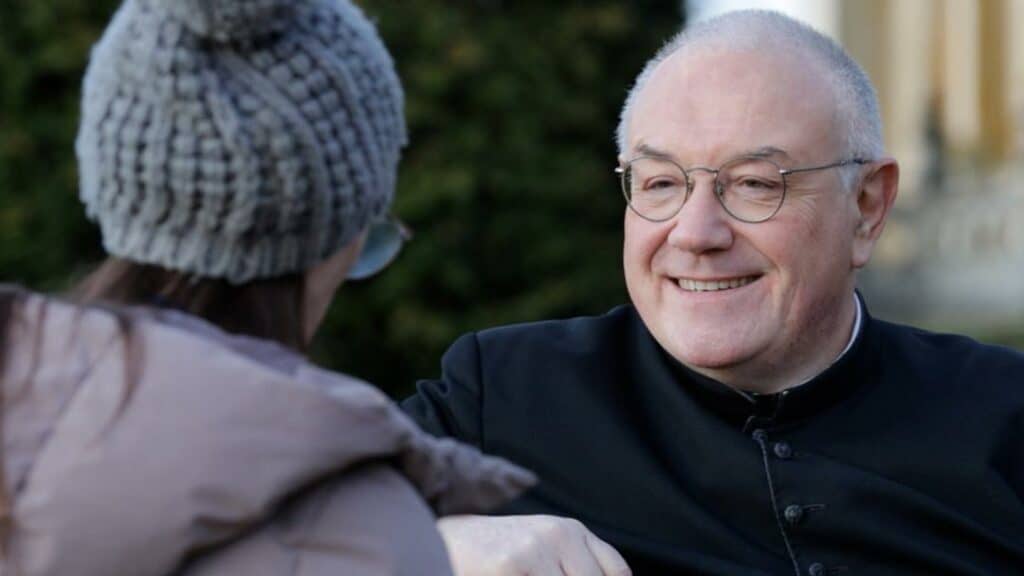
Is there an end to mourning? How can we come to the realization that a loved one is gone without denying their death nor hushing up the pain? Drawing on his experience as a counselor with bereaved persons at the shrine, Don Maurice addresses these questions. During the interview, he suggests concrete spiritual milestones to overcome absence.
This interview was completed for the program Sanctuaires normands, broadcast on Tuesdays at 19h15 on RCF Orne-Calvados-Manche.
What do the terms “mourning” and “bereavement” cover?
The term “mourning” is often used for a variety of situations, including “mourning one’s job” or “mourning a step”. Now, when death occurs, the experience of mourning is indeed an experience – brutal or not – of missing someone we used to like or love.” We do not have the same experience of their absence, depending on the relationship. After the loss of your parents, bereavement is part of the normal course of things, no matter how painful. On the other hand, when the opposite situation happens, like when parents loose a child, the pain becomes “so much more severe”. They need to realize “very gradually”, then to learn to live with their absence. This realization is not straightforward. Sometimes, there is a “kind of denial” at the time of the funerals, reflected by the fact that people “insist on putting the deceased person’s photo on the coffin” during the funeral service. This desire may indicate that, on the psychological level, they have not yet accepted that the departed will never be there anymore.
Why do some actions reflect a denial of reality?
The numbers mentioned at the start of the program correlate with the presence or absence of faith in people’s lives. Catholic practice tends to decline or disappear. However, placing a photo on the coffin, says don Maurice, may mean: “We want to keep seeing that face we won’t see anymore.” Referring to the prayers of the Church at the closure of the coffin, don Maurice reminds us that the liturgy includes a fair word to help people face reality:
“Let’s gaze at that face we won’t see anymore one last time.”
You need to distinguish between two different things, says don Maurice. On the one hand, keeping “a couple of photos” in your home showing the child, the wife or the husband. On the other hand, praying “for the repose of their soul” during the office, or the fact that you want to “keep the person with you through a photo on the coffin” may be a way to avoid reality, like when you say “S/He has departed”. “No”, corrects don Maurice, “the person has not departed, s/he is dead”. People are afraid of the word “dead”, he explains, because they don’t want that reality. Yet, he would not be forceful with them. He rather insists on one particular attitude, helping people to move forward “very gently”, because “the pain or the suffering we are dealing with are so great” and helping the bereaved to walk that path.
Does talking about a “duration” make any sense?
“Yes and no”. Hopefully there will be some boundaries, however “bereavement has got no end.” Absence remains, more or less acutely. The strength of suffering depends on “how strong the love bind has been” between a wife and a husband, parents and their child, children and their parents or grand-parents. Don Maurice uses a metaphor to help understand the shock. When some people apologize because they are crying, he says: “You lost a child, you lost a wife, a husband, that’s amounts to a collision with a truck.” This image opens people’s eyes sometimes, he says, because it puts words on what they have been through.
Moreover, this is what happens when two people have shared fifty or sixty years living together, explains Don Maurice. From one day to the next, one of the two remains alone. Well, on the day of their wedding, they got married “forever”, didn’t they. Therefore, the break can be compared to “a collision with a truck”. “The mourning process starts from that point.” Getting used to living with absence takes time. It “never ends”, stresses don Maurice. For instance, he says, a mom who has lost a child may get up everyday wondering where her son or daughter is. However, a “reconstruction process” also takes place: “Bit by bit, people rebuild their lives”, depending on the situations and the persons involved,
How can a life be rebuilt on a different basis?
After establishing those differences between the various bonds and the severity of the impact, don Maurice suggests a mean duration. Usually, he says, according to his observations, “it takes three years”, although, clearly, we should not “slice up time” too much. In the first year, he says, people relive the events one after the next, Christmas, Easter, the birthday… each time the question returns: Why is s/he not there? Suffering then can be “colossal”. In the second year, people have generally admitted that the other person is no longer there. The pain is still present but one gets used to absence. Then comes the third year. He says it with caution, although some psychologists may object to his time-slicing, reporting what he has been observing “as a parish priest” for 33 years. At that stage, “people start emerging” and “rebuild their lives on a new basis.”
Rebuilding does not mean that you forget. There is still a difference between loosing a child and loosing your parents, and the different sensibilities matter. Besides, you see what people voice or don’t voice. Some think that men have less difficulty to go through that period. “They don’t”, replies don Maurice. Men keep their feelings inside more than women. However, suffering and pain remain the same, “just as great for a man than for a woman.” Then, people live with the absence, until the time when they will “‘enter eternity too.”
Does faith make a difference in the journey and the prayer?
To address this question, don Maurice refers to both his life experience and to those he has been counseling. He remembers his own losses – his parents and grand-parents, some close friends and some members of his family. He also shares something he heard in his family, when his brother, who had lost his wife, had then told him: “If I had not had faith, I would have thrown myself against a wall.” This is one experience amongst many more: “There are thousands and thousands more.” Yet, those words were the key to understanding something: “Hope, when it is anchored in faith and in a life lived in Christ, completely changes the way you go through bereavement.”
Changing does not mean suppressing. “Faith will not suppress the pain, it won’t suppress the suffering”, he says. Sometimes, people ask him : “If you’re a Christian, why are you crying?” His reply is simple: “Because it hurts.” So, faith does not remove the tears but it opens “a meaning, a direction, a goal”. He describes this horizon in the following terms: “I know that one day, in eternity, I will find those I love to be in God’s heart, in a different mode.” He links that with faith, hope and charity, as well as to a grace for living and sharing. Then, to conclude, he uses an inner image: “That light which grows in our heart” as we get to realize that those we love “are in God’s heart.”