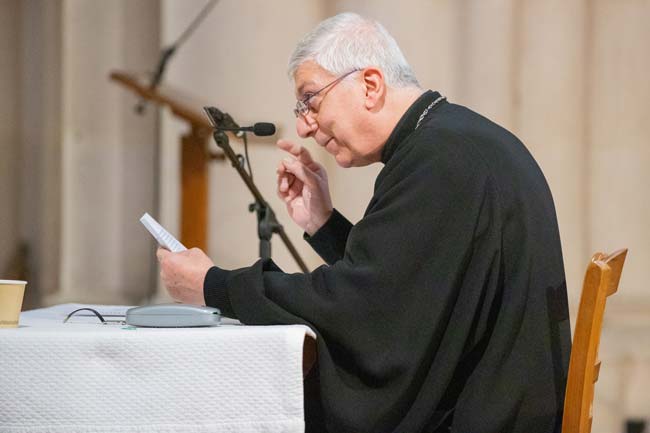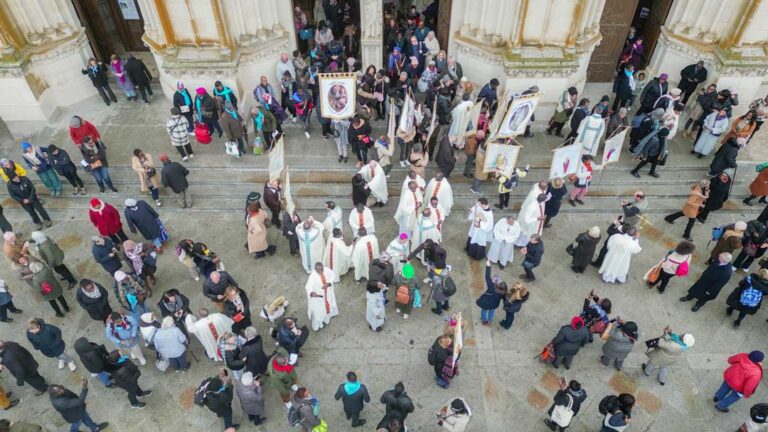
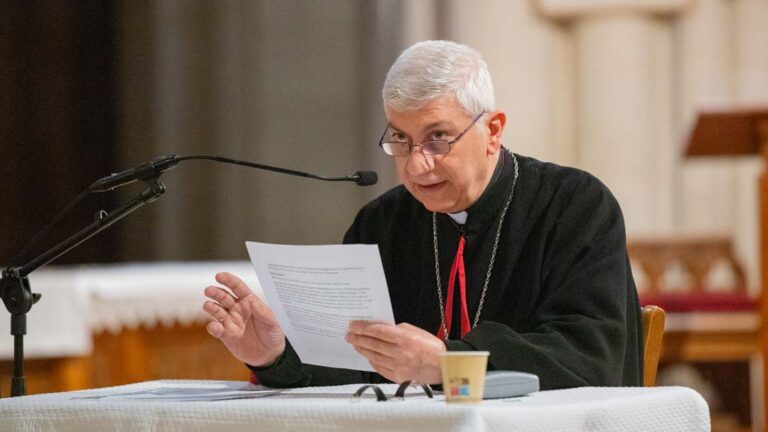
Why talk about death without giving in to fear? On November 22, 2026, at the Shrine of Our Lady of Montligeon, Archbishop Joseph Tobji, the Maronite Archbishop of Aleppo (Syria), gave a lecture on death and eternal life. Drawing on the Catechism of the Catholic Church, he addressed the particular judgment, purgatory, hell, and the resurrection of the body. He then referred to the image of birth proposed by Father Henri Boulad, the words of the saints, and the witness of the martyrs, particularly the Christians of Syria. A meditation on Christian hope in the face of death.
Archbishop Joseph Tobji, Maronite Archbishop of Aleppo (Syria) • Shrine of Our Lady of Montligeon • November 22, 2026, 3:00 p.m.
Introduction
My dear friends.
Today, I’d like to talk to you about a subject we’d rather avoid. We rarely talk about it at the dinner table or among friends; we quickly change the subject. And yet, it is the only event we are all absolutely certain will happen to us. Not success, not wealth, not even good health. There is only one event that is 100 percent guaranteed for each and every one of us: death.
So why talk about it tonight, and why talk about it with a smile, almost with joy? Because I believe, along with the whole Church and the saints who have gone before us, that we’ve been looking at it the wrong way. We view death as a wall. But what if, in reality, it were a door?
A priest whom I admire greatly, Father Henri Boulad, wrote a book whose title sums up what I’d like to share with you tonight: “To Die Is to Be Born.” Three words that turn everything upside down. We will proceed guided by the teachings of the Catholic Church, with the help of a few saints and martyrs who faced death without flinching.
I’d like to suggest five steps. First, what our faith truly teaches, based on the Catechism: judgment, purgatory, and the dramatic freedom to say “no” to God. Next, the beautiful image of Father Boulad. Then, the words of a few saints. Next, the martyrs—both past and present—those who chose death rather than deny Christ. And finally, eternal life, so that we may conclude not in fear, but in hope.
Part One: What Our Faith Really Says
What does the Catechism of the Catholic Church say about death?
First, there is a passage that is very accurate and very human: death seems to thwart that impulse toward life that lies deep within us. It’s normal to find it unacceptable. Even Christ, in the Garden of Gethsemane, was afraid of death. So if you’re afraid, rest assured—you’re in good company.
But here is what our faith adds. The Catechism teaches us, in number 1051, that every person, in his or her immortal soul, receives his or her eternal reward immediately upon death, in a judgment called the particular judgment, rendered by Christ Himself. Note well: this judgment is not rendered by a stern and distant judge. It is rendered by the One who loved us first, who died for us on a cross. We have often been told this in a frightening way: “You will be judged.” But the true meaning is rather this: “You will finally be looked upon by the One who loves you, in all truth.”
And what happens next? The Catechism presents us with three possible fates: heaven, purification in purgatory, and damnation. Let’s look at them one by one.
Heaven
For those who die in God’s grace, in full communion with Him, and perfectly purified, there is immediate eternal life—the vision of God face to face.
Purgatory
But what happens to all those who die in God’s favor but are not yet perfectly purified? That is the whole point of purgatory, and I’d like to dwell on it for a moment, because it is a truth of our faith that is often misrepresented, yet deeply beautiful.
Let’s start by saying what purgatory is not. It is not a “temporary hell,” a kind of prison where God would make us pay, through punishments, for the sins we have committed. Nor is it a second chance after death, as if we could still change our minds about God. The Catechism is very clear: those who die in God’s favor are assured of their eternal salvation. In paragraph 1030, it states that these souls are assured of their salvation. After death, they enter a period of purification in order to attain the holiness necessary to enter into the joy of heaven. Purgatory is therefore already the threshold of heaven, not the antechamber of hell.
And why purification? Because God is holiness itself, and the human heart—even that of someone who sincerely loves God—often remains burdened by attachments, petty selfishness, and poorly healed wounds, which are the consequences of sins that have been forgiven but not atoned for. The Catechism, in paragraph 1472, explains that sin leaves a kind of mark within us—a disordered attachment to creatures—that needs to be healed, either here on earth or after death. In other words, we cannot enter into the full light unless everything within us that stands in opposition to it has been gently restored to its proper place.
This isn’t a punishment; it’s a way to finally get ready for the celebration. Think, too, of how gold is put through fire to remove its impurities. St. Paul himself uses this image in his First Letter to the Corinthians 3:15: everyone’s work will be tested by fire, and whoever’s work withstands the test will be saved, but, he says, “as through fire.” Church tradition has always understood this fire to be the fire of God’s love, which burns away what is not love so that only what is true may remain.
There is a saint, Catherine of Genoa, who meditated deeply on this mystery. She said that the souls in Purgatory experience immense joy—the joy of being certain of their salvation and of knowing they are loved—mingled with suffering; that is to say: the ardent desire to see God, while at the same time recognizing what, within them, still prevents them from being fully united with Him. You see: this is not the suffering of one who is afraid; it is that of one who loves and longs—the suffering of a lover awaiting a reunion.
And this is where Purgatory speaks to us, the living. For while the souls in Purgatory can no longer change their fate on their own, we can help them. This is the beauty of the doctrine of the communion of saints. Already in the Second Book of Maccabees, Judas has a sacrifice offered for his fallen soldiers, because he considers it “holy and pious” to pray for the dead. Since the early centuries, Christians have prayed for their dead, had Masses celebrated for them, and offered alms and sacrifices. The Catechism, in paragraph 1032, expressly invites us to do so, saying: our prayer for the deceased can not only help them but also make their intercession for us effective. The one we loved is not lost: we can still do something for them, and they can still do something for us. This also changes the way we experience grief: it is not just about tears; it is also about prayer and the love that continues.
So let us no longer speak of purgatory with fear. Let us speak of it as yet another act of God’s mercy, until we are able to bear the joy of His light.
Damnation: The Rejection of Love
It would be dishonest not to tell the whole truth. Our faith also teaches us that there is a third possibility: hell, or eternal perdition. I want to speak of this seriously, but without beating around the bush, because we cannot speak honestly about human freedom without addressing this risk.
In numbers 1033 through 1037, the Catechism explains that to die in a state of mortal sin, without having repented and without having accepted God’s merciful love, is to remain separated from Him forever, by our own free choice. Take these last words to heart: by our own free choice. The Church has never taught that God sends anyone to hell. The Catechism states this explicitly in number 1037: God does not predestine anyone for hell. On the contrary, He desires that all people be saved. Hell is not something God decrees against us; rather, it is the definitive rejection of God that becomes, in a sense, its own punishment.
Let’s consider a simple analogy. God is like the sun: He shines for everyone, without ever withdrawing. But anyone who voluntarily locks themselves in a room, closes all the shutters, and stubbornly refuses to open them will eventually end up living in darkness—not because the sun has stopped shining, but because they have rejected the light. Love is never forced upon us. If God were to force our hearts, it would no longer be love—it would be coercion. He created us free, and that freedom is so real that it can go so far as to say “no”—and to stand by that “no” to the very end.
At the end of time, at the Last Judgment, this distinction will be made clear: some will enter into eternal joy—those who have welcomed the love of Christ; the others will remain in perdition—those who, of their own free will, until their last breath, have rejected Christ and his mercy. Christ himself, in the Gospel, did not hide this reality: he speaks of it with gravity, precisely because he loves us and does not want us to be lost.
But let us be neither naive nor anxious. The Church never tells us that this or that particular person is in hell. It canonizes saints; it never “condemns” anyone personally. And above all, there is room for mercy right up until the very last second of our lives: the good thief, on his cross, needed only a moment to hear, “Today you will be with me in Paradise.” ” The purpose of this doctrine is not to terrify us, but to take us seriously: our freedom matters, our choices matter.
The Resurrection of the Body
At the end of time, when Christ returns in glory, everyone will be raised with their bodies, as the Catechism tells us in number 1040. Our faith does not teach that only our soul survives, like smoke rising from the body. It teaches that the body itself—transformed and glorified—will rise again. The body that worked, loved, suffered, and embraced—that very body will share in eternal life.
Our faith, then, does not deny death. But it places it within a story far greater than itself—a story that begins in God’s love and ends in that love, for all who are willing to let themselves be welcomed into it.
Part Two: The Image of Father Boulad
Father Henri Boulad, the Egyptian Jesuit who spent his life preaching and writing, offers a magnificent image to help us understand all of this. Here it is.
Imagine a baby, still in its mother’s womb. If that baby could think, and someone asked it, “Tell me, what comes after you’re born?” it wouldn’t be able to answer. For the baby, the only reality is that small, warm, dark space where it lives. It has no idea that there is light, a sky, faces, colors, voices—a whole vast world waiting for it. And yet, that world truly does exist, just on the other side of the passage.
“Well,” said Father Boulad, “we are exactly like that baby.” Our life on this earth is a bit like nine months in the womb. That’s where we form our hearts and our character. And then comes a moment of transition—narrow, sometimes painful—which we call birth for the baby, and death for us. But on the other side, there is a world, a light, a face waiting for us. And that face, for us Christians, has a name: it is the face of God.
Father Boulad even says that we die because we have not yet been fully born—to ourselves, to others, to the world, and to God. Throughout our lives, we are born a little more each day. A child is born into walking, then into speech, then into friendship, then into love. And death is said to be the final birth, the greatest one—the moment when we finally become fully ourselves, in the light of God. This image, then, reassures us; it strengthens within us the virtue of hope.
Part Three: What the Saints Tell Us
It would be dishonest of me to offer you nothing but lofty theories. Real men and women, of flesh and blood, have faced death with peace—and even joy. The saints are those who have already made the journey and are sending us news from the other side.
The best-known testimony is that of Saint Thérèse of Lisieux. This young Carmelite died at the age of twenty-four, ravaged by tuberculosis and in great pain. And yet, in her final days, she kept repeating to her sisters: “I am not dying; I am entering into life.” Even as her body was failing her, she was certain that what awaited her was not nothingness, but a life more real than the one she was leaving behind. She also said that she wanted to spend her time in heaven doing good on earth, so certain was she that death does not truly separate those who love one another.
There is also Saint Francis of Assisi, who composed the Canticle of the Creatures shortly before his death. Do you know what he calls death in it? He calls it “sister”: “Praised be You, my Lord, for our bodily death, our sister.” ” A sister isn’t a monster; she isn’t an executioner. She’s a member of the family who comes to take you home.
All these witnesses tell us the same thing: we can look death in the face, without deluding ourselves, and still find peace, because we know who is waiting for us on the other side.
Part Four: The Martyrs, Witnesses to the Very End
There are even more radical witnesses. Thérèse and François welcomed death as it came to them. Others had to choose: deny Christ and live, or remain faithful and die. They are called martyrs, a Greek word that simply means “witnesses.” They show us that the hope of eternal life is not merely a comforting idea, but a real force, stronger than fear.
Saint Paul Miki and his companions, in Japan
My thoughts turn first to Saint Paul Miki, a young Japanese Jesuit, and his twenty-five companions—priests, religious, laypeople, and even children—who were martyred in Nagasaki in 1597. After enduring the cold, humiliations, and a long forced march, they were tied to crosses atop a hill facing the sea. And there, from the top of his cross, what did Paul Miki do? He preached. He declared to the crowd that the only path to salvation is Christ, and he publicly forgave his executioners. Those who were there report that the martyrs were singing, that some were praying aloud, and that one of them—a child of about twelve—simply said he was going to heaven. Here were people dying while forgiving and singing. There is no other way to explain this except through the certainty of the life that awaited them.
Saint Barbara, a martyr from our Eastern lands
There is also a martyr from our own region: Saint Barbara, also known as Saint Barbe. According to tradition, she was born in the third century in Heliopolis—today’s Baalbek—in ancient Syria, and her veneration has remained alive in all the Eastern Churches. She was the daughter of a wealthy pagan, Dioscorus, who locked her away in a tower to protect her from the world. But from her tower, Barbara gazed at the sky, seeking God, and she eventually found Him: she was baptized.
When her father learned that she was a Christian, he flew into a terrible rage. Tradition has it that she was handed over to the judge, tortured, and offered—as all martyrs are—the same choice: to renounce Christ, worship idols, and live. Barbara refused. She refused to give in to fear; she refused to yield to threats; she even refused her father’s love when that love demanded that she renounce Christ. And according to tradition, it was her own father who took up the sword. Consider the anguish of this scene: she dies at the hand of the one who gave her life, and she dies without having denied the One who had given her eternal life.
In many of our Eastern countries, Saint Barbara is still celebrated on December 4. We are not celebrating a victim—we are celebrating a young woman who was not afraid, because she knew where she was going.
Christians in Syria Today
And now, my friends, I cannot speak of martyrs without speaking of my people. I am Syrian. I come from this land where, in Antioch, the disciples were first called Christians, and where Saint Paul was struck by Christ on the road to Damascus. Our land is as old as our faith. And it is on this land that, even today, men and women have died simply because they were Christians.
What I’m about to tell you, I didn’t read in a history book. I heard it directly from the survivors: families, priests, neighbors, and friends of those who disappeared.
During the long years of war, in regions that fell into the hands of jihadist groups, being a Christian became in itself a reason for persecution. Churches were desecrated, families were driven from their homes, and men and women were arrested for one reason alone: they bore the name of Christ. Survivors recount that some were detained, beaten, tortured, and humiliated—sometimes for weeks on end—solely because they were Christians. And they were always offered the same way out, just as Barbara was: all they had to do was say a few words, deny Jesus, and their lives would be spared.
That’s where what I was told becomes truly moving. With a knife already pressed against their throats, several of these Christians refused to renounce their faith. They could have spoken, saving their lives in an instant. Instead, they chose to say, “I am a Christian.” ” Some, I’ve been told, even spoke the name of Jesus to the very end. What was going on in their hearts at that moment? We cannot know the details. But we see the result: ordinary people—fathers, young people, women—who did not consider themselves heroes, and who, in the moment of trial, chose Christ over their own lives.
What does this tell us? It tells us that they did not fear death as much as they feared losing the One who is Life. For them, denying Jesus would have been true death—the death of the soul, separation from the One they loved. To die for Him, on the contrary, was to enter into that life we were talking about. This is exactly what Jesus had promised: “Do not fear those who kill the body but cannot kill the soul.” ” That is exactly what Thérèse was saying in her own way: I am not dying; I am entering into life. They may never have read a book about eternal life, but they were already living it through their trust.”
This is the face of Christian hope: a quiet strength that does not respond to violence with violence, and that, even in the face of the sword, remains faithful to love.
From its very beginnings, the Church has taught that the blood of the martyrs is the seed of Christians. My brothers and sisters in Syria are calling out to us today: and we, who face neither knife nor executioner, what is it that sometimes prevents us from simply saying, in front of our colleagues or friends, that we believe in Jesus Christ? They also ask us to pray for them, not to forget them, and to support those who, even today, live out their faith at the cost of their own safety.
Part Five: Eternal Life—A Hope, Not a Threat
Let’s turn to this phrase that we repeat every Sunday in the Creed, without always giving it much thought: “I believe in eternal life.”
It is not simply a life that lasts a very, very long time, as if we were extending earthly existence indefinitely. It is a life of a different quality, a life in which we will see God face to face, in which, as the Catechism tells us, we will finally be fully ourselves, without any further limitations, without any further separation.
And I’d like to reassure you about one thing. Many people, when they hear talk of judgment, hell, and purgatory, think that the Christian faith is a faith based on fear. But look at the order of things. Before speaking of judgment, the Church first tells us this: God wants our happiness. He is not waiting to catch us in the act. He awaits us with open arms, like the father of the prodigal son, who runs toward his son even before the son has finished his words of apology. The particular judgment is not a cold courtroom: it is an encounter with Love, who, by looking at us with truth, completes our purification and transformation. And if hell exists, it is not because God ceases to love, but because love, to be true, must respect even the freedom of those who reject it. The door remains open until our last breath: it is up to us not to close it.
Eternal life, far from being a threat hanging over our heads, is the greatest promise ever made to us: the love we have given and received here on earth never dies; it finds its full fulfillment on the other side of that passage we call death. Nothing that has been experienced in love will be lost.
Conclusion
My friends, I would like to conclude with a very simple image.
When a child is about to go to summer camp for the first time, far from his parents, he may feel scared, especially the night before he leaves. He doesn’t know the place, and he doesn’t know what to expect. But if they know that their parents love them, that the place they’re going to has been carefully prepared for them, and that their parents themselves will join them there soon, then their fear—while not disappearing completely—gives way to something else: confidence.
Death remains a narrow passage, sometimes a difficult one—I won’t try to tell you otherwise. But this passage leads to a light, to a face, to open arms. That face is God’s, who has been waiting for us from the very beginning, and who has but one desire: that we may finally be born, fully, into the life He has prepared for us—provided we accept it.
So let us not be afraid. Or rather, let us feel that perfectly natural fear, but let hope shine through it. For “to die is to be born.”
Thank you for your attention.