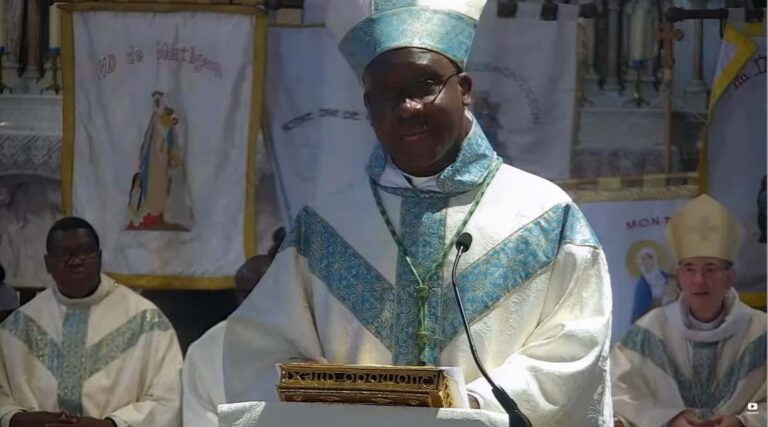
Homily by Archbishop Roger Houndjébedji of Cotonou on the Solemnity of the Assumption, Saturday, August 15, 2026
Dear brothers and sisters in Christ,
On this Solemnity of the Assumption of the Blessed Virgin Mary, we are gathered here at this renowned center of spirituality to honor Mary. Through her, our purpose is also to pray for our departed brothers and sisters who have gone before us to the heavenly homeland. Yes, celebrating Mary’s Assumption means commemorating her entry, body and soul, into the glory of her Son—the glory of the resurrection, which stands as the triumph of life over death.
Celebrating the Assumption of Mary in this place dedicated to prayer for the deceased must therefore have a twofold significance for us. First, this celebration reminds us of the central mystery at the core of our Christian faith: Christ’s victory over death. Indeed, as the Apostle Paul reminds us in today’s second reading: “ Christ has been raised from the dead, the first to be raised from among those who have fallen asleep.” We are gathered here this morning to honor Mary and to pray for our dead, and in particular because we firmly believe that Christ, the first to rise from the dead, is the one in whom our faith rests: “If Christ has not been raised, our faith is futile,” Saint Paul tells us. It is because Christ is the first to be raised that he welcomed Mary, his Mother, into his glory. It is also because he rose from the dead that we can pray for our departed, so that, purified of their sins and impurities, they too may enter into his glory.
Furthermore, the celebration of the Assumption also reminds us that Mary, as a daughter of our race, has already been taken up, body and soul, into the glory of the risen Christ. The resurrection of the body is therefore no longer a pious promise: it is already a reality in the life of Mary, the first to have believed “in the fulfillment of the words spoken to her by the Lord.”
This very triumph of Mary over evil and death—her entry into the glory of her Son—is described to us by the Apostle John in the passage from the Book of Revelation which we have just heard in the first reading. This text tells of a woman who, in the frailness of her human condition—she is pregnant and crying out in the pain and agony of childbirth—is faced to Evil. Evil is portrayed as a fearsome dragon that threatens to devour the unborn child and to pursue the woman. But the woman gets miraculously saved from evil and death by the almighty power of God.
Mary is indeed the one who embodies the figure of the woman rescued from the constant threat of evil and death. In this, she appears as a model: she is the mother of hope. In fact, she shows us how, in the face of the reality of evil, suffering, and death, the believer rooted in the death and resurrection of Christ can never give in to despair. He or she holds fast to the hope of a new life, which is the hallmark of his or her own resurrection. Mary, whose Assumption into heaven we celebrate today, is the one whose life bears witness to the victory of life over death. Her Assumption into Heaven thus stands as the crowning achievement of her life on this earth. Through today’s Gospel reading, we can identify three key attitudes presented as models to follow so that we, too, may attain the triumph of life over death.
The first attitude is Mary’s enthusiasm
Mary is filled with an enthusiasm (a strength of spirit) that clearly shows life’s triumph over death. In fact, according to Luke’s account, after the angel’s visit, Mary “hurried to the hill country, to a town in Judea.” Note that the great haste, the eagerness, of Mary to go to her cousin Elizabeth’s home. The excitement she displayed as she eagerly made her way through the mountainous region is a sign of the life of Christ she was already carrying within her. This means that one cannot have the life of Christ within oneself and remain stagnant, closed off within oneself: the life of Christ present within us draws us out of ourselves to reach out to others and enthusiastically show them our closeness.
Dear pilgrims, your presence here to honor Mary and to pray for the dead is a sign of your enthusiasm, an evidence of the life of Christ present within you. Aware of this new life of Christ that dwells within you, you have come to this place to give thanks to the Lord of life and to pray, through Mary’s intercession, that this life may shine ever more brightly in those who have gone before us to heaven and who bear the mark of faith in Christ. May this Mass sanctify them and enable them to enter into eternal happiness.
The second attitude shown by Mary is her joy
Throughout her earthly life, Mary was filled with immense joy, which reflects life’s triumph over death. Mary’s joy is so great that she cannot keep it to herself: she radiates God’s joy and shares it with all who meet her. The same thing happens with Elizabeth, whom the Gospel passage tells us about: “Now when Elizabeth heard Mary’s greeting, the child leaped in her womb. Then Elizabeth was filled with the Holy Spirit and exclaimed in a loud voice, ‘Blessed are you among women, and blessed is the fruit of your womb.’ ” In describing how John the Baptist leapt for joy in his mother’s womb, ‘the evangelist Luke uses the Greek term “σκιρτάω,” meaning ‘to leap,’ the same term found in one of the oldest Greek translations of the Old Testament to describe King David’s dance before the holy ark, which had finally returned to its homeland (2 Sam 6:16)”[1]. This detail leads us to conclude that the New Testament recognizes Mary as the Ark of the New Covenant[2].
[1] Benedict XVI, Homily for the Solemnity of the Assumption, Monday, August 15, 2011.
[2] Ibidem.
Mary is the source of our joy, the Ark of the Covenant, whose presence—or even whose very mention—fills all generations with joy. In her presence, men and women of every age sing and dance with joy, like David and John the Baptist. She is God’s treasurer[1], the tabernacle of grace, the bridge between the Old Covenant and the New, the woman who knew no corruption, the Mother of Jesus, our mother, the model of our humanity whom God welcomes into His glory.
The life of God that Mary carried within her was indeed the source of the joy that radiated from her. This means that we cannot have the life of God within us and remain in sadness. The life of God is synonymous with joy, even in the midst of life’s tribulations that overwhelm us. To be women and men of hope is to bear witness to this joy of God in the midst of life’s trials and sufferings.
[1] See *Treatise on True Devotion* by Saint Louis-Marie Grignon de Montfort.
From this perspective, the Apostle Paul strongly urges us: “ Rejoice in the Lord always; again I say, rejoice. Let your gentleness be known to all people. The Lord is near. Do not be anxious about anything, but in every situation, pray and make your requests known to God, giving thanks. And the peace of God, which transcends all understanding, will guard your hearts and your minds in Christ Jesus. ” (Phil 4:4–7). May Mary, mother of hope, help us share in her joy and peace so that we may truly bear witness to them throughout our lives.
The third way in which Mary bears witness to the triumph of life over death is her ability to remember God’s deeds in her life and in the lives of her people
Indeed, through her song of thanksgiving (the Magnificat), Mary recalls the marvelous deeds God has performed in her own life and in the life of the people of Israel: “ The Lord has looked upon his humble servant; from now on, all generations will call me blessed. The Almighty has done great things for me; holy is his name! “
As she reviews God’s actions in her life, Mary recognizes and emphatically affirms that God is truly present in her life. God acts within her with His almighty power, so that life may triumph over death. Indeed, the Lord who acts in her life is the One who reveals Himself as the God of hope who cares for the little ones and the weak: “ With the power of his arm, he scatters the proud. He brings down the mighty from their thrones and lifts up the lowly. He fills the hungry with good things and sends the rich away empty-handed. “
This means that Christian hope is rooted in the history of salvation, in the remembrance of what God has done. And following in His footsteps, the Christian people continue to proclaim: “ He remembers his love, the promise made to our fathers, to Abraham and his descendants forever.” The evangelist Luke shows how Mary treasured these events and pondered them in her heart: “ Mary treasured all these things and pondered them in her heart.” ” (Luke 2:19). And a little further on, he adds: “ His mother treasured all these things in her heart.” (Luke 2:51).
It seems that for the true believer, there is no such thing as a neutral—or even secular—event. God reveals Himself and attests to His presence through events. Thus, to meditate in one’s heart is to reexamine events in order to discern God’s work in them. For those who know how to read God’s deeds in their lives by recalling past events, there is no reason to despair of life. For if God was able to act in the lives of His people to save them from death, He will certainly raise from the dead those who place their trust in Him.
May we, following Mary’s example and through her intercession, place all our trust in God, so that we may bear witness to Him with enthusiasm and joy, and with the ability—like Mary—to recognize God’s actions in our daily lives. May the Lord grant us this grace—He who lives and reigns now and forever and ever. Amen!