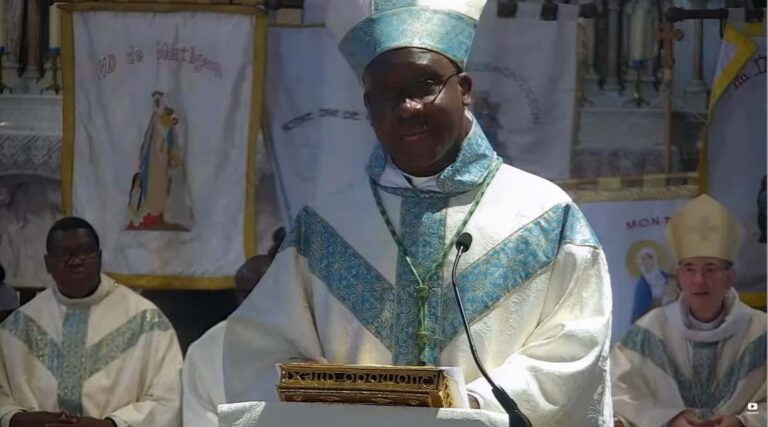
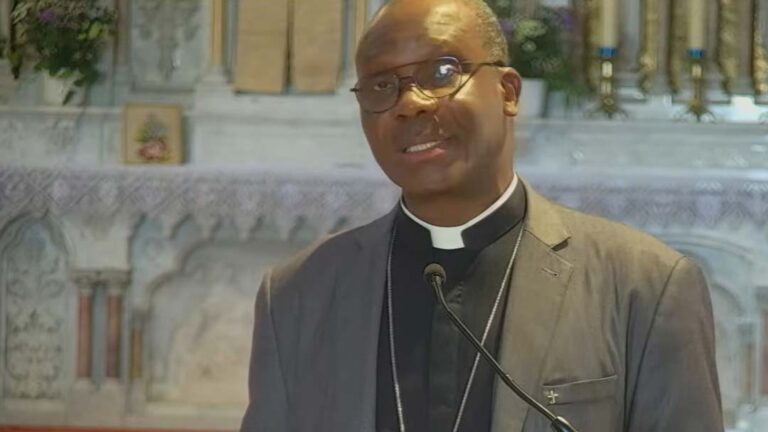
Archbishop Roger Houngbédji of Cotonou explores the theme of “Mary, Mother of Hope.” This homily was delivered on the Solemnity of the Assumption in 2026 at the Shrine of Our Lady of Montligeon.
Mary, Mother of Hope
Dear pilgrims, dear brothers and sisters in Christ,
On this Solemnity of the Assumption, I am delighted to be with you at this sacred place of spirituality dedicated to prayer for the faithful departed, to strengthen you in the faith and to share a few reflections with you. The theme proposed for our meditation is: “Mary, Mother of Hope.” The Jubilee of 2025 gave us the opportunity to reflect at length on the theme of hope, which is one of the fundamental tenets of our Christian faith. On that occasion, Pope Francis invited us to set out on a journey of faith as “pilgrims of hope,” called to rekindle our faith and never give in to despair, but rather to entrust ourselves to God, who never abandons those who rely on him.
This call to hope resonates in a special way in this place dedicated to the commemoration of the departed. If the mystery of Christ’s death and resurrection is the foundation of Christian hope, in what way can Mary (whose Assumption we celebrate today) be called the mother and model of hope?
We will approach this topic in two parts. First, we will examine the meaning of hope in the Bible (Old and New Testaments). Our goal will be to examine the Old and New Testament roots of the theme of hope, along with all the theological significance it encompasses. Next, we will explore how Mary, our model, can be called the Mother of Hope. Our study here will focus specifically on the New Testament texts.
The biblical and the theological meanings of the theme of hope
The theme of hope runs through the entire Bible like a golden thread linking the various stages of the history of salvation. From the promise made to Abraham to the final cry of Revelation—“ Amen! Come, Lord Jesus! ” (Rev. 22:20) — the Bible tells the story of a people who learn to live not by their own strength, but through God’s faithfulness. Thus, the entire Scripture is permeated by the paedagogy of hope.
In the Old Testament, even the story of Abraham—who obeyed God solely on the basis of His promises—reveals not only this man’s faith but also his hope. In the story of the Exodus—from the cry of the enslaved Hebrews to the journey through the wilderness marked by the people’s unfaithfulness and God’s ever-renewed forgiveness—the theme of hope is strongly emphasized. As to the Psalms, they constitute one of the books of the Old Testament where hope has the strongest focus: “ Wait for the Lord; be strong and take heart; wait for the Lord” (Ps 27 (26):14).[1] Ultimately, the prophets, especially during times of trial, strongly emphasize the hope of salvation.
[1]קַוֵּה אֶל־יְהוָה חֲזַק וְיַאֲמֵץ לִבֶּךָ וְקַוֵּה אֶל־יְהוָה (qawwêh ʾel-YHWH, ḥăzaq weyaʾămēṣ libbekā, weqawwêh ʾel-YHWH.)
Yet, despite the recurring nature of this theme, it is never encapsulated by a single term—at least not in the Old Testament. Thus, in the Old Testament, hope is expressed through a rich array of verbs that highlight the believer’s attitude of radical dependence on God. Among the most important are the following verbs:
קָוָה (qāwâ), which means “to wait with confidence,” “to hope,” or “to persevere in waiting” (cf. Ps 25:3, 5; 27:14; 37:9; Isa 40:31; 49:23); this is the verb used in the Psalm we just quoted: “Wait for the Lord…” (Ps 27);
יָחַל (yāḥal), which evokes patient and persevering waiting based on God’s faithfulness (cf. Gen 8:10, 12: Noah’s attitude as he waited for the waters to recede; Job 13:15: Job places all his hope in God; Ps 31:25; 33:18; 130:5–7; Lam 3:21, 24, 26);
בָּטַח (bāṭaḥ), which primarily expresses trust, freedom from anxiety, security, and confident surrender into the Lord’s hands (cf. Ps 4:6; 9:11; 22:5–6; 56:4; Isa 26:3–4; Jer 17:7); it is the verb used in the famous passage from Jer 17:7: “Blessed is the man who trusts in the Lord…”
חָסָה (ḥāsâ), which means “to seek refuge” or “to place oneself under God’s protection,” thus emphasizing the existential dimension of hope as surrender to divine providence (cf. Ruth 2:12; Ps 2:12; 5:12; 7:2; 16:1; 34:9; 57:2; 91:4; Is 14:32).
The absence of a single term, especially in the Old Testament—far from being a problem—is a powerful theological signal: it indicates that hope is not an abstract concept, but a concrete experience expressed in many different ways. It arises primarily from the remembrance of what God has done, which bears witness to his faithfulness and forms the basis for the believer’s trust. Consequently, biblical hope does not arise primarily from an optimistic projection into the future. Rather, it is rooted in the memory of God’s works. In other words, rather than being an anticipation of what will happen tomorrow, it is first and foremost a faith-filled reflection on what God has accomplished in the past.
In our modern context, marked by an unshakable faith in science and the predictability of technology, such a conviction needs to be reaffirmed. Can science and technology—despite their achievements and their ability to master reality—serve as the foundation of human hope? To answer in the affirmative would be to misunderstand the limits of science and human reason. This is why the call to hope is frequently associated, in the Old Testament, with the verb זָכַר (zākar), “to remember,” which, theologically, takes on the meaning of making God’s salvific action present in order to draw from it the confidence necessary to face the future. We can therefore say this: memory is the matrix of hope.
- “Remember the whole journey the Lord your God has led you on for forty years in the wilderness.” (Deut. 8:2)
- “You shall remember what the Lord your God did to Pharaoh and to all of Egypt.” (Deut. 7:18)
- “Remember the days of long ago; consider the years of generation after generation.” (Deut. 32:7)
- “I remember the Lord’s mighty deeds; yes, I recall your wonders of long ago. I meditate on all your works.” (Ps 77:12–13)
- “Remember the wonders he has done, his marvels, and the judgments he has spoken.” (Ps 105:5)
- “I remember the days of long ago; I meditate on all your works.” (Ps 143:5)
- “This is what I will keep in my heart, and it will give me hope: the Lord’s steadfast love never fails; his mercies are never exhausted; they are new every morning. Great is your faithfulness! ” (Lam 3:21–23)
- “I am the Lord your God, who brought you out of the land of Egypt, out of the house of slavery.” (Ex 20:2)
It would be interesting to take a quick look at an Old Testament passage about hope, without dwelling on it too long. It is the passage in Ezekiel 37, the vision of the dry bones. The passage is fairly well known, so we will read only the conclusion.
11 He said to me, “Son of man, these bones are the whole house of Israel. They say, ‘Our bones are dried up, our hope is gone, and we are in ruins.’ ’ 12 Therefore, speak a prophecy and say to them: Thus says the Lord GOD: I will open your graves; I will bring you up from your graves, O my people, and I will bring you back to the land of Israel. 13 You will know that I am the LORD when I open your graves and bring you up from your graves, O my people. 14 I will put my breath into you so that you may live; I will settle you in your own land; then you will know that it is I, the LORD, who speaks and acts—declares the LORD.”[1]
[1] Traduction œcuménique de la Bible : comprenant l’Ancien et le Nouveau Testament … (Paris,58, rue de Clichy, 75009) 1977) Ez 37.11-14.
The situation here is the tragic context of the exile in Babylon. What has become of the Lord’s promises? The Promised Land is now lost, seized and controlled by the pagans, the Babylonians. A large portion of the people is in exile, far from their homeland. The Lord’s temple has been ruthlessly destroyed, and God did not prevent such a catastrophe. The people, disappointed and disillusioned, had every reason to despair. And Ezekiel expresses this well with a strong statement in verse 11: “Our hope is gone.” The French Ecumenical Translation of the Bible (TOB) seems to soften the force of the expression somewhat; literally, it could be translated as: “ Our hope is dead, is lost.”[1] And this declaration of the people to the prophet is conveyed by God himself: “Our hope is dead.”
[1] Sander, N. P. – Trenel, I., « אבד », Dictionnaire Hébreu-Français, 2. Cesser d’être, disparaître, pourrir, périr. Also re. Koehler, L. – Baumgartner, W. – Richardson, M. E. J. – et al., The Hebrew and Aramaic lexicon of the Old Testament
But to revive and restore the people’s hope, the memory will be elicited once again, even if the term itself is not used. In particular, there is the memory of creation: the God who created out of nothing is the one who will recreate even from dried-up bones. There is the evocation of the life-giving breath, the ruḥ, which will breathe life into them (re. Gen 2:7). Furthermore, the terms “to bring out” and “to bring back to the land” explicitly refers to the memory of the Exodus. And then there is this phrase that sums up all of God’s wonders and recurs like a refrain: “I am the Lord ” for, associated with this Name, is the memory of so many wonders. This is how Ezekiel describes hope in this passage. More generally, this is how hope is presented in the Old Testament.
The New Testament, for its part, primarily uses the noun ἐλπίς (elpis), “hope” (cf. Rom 5:2–5; 8:24–25; 12:12; 15:13; Col 1:27; Titus 2:13; 1 Peter 1:3, 21), as well as the verb ἐλπίζω (elpizō), “to hope,” “to set one’s hope on,” or “to trust” (see Matt. 12:21; Lk 6:34–35; Jn 5:45; Rom 15:24; 1 Cor 13:7; 15:19; Phil 2:19; 1 Tim 4:10; 6:17). In addition to this fundamental terminology, there are other expressions that enrich the New Testament theology of hope, notably the expressions: “to wait with confidence” or “to welcome in hope” (προσδέχομαι (prosdechomai) : cf. Mk 15:43; Lk 2:25, 38; Titus 2:13), as well as the term “perseverance,” which refers to the believer’s endurance sustained by hope (ὑπομονή (hypomonē): cf. Rom 5:3–5; 8:25; 15:4; James 1:3–4; Rev 13:10; 14:12).
The hope as foretold and gradually deepened throughout the Old Testament finds its complete fulfillment in the New Testament–in the person of Jesus Christ. In him, God’s promises become true, and the hope of Israel is now open to all peoples. Christ thus appears as the foundation, the substance, and the ultimate fulfillment of Christian hope. “ Christian hope is not merely a wishful thought but rather a confident expectation, the firm assurance of things that are still unseen and unknown (Re. Rom 8:22–25). In other words, Christian hope is the attitude that causes us to turn radically toward God. It is the active expectation that causes us to turn radically toward God. It is the active expectation of a good promised by God himself .“ [1]
In the New Testament, after Christ—who is the unsurpassable model of all virtues—an outstanding figure emerges as a model of hope: the Blessed Virgin Mary. We will now explore how Mary is the mother and model of hope through four major episodes told in the Gospels: the Annunciation, the Presentation in the Temple, the Wedding at Cana, and the death of Jesus on the Cross.
[1] Mgr Roger Houngbedji, O.P., Lettre pastorale Dans l’espérance, sauvegardons la création ! N°5.
Mary, mother and role model of hope in the New Testament
Si la figure de Marie est souvent évoquée et présentée comme modèle, c’est parce qu’elle est la plus proche du Christ, qui a vécu au premier plan, tous les mystères de la vie terrestre du Christ. Par ailleurs, la figure de Marie est en quelque sorte plus proche de nous, car elle est une figure entièrement humaine. Nous pouvons donc, à côté du Christ et après lui, la regarder comme modèle de l’espérance, à travers quelques épisodes qu’il est bon d’évoquer ici.
The Annunciation (Lk 1:26–38)
In this episode, we see how Mary receives a promise that goes beyond all human logic. When she asks the angel for an explanation, she probably doesn’t understand much of it. The only thing that is clear is that the mission comes from God and that God will be present. Without demanding any proof or guarantees, she welcomes God’s Word with complete trust; Mary places all her hope in God. Let us focus on Mary’s final words: “Behold, I am the handmaid of the Lord; let it be done to me according to your word” (v. 38).
First, the phrase “Behold, I am” (prominently highlighted in the Greek text: Ιδού) is meant to emphasize Mary’s openness: her acceptance, her receptivity, her willingness, her offering, and her surrender in the face of God’s sudden entry into her life. Through her “Here I am,” Mary willingly accepts to give herself entirely to God, no matter what such a gift may cost her. What matters is the offering of her whole self to a God whom she had hitherto regarded as the All, the One and Only Necessary, the Truth of her life. Note the voluntary nature of her response: it is in complete freedom that Mary presents her life to God as an offering (cf. Rom 12:1–2). Through her “fiat,” Mary shows that she is entirely willing to offer her life “as a living sacrifice, holy and pleasing to God.”
The term “handmaid” ( “I am the Lord’s handmaid” ) further reinforces the idea of this self-giving: it is as a slave of the Lord (doulê) that she presents herself before God. By offering her life, she desires that it be entirely at the service of God (His work of salvation). In biblical tradition, the title “servant of God” indeed refers to those whom God has called, par excellence, to His work of salvation. This shows just how this title is for just made for Mary, whose greatness is proclaimed therein. Mary therefore agrees to take on the role of a servant—a servant who voluntarily and freely commits herself to God in the image of Jesus, the Son of God and of Mary—in collaboration with the work of salvation. For Mary, this will mean living in complete submission to God—a submission that will also be that of Jesus, who came to serve and not to be served. In other words, as the Lord’s handmaid, Mary takes on the role of Mother of Hope as she awaits the salvation yet to be fulfilled—a role that Jesus would fulfill even unto death on the Cross.
In the phrase, “May it be done to me according to your word,” Mary acknowledges that, while she is the Lord’s servant and a partner in the work of salvation, this work can truly be accomplished only through the power of God; He is the principal agent. Hence the use of the passive voice ( “let it be done to me ”). But for Mary, this power of God is already at work in the angel’s word that she has received. The Greek word rhêma (which corresponds to the Hebrew dâbâr) means both “word” and what it signifies—that is, the event, the thing itself. When it is God who speaks, the two meanings are entirely one and the same, since “He spoke, and it was done” (Gen 1:1; Ps 33:6, 9). This word, rhêma, is characteristic of chapters 1 and 2 of Luke. Thus, for Mary, only the power of God residing in the angel’s Word can bring about in her the promise she has received. She agrees to cooperate in the fulfillment of this promise, but God alone is its primary author and the principal agent. How can this final statement by Mary, taken from Luke’s Gospel, inspire our Christian hope?
Mary’s words seem to draw our attention to her ability to listen to the Word of God. In other words, Mary is the mother and model of hope through her ability to listen to the Word of God: “Blessed rather are those who hear the Word of God and keep it” (Lk 11:28). In our Christian life, as pilgrims of hope, Mary’s attitude invites us to constantly offer our own will to God so that the event (rhêma) contained in the word we received at our first call to the Christian life may be fulfilled within us. Within this very word, our life’s purpose is encapsulated, and it contains the truth to which we must respond, according to God’s plan. Mary teaches us that it is as servants of the Lord—that is, entirely dependent on and open to His grace (in an obedience that imitates that of Jesus, her Son)—that we too can respond to God’s plan (our hope) engraved within us from the moment of our baptism. In other words, through listening, we must—following Mary’s example—set aside our own selves (our personal desires and plans regarding God) so that we may allow ourselves to be shaped by the power of God residing in his Word. In short, Mary, as mother and model of hope, encourages us to maintain at all times an attitude of self-giving and openness to the Word of God, just as she did at the Annunciation.
The Journey to the Temple (Lk 2:41–52)
In this account, I would like to draw our attention in particular to the dialogue between Jesus and Mary (vv. 48–49). In this dialogue, we can note:
From Mary’s perspective: an affirmation of the blood ties (family relationships) binding the infant Jesus to his parents. Primarily in the name of these ties (or prompted by them), Mary and Joseph searched for Jesus for three days among their relatives and acquaintances. Mary’s rebuke —“My child, why have you done this to us? ”—is motivated by her maternal affection for the infant Jesus. The family bonds seem so strong that Mary and Joseph were deeply distressed when they could not find Jesus.
As for Jesus: He contrasts blood ties with another bond—the one that unites Him to His Father. For Jesus, this bond takes precedence over the one that unites Him to Mary and Joseph: “Don’t you know that I must be in my Father’s house? ”
In fact, in his reply, Jesus seems to be explaining to his parents what a true journey to Jerusalem entails: it is a place where the affairs of God the Father are attended to, where the entire tragedy of the Paschal Mystery will also unfold, a place where our hope ultimately resides. This journey implies a breaking away from the bonds of blood and kinship—such bonds that could prevent one from being fully available for the service of God (cf. Lk 18:28–30 // Mk 10:28–30 // Mt 19:27–29). Insofar as they are making their way up to Jerusalem, Jesus’ parents should not have sought him where blood ties are affirmed—a search there would have led inexorably to anguish—but rather they must turn toward the place where bonds of intimacy with God are affirmed. It is to this place that Jesus wants to send them back by allowing them to search for him. The journey to Jerusalem therefore required Mary to break away from the bonds of blood, and this is what she did by faithfully treasuring all these things (these words) in her heart. Now, keeping God’s Word is the very place of listening, the place where true blessedness is experienced (re. Lk 11:28). Although Mary did not immediately understand the events that were unfolding, she submitted to God’s will and placed herself in her Son’s school. In other words, Mary agreed to break away from the closeness of the natural bonds she seemed to maintain with her son in order to enter into the dynamic of faith, where intimacy with God and identification with Christ—who is the Truth—take place.
In the momentum of hope, Mary’s openness can be likened to the spirit of evangelical poverty: “Blessed are the poor in spirit, for theirs is the Kingdom of Heaven” (Mt 5:3). This beatitude in fact requires a radical detachment from oneself, a breaking away from any enjoyment of material goods or blood ties (attachment to family ties or affection) that would prevent one from devoting oneself to the realities of the Kingdom of God. In other words, those who devote themselves to the affairs of God should not allow themselves to be guided by attachment to earthly possessions to the point of losing sight of the realities of the world to come. The Apostle Paul’s powerful challenge is found precisely in this perspective: “ I tell you, brethens, the time is short.so that from now on even those who have wives should be as though they had none, those who weep as though they did not weep, those who rejoice as though they did not rejoice, those who buy as though they did not possess, and those who use this world as not misusing it. For the form of this world is passing away. ” (1 Cor 7:29–31). Through her poverty of heart and her radical detachment from all enjoyment of natural bonds, Mary teaches us to detach ourselves from the realities of this world and turn toward the realities above, where our hope resides. In this, she presents herself as a true mother and model of hope.
The Wedding at Cana (Jn 2:1-12)
With this passage, we are dealing with one of the most difficult—but also one of the most widely commented-on—texts in the Gospel of Saint John. The text is very rich in symbolic and theological meaning, but in our study we will not get bogged down in details that would distract us from our subject. We will simply highlight a few key points that will help us understand the role Mary played at Cana and the significance this account holds in relation to the theme of hope.
First, let’s comment briefly on the text. There are undeniable parallels with the passage in John 19:25–27 (Mary at the foot of the Cross):
- The presence of Mary, the mother of Jesus, whom he addresses as “woman,” as in John 19:26. This word “woman,” which in Semitic languages is an honorable title, evokes—from the perspective of salvation history—the Woman, the New Eve (Gen. 2), the Woman of chapter 12 of Revelation, and “the hour of the woman” in John 16:21.
- The term “the hour” (in “My hour has not yet come”) refers to Jesus’ crucial hour—his death on the Cross. In John’s Gospel, Jesus’ hour is, in fact, the moment when the work for which he was sent into the world by the Father is definitively fulfilled, i.e his victory over Satan, sin, and death (re Jn 12:23–24, 27–31, 32). Therefore, Jesus’ decisive work is accomplished through his death on the Cross, as a work that leads to the Resurrection and to life.
- The water turned into wine referred to here alludes to the symbolism of the blood and water that flowed from the side of Jesus on the cross. We know the full theological significance that John attaches to these two elements: blood represents the Eucharist (wine becoming the blood of Christ), and water represents baptism; both flowing from Jesus’ side on the Cross will found the Church (embodied by the Beloved Disciple and Mary at the foot of the Cross).
The following are other important remarks especially pertinent to our pericope.
What is surprising about this passage is that there is no mention of the bride and groom: John simply names Jesus and his mother and states, “There was a wedding in Cana.” There is no reference of the bride or the groom, but everything seems to focus instead on the two main characters of the story, namely Jesus and Mary. Symbolically, Jesus presents himself as the true Bridegroom in the sense that it is ultimately he who provides the good wine, a symbol of the Love of the Covenant. This very wine precisely is referred to in the Song of Songs: “Your love is more delightful than wine” (Song 1:2); “We rejoice in your love more than in wine” (Song 1:4); “How delightful is your love… more than wine” (Song 4:10). Jesus is therefore the Bridegroom who has the power to provide the wine for the messianic wedding feast (cf. Mk 2:22); indeed, he presents himself as the Bridegroom who comes to establish an intimate relationship with his own (Mk 2:19–20).
The new wine that Jesus brings is, in fact, the way he lives–in perfect intimacy with the Father. It is this way of life that he comes to share—as the Bridegroom—with those he loves.
Furthermore, Mary presents herself as the true bride, the faithful bride (in contrast to the unfaithful bride, Israel: cf. Hos 2; Ezek 16:38). As the faithful bride, Mary is attuned to the needs of humanity and places her complete trust in her Son (the Bridegroom), to whom she entrusts herself in faith—that is, without encroaching on what belongs to God. All she points out is, “They have no more wine,” and nothing else. Consequently: “The true marriage, of which the wedding at Cana is a symbol, is the New Covenant lived out in the hearts of Jesus and Mary. They are continually present to one another to do the Father’s will together. The fruit of their love will be the Church.”[1].
[1] P. Léon MARCEL, Regard sur Jésus à la lumière de Jean, [Outlook on Jesus through John’s Enlightenment] Kinshasa, Paulines, 2003, p. 40.
Another interesting point is Mary’s recommendation to the servants: “Whatever he tells you, do it.” This phrase parallels Mary’s response at the Annunciation: “Let it be done to me according to your word,” which underscores Mary’s caring openness as the “handmaid of the Lord.” Her purpose is to invite the servants to the same openness to the Master. Mary once again manifests her role as bride here in that, being filled with the Holy Spirit, she lives with Jesus in a profound intimacy that allows her to be nourished by the Father’s will. In fact, “her reaction is the same as Jesus. Her desire is that Jesus be recognized by his disciples and that the purpose of his immense mission be revealed, at least in part, to those who already trust him.”[1]. Through this invitation, Mary thus points to what the disciples’ faith must consist of: placing unwavering trust in Jesus, whatever risks they may face: “They must rely without hesitation on the steadfastness of Jesus’ word. One must believe, trust, and embody this faith in the risks one takes on His word. Their certainty must lead them to action”[2].
What insights can we draw from this story regarding the theme of hope?
First, Mary teaches us to become true spouses of the Bridegroom (Christ)—that is, people who, like her, are capable of entering into a profound relationship of love with Christ. This relationship of love is achieved by listening to and putting into practice the Word of God—a practice that extends to the total gift of self, no matter the cost for us. Entering into this intimate relationship with Christ allows us to taste the wine of Love, the wine of the messianic age, which has nothing to do with the water of purification of the Old Covenant. This intimate relationship with Christ (the true Bridegroom) is the source of our hope, the ultimate goal toward which we are journeying.
Becoming true spouses of Christ also calls us to be, attentive to the true needs of the people of our time, just like Mary. Thanks to the love binding Mary and the Bridegroom, she was able to quickly discern the true needs of the wedding guests and intercede for them with the Bridegroom, who did not hesitate to provide the most precious wine, a source of unexpected joy. Our Christian vocation in the world consists primarily in this awareness of the needs of the men and women of our time, and in compassion for their distress and lack. Like Mary, we must—through our loving and intimate relationship with the Bridegroom—be able to bring them the new wine that can deeply comfort them and give them new life. In this way, our Christian life can be a beacon of light amid the sufferings of our world, and we can truly fulfill our role as “the salt of the earth” and “the light of the world” (Mt 5:13–16). It is by being united to Christ, in the manner of Mary (the model bride in union with the Bridegroom), that we can truly fulfill our mission in the world.
Mary at the Foot of the Cross: (John 19:25–27)
This account from John places us at the most crucial moment in Jesus’ life –when Jesus’ kenosis took place—that is, when he emptied himself through a total self-offering of his life. The preceding verses (vv. 23–24) show us, through the sharing of his clothes (the only possessions Jesus still had on his person), just how far this self-offering went.
Mary, standing at the foot of the Cross, experiences this painful moment in the depths of her being. Simeon’s prophecy is fulfilled within her at that time: “And a sword will pierce your own soul ” (Luke 2:35). At the foot of the Cross, Mary thus communes very intimately with her suffering Son, stripped of everything and utterly poor. But this communion with Jesus, at the hour of his death, will not fail to bear fruit: He is the son born to Mary just as he is about to die: “Woman, behold your son” (vv. 26–27).
Thus, at Calvary, all the promises seem to be crumbling. Yet she, Mary, knows in her heart that the hour has come. She stands by her crucified Son. Though she may not fully understand the mystery being fulfilled, she perseveres in faithfulness. She thus becomes the image of hope that withstands trials and continues to believe when all light seems to have vanished. By stating, “Near the cross of Jesus stood his mother…” (John 19:25), the Fourth Gospel contrasts two powerful symbols: on the one hand, Jesus, who, when delivered into the hands of his adversaries seemed powerless; and on the other, a woman standing there, who seemed to continue believing that all was not lost, but that everything had been accomplished. Jesus’ final words at the end of this episode –“ It is finished.”– were perfectly fitting. Hope is not triumphalism. It is humbly entering into God’s plan, whatever it may be.
So, the Virgin Mary offers herself to us as a mother and model of hope because, throughout her life, she demonstrated a complete self-offering to God—an offering that led her to welcome the Word of God into her womb and to give Him to the world. Taking Mary as a model does not mean replicating her experience or copying what she went through—that would be impossible for us anyway. Rather, it means committing ourselves personally to Christ, in communion with his Passion, his death, and his Resurrection. This means that communion with Christ’s suffering and death inevitably leads to a new life.
This is affirmed by Paul the Apostle in that way:
“Remember Jesus Christ, who was raised from the dead… If we have died with him, we will live with him. If we endure, we will reign with him. If we deny him, he too will deny us. Even if we are unfaithful, he remains faithful, for he cannot deny himself. ” (2 Tm 2, 8. 11-13).
Mary as a model of hope is a woman who never escaped the consequences of her commitment. She accompanied her son right to the foot of the Cross, she always said ‘Yes‘ to God, her yes showing her identification to Christ. Thus, taking Mary as a model of hope means facing our own Christian call by renewing our yes daily before God. This renewal demands from us the offering of our person to God (Re. Rm 12, 1-2) to bear the sufering of our live in faith.
Conclusion
Mary is truly a mother and a model of hope in that she teaches us to listen to the Word of God as true servants of God. In this way, she teaches us to live in a spirit of poverty that enables us to free ourselves from the grip of this world’s realities and to strive toward eternal realities. The life of deep intimacy with Christ, which we must always seek, is the guarantee of this inner liberation that disposes us to give ourselves entirely to God and to be attentive to the true needs of the men and women of our time. Furthermore, through communion with the passion and death of Jesus on the Cross, Mary teaches us that only by uniting ourselves intimately with the suffering of her Son can we embrace the sufferings of our own lives and live as men and women of hope.
Let us conclude our meditation by turning our gaze to Mary in the Upper Room (Acts 1:14). The Upper Room is another place where Mary truly bears witness to her hope among the still-hesitant disciples. She stands amidst the Apostles, awaiting Pentecost and she attends the birth of the Church through persevering and trusting prayer. As she did long ago in Nazareth, she remains open to the Holy Spirit’s action and becomes the model of the Church that watches in hope for the fulfillment of Christ’s promises.
Let’s take a slightly critical look at this seemingly mundane statement and try to put it in context. Jesus had died. Everyone had been devastated. Then they had seen him rise from the dead. He had appeared to them and filled them with joy. Then he had ascended into Heaven. Then, nothing. They were there, waiting, since he had given no specific timeframe for the gift of the Spirit. It could have been a rather difficult, depressing time: waiting indefinitely, without knowing exactly how long the wait would last, or how it would be fulfilled. For Jesus had never specified how the Holy Spirit would be given. What was Mary doing during this time? Luke tells us: “They all joined together diligently in prayer, along with some women, including Mary, the mother of Jesus. ” (Acts 1:14). Yes, as mother and model of hope, Mary teaches us to dedicate ourselves to prayer as we await the fulfillment of God’s promises. In his encyclical *Redemptoris Mater*[1], Saint Pope John Paul II described Mary as the woman of the “pilgrimage of faith,” whose entire life is marked by an unshakable trust in God’s promises, even when they remain obscure.
May we be as Mary men and women rooted in prayer, in order to live in unwavering trust the materialization of God’s promises.
[1] Jean-Paul II, Redemptoris Mater, No. 14-19.