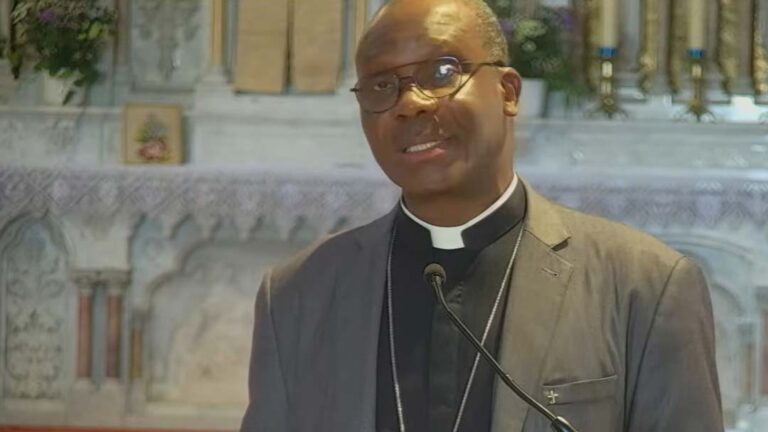

Faced with the prospect of eternity, we might be tempted to pretend that hell does not exist—or that it is empty. What difference does it make to us to believe in its existence? Don Paul Denizot, rector of the Montligeon Shrine, explains.
What does it mean to live through hell on earth?
Hell is being overwhelmed by sin and evil. We can experience it, for example, when we’re caught up in certain addictions and think we’ll never break free. Hell is identifying completely with one’s sin, without hoping for any forgiveness. It is also judging oneself and refusing to love or be loved. I’m thinking, for example, of someone who distrusted everything and had shut themselves off so completely in their suffering, anger, and loneliness that they no longer even spoke.
Here on earth, right up until the very last moment, the Lord can open a way out. When you are in hell, it is final. The image of “gnashing of teeth” used by Jesus in the Gospel clearly illustrates the self-imprisonment that comes from hating God and others.
Was Auschwitz hell?
There are places on earth where hatred, evil, and suffering seemed to sweep everything away and destroy everything. And yet, even in Auschwitz, there were acts of love, courage, and humanity. Such as Saint Maximilian Kolbe’s sacrifice to save the life of a father. In these places so deeply marked by hatred, there was love nonetheless.
In hell, there is no more love. There is nothing left but despair, cynicism, and nonsense.
Hell is often depicted as a terrifying furnace. In reality, it is cold—the bone-chilling cold of loneliness.
Can we imagine the torments of hell based on what we experience on earth?
Church tradition mentions two types of suffering in hell: the punishment of “dam” and the punishment of the soul. The torment of “dam” is the torment of separation from God. The damned are torn apart (as French singer Patrick Fiori sings), for they are made to love God with their whole being, yet they refuse Him with all their will. As a result, they are torn between their deep inclination to love and the refusal in which they persist—just as one might persist in sulking, anger, or hatred. What suffering this perpetual obstinacy entails!
The punishment of the soul consists of the other punishments associated with being deprived of the sight of God. These include enslavement to creatures, to money, to the thirst for power, to sex, and to all the addictions that prevent us from being free. Hell is slavery with no possibility of liberation! Then there is the aversion to reality. Pride has deceived the damned by making them believe they were the center and measure of the world. Reality burns them because it resists their thirst for omnipotence, and this burning is unbearable.
But aren’t our desires good?
Our desires are good at their source, since they come from God, and man’s fundamental desire is to see God, who alone can satisfy his thirst for happiness and love. However, our desires can also blind us by directing us exclusively toward creatures—finite realities that are not evil in themselves but to which we can become enslaved. Ultimately, these desires can cause us to focus on ourselves and our own satisfaction. That is when they consume us, for they remain unfulfilled. The fire of hell is the fire of the desire for God, which burns because it is rejected. In Heaven, however, this fire of God’s love illuminates, gives life, and transfigures.
Is hell other people?
No, hell is being alone. We know full well that living with others isn’t always a walk in the park and that we can sometimes suffer greatly because of it (with family, at school, or at work…), but I think we are deeply meant to live with others. A newborn child needs its parents to be fed and to grow. We also feel this in the celebrations that move us (family gatherings, at a soccer stadium, during a concert, on a pilgrimage…). Conversely, hell is loneliness.
Furthermore, we sense that only love—love given and received—can give meaning to our existence. On the contrary, hell is the inability to love and be loved.
In hell, no one calls us by our names anymore.
Is it God who sends people to hell?
God never ceases to give us His love. At the moment of our death, the state of our heart is determined by the fundamental choice we have made in our lives. If I have chosen hatred or anger and have built my life upon them, I may reject God’s salvation when I will be on the point of dying. I may choose hell, and God will simply uphold my choice. God does not send us to hell, but death crystallizes our choice, making it final. Just as a tree falls the way it leans, there is a strong likelihood that we will die as we have lived. The damned persist forever in their refusal.
Should we wish hell on someone?
No, because it’s terrible. I wouldn’t wish it on anyone. That’s why we’re called to pray for sinners—of whom we are a part! When we pray the Hail Mary, we say: “Pray for us, sinners, now and at the hour of our death.” We ask for the grace to open ourselves to God’s mercy and for perseverance to the end.
Jesus preached extensively about hell and its eternity. This is first and foremost a warning for us. Before we start crunching numbers to figure out who is in hell, let’s ask ourselves instead, “If I were to die tonight, would I be ready?” and let’s pray for sinners. The question of hell urges us on, just as Christ’s love does.
At the Last Judgment, this will in fact be the ultimate criterion: “Whatever you did for one of these little ones who are mine, you did for me.” ” We cannot, therefore, remain indifferent. The Christian life is not a mere tally of our good and bad deeds, but a pilgrimage that commits us ever more deeply to the service of our neighbor.